
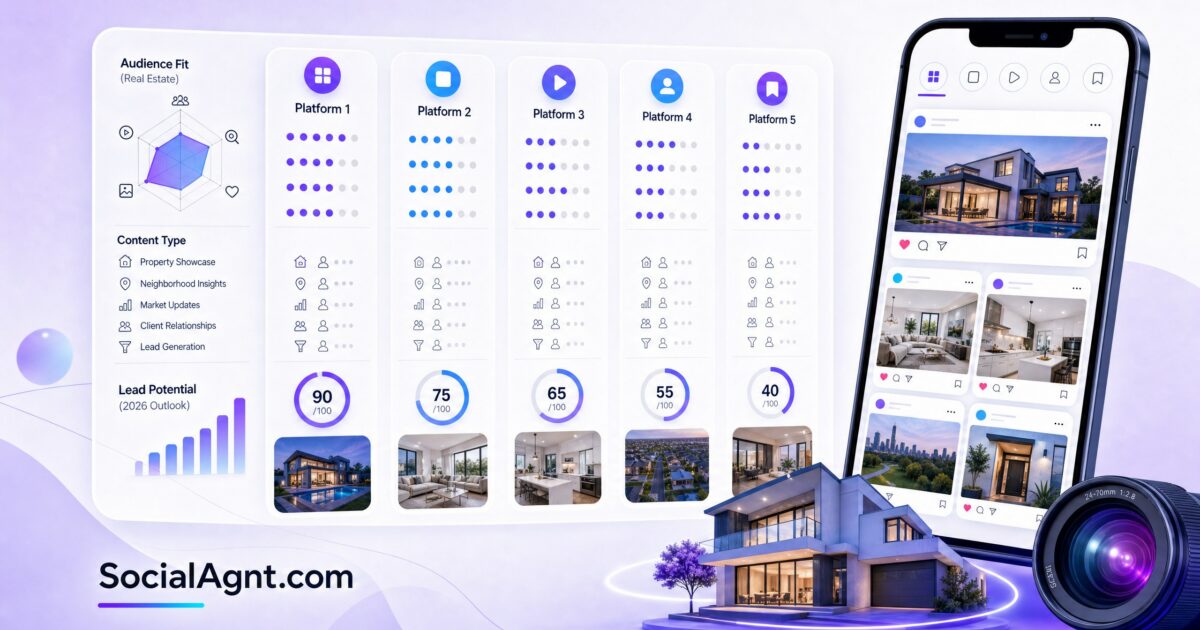
Key Takeaways: Not every social media platform deserves your time. The best social media platforms for real estate agents depend on your market, your target clients, your content strengths, and the amount of time you can realistically commit. Instagram, Facebook, YouTube, TikTok, LinkedIn, and Google Business Profile each offer distinct advantages — but trying to master all six simultaneously is a recipe for burnout and mediocre results. This guide breaks down each platform’s strengths and weaknesses for real estate professionals, helps you identify which platforms align with your business goals, and gives you a clear framework for choosing where to invest your time for maximum return.
The Platform Selection Problem
Every real estate marketing article tells you to “be on social media.” Very few tell you which platforms actually matter for your specific situation — and which ones you can safely ignore. The result is that most agents spread themselves across four or five platforms, post inconsistently on all of them, build meaningful traction on none of them, and conclude that “social media doesn’t work for real estate.”
Social media works extremely well for real estate. But only when you choose the right platforms and commit to them deeply enough to build real momentum. The agents generating consistent leads from social media aren’t on every platform — they’ve chosen one or two primary platforms, mastered them, and added secondary platforms only after establishing a strong foundation.
The framework for choosing your platforms comes down to four questions: Where does your target audience spend their time? What type of content are you willing and able to create consistently? What are your specific business goals (brand awareness, lead generation, recruiting, referral building)? How much time can you realistically dedicate to social media each week?
Instagram for Real Estate Agents
Why Instagram Works for Real Estate
Instagram is the most popular social media platform among real estate agents — and for good reason. Real estate is an inherently visual industry, and Instagram is built for visual storytelling. Property photos, neighborhood tours, before-and-after renovations, and market data graphics all perform well on Instagram. The platform’s combination of feed posts, Stories, Reels, and direct messaging creates multiple touchpoints for connecting with potential clients.
Instagram’s demographic skews toward 25-to-44-year-olds — the prime homebuying age range. The platform’s local discovery features (location tags, hashtags, the Explore page) make it possible for agents to reach people searching for real estate content in specific areas. And Instagram’s DM functionality provides a natural, low-pressure way for prospects to initiate conversations.
Best For
Agents targeting first-time buyers and move-up buyers in the 25-to-44 age range. Agents who enjoy creating visual content — photography, short video, graphic design. Agents focused on local market authority and community connection. Residential agents in markets where lifestyle and aesthetics influence buying decisions.
Content That Performs Well
Listing showcases with strong photography perform consistently, but the highest-engagement content on Instagram for real estate agents tends to be educational Reels (quick tips, market updates, home buyer/seller advice), neighborhood and community content (local restaurant features, area guides, event coverage), behind-the-scenes content (showing days, client meetings, the real work of being an agent), and personal content that helps followers connect with you as a person, not just a professional.
Limitations
Instagram’s organic reach has declined significantly — the platform increasingly favors Reels and paid content over static feed posts. Building a following takes months of consistent posting. And Instagram leads tend to have longer conversion timelines than leads from search-based platforms like YouTube or Google. Links are limited to your bio (no clickable links in captions), which makes direct lead capture more challenging than on some other platforms.
Time Commitment
To use Instagram effectively, plan for four to five feed posts per week plus daily Stories and 15 to 30 minutes of daily engagement (responding to comments and DMs, engaging with other accounts). Total time investment: five to eight hours per week for a serious Instagram presence.
Facebook for Real Estate Agents
Why Facebook Works for Real Estate
Facebook remains the largest social media platform by active users, and its user base skews older than Instagram — making it particularly valuable for reaching move-up buyers, downsizers, and sellers who tend to be homeowners in their 40s, 50s, and 60s. Facebook’s greatest strength for real estate agents is its advertising platform, which offers the most sophisticated targeting options of any social media platform: you can target by age, location, income level, homeownership status, life events (recently married, recently moved), and interests.
Facebook Groups are another powerful feature. A well-managed local real estate group — where the agent provides market insights, answers questions, and positions themselves as the community’s real estate resource — can generate a steady stream of leads from an engaged, local audience.
Best For
Agents targeting sellers, move-up buyers, and the 35-plus demographic. Agents who want to invest in paid advertising with precise targeting. Agents willing to build and manage a local Facebook Group. Agents in suburban and rural markets where Facebook usage remains especially strong.
Content That Performs Well
Facebook rewards content that generates comments and shares. New listing announcements with strong photos, local community content, client milestone celebrations (just closed, just listed), and market updates all perform well. Video content — particularly Facebook Live for open houses and Q&A sessions — receives preferential algorithmic treatment. Facebook Groups content should focus on providing value: answering real estate questions, sharing market data, and fostering community discussion.
Limitations
Organic reach on Facebook business pages has been declining for years — the platform has increasingly shifted to a pay-to-play model. Without advertising spend, your Facebook page posts may reach only 2-5% of your followers. The platform also has an older demographic, which means if your primary target is first-time buyers in their twenties, Facebook may not be your best primary platform.
Time Commitment
For organic-only Facebook: three to four posts per week plus Group management if applicable. For Facebook with advertising: add two to three hours per week for ad creation, monitoring, and optimization. Total: three to seven hours per week depending on your approach.
YouTube for Real Estate Agents
Why YouTube Works for Real Estate
YouTube is the only social media platform where your content has a genuinely long shelf life. A well-optimized YouTube video about “Moving to Denver” or “Best Neighborhoods in Austin” can generate views and leads for three, four, even five years after publication. This is because YouTube functions as a search engine — the second largest in the world after Google — and YouTube videos also appear in Google search results. This dual searchability makes YouTube uniquely powerful for capturing high-intent prospects who are actively researching a move.
YouTube also builds trust at a level no other platform can match. When someone watches ten minutes of your neighborhood tour or market analysis, they feel like they know you. By the time they reach out, the trust-building is largely done. YouTube leads convert at higher rates and require less selling because the relationship has been developing through your video content for weeks or months.
Best For
Agents targeting relocating buyers (the highest-value lead source on YouTube). Agents willing to create longer-form video content (five to fifteen minutes). Agents in markets with significant inbound migration (growing cities, popular retirement destinations, college towns). Agents who are comfortable on camera and can explain complex topics clearly.
Content That Performs Well
Search-optimized content dominates YouTube for real estate. The videos that generate the most leads are city and neighborhood guides (“Living in [City]: Everything You Need to Know”), market updates (“Is Now a Good Time to Buy in [City]?”), area comparison videos (“[Neighborhood A] vs. [Neighborhood B]”), relocation guides (“Moving to [City] — What You Need to Know”), and first-time buyer education (“How Much House Can I Afford?”). Each video should target a specific search query that your potential clients are typing into YouTube or Google.
Limitations
YouTube has the highest barrier to entry of any social media platform for real estate. Creating quality video content requires more time, equipment, and skill than posting photos or writing captions. The payoff period is also longer — most agents see minimal results for the first three to six months as their channel builds authority and their video library grows. YouTube rewards patience and volume, which means agents who need quick results may be frustrated by the timeline.
Time Commitment
Plan for one to two videos per week. Each video requires research and scripting (one to two hours), filming (one to two hours), editing (two to four hours), and optimization and uploading (30 minutes to one hour). Total: six to twelve hours per week for a serious YouTube presence. This is a significant investment, which is why many agents hire editors to reduce the time commitment.
Whether you choose Instagram, Facebook, TikTok, LinkedIn, YouTube, or Google Business Profile — SocialAgnt lets you schedule, publish, and track content across all six platforms from a single dashboard. AI-powered captions built for real estate help you post consistently without spending hours writing. Start your free account today.
TikTok for Real Estate Agents
Why TikTok Works for Real Estate
TikTok’s algorithm is the great equalizer in social media. Unlike Instagram or Facebook, where your content primarily reaches your existing followers, TikTok distributes content based on engagement quality — meaning a brand-new account with zero followers can reach hundreds of thousands of viewers with a single well-performing video. This organic reach potential is unmatched by any other platform and makes TikTok the fastest way to build brand awareness as a real estate agent.
TikTok’s audience has also matured significantly. While the platform started as a Gen Z entertainment app, its user base now includes substantial numbers of millennials and Gen Xers — including active homebuyers and sellers. TikTok is increasingly functioning as a search engine for younger demographics, with users searching for neighborhood information, home buying advice, and real estate market data directly on the platform.
Best For
Agents targeting first-time buyers and younger millennials. Agents with a natural, entertaining personality who are comfortable being informal on camera. Agents willing to post frequently (one to three times daily for best results). Agents in visually interesting markets with distinctive properties or neighborhoods that translate well to short video.
Content That Performs Well
TikTok rewards content that’s entertaining first and informative second. The most successful real estate TikTok content includes dramatic property reveal tours (before-and-after, luxury reveals, unique properties), quick educational tips delivered with personality and opinion, day-in-the-life content showing the real (often unglamorous) work of being an agent, trend-based content adapted to real estate (using trending sounds, formats, and challenges with a real estate twist), and market commentary that sparks engagement and debate in the comments section.
Limitations
TikTok’s biggest limitation for real estate is the conversion gap. The platform excels at awareness (people see you and remember you) but struggles with direct lead generation (people don’t typically search TikTok when they’re ready to buy or sell next month). TikTok leads tend to be earlier in their journey and take longer to convert. The platform also requires high-volume posting to maintain algorithmic momentum — one video per day is the minimum, and top performers post two to three times daily. Additionally, TikTok’s future in the United States has faced regulatory uncertainty, which is worth monitoring as you plan your long-term platform strategy.
Time Commitment
TikTok’s time commitment depends on your posting frequency. At one video per day: expect two to four hours of daily creation time initially, decreasing as you develop a faster workflow. TikTok content is quicker to produce than YouTube content (shorter videos, less editing expected), but the volume requirement means the total time investment can be comparable. Plan for three to six hours per week at minimum.
LinkedIn for Real Estate Agents
Why LinkedIn Works for Real Estate
LinkedIn is the most underutilized platform in real estate — and that’s precisely what makes it valuable. While every agent and their competitor are fighting for attention on Instagram, LinkedIn has virtually no competition for real estate content. The platform’s audience consists of professionals, business owners, executives, and high-income earners — the demographic most likely to buy, sell, or invest in real estate at higher price points.
LinkedIn’s real power for real estate agents is referral networking. Mortgage brokers, financial advisors, attorneys, HR managers, and corporate relocation specialists all live on LinkedIn. Building relationships with these professionals through consistent, valuable content can generate a steady stream of high-quality referrals that become the most reliable — and most profitable — lead source in your business.
Best For
Agents targeting luxury or higher-price-point buyers and sellers. Agents who want to build a professional referral network (mortgage, title, financial advisors, attorneys). Agents focused on corporate relocation business. Commercial real estate professionals (LinkedIn is the primary platform for commercial). Agents who prefer writing and professional content over casual social media.
Content That Performs Well
LinkedIn rewards thoughtful, professional content. Data-driven market analysis performs exceptionally well — when you break down local market trends with specific numbers, LinkedIn’s professional audience engages deeply. Professional storytelling from your real estate practice (lessons learned from transactions, client success stories told with business takeaways), industry thought leadership (opinions on market trends, policy impacts, technology changes), and referral partner collaborations (co-created content with mortgage brokers or financial advisors) all resonate with LinkedIn’s audience.
Limitations
LinkedIn is not a mass-audience platform. You won’t reach first-time buyers in their twenties here, and the platform isn’t built for the casual, personality-driven content that thrives on Instagram or TikTok. LinkedIn also has lower posting frequency expectations (two to four times per week is optimal), which means building momentum takes longer. Lead volume from LinkedIn will be lower than from Instagram or Facebook — but lead quality and conversion rates tend to be significantly higher.
Time Commitment
Two to three posts per week plus 15 to 20 minutes of daily engagement (commenting on others’ posts, responding to comments on yours, and initiating conversations with connections). Total: three to five hours per week.
Google Business Profile for Real Estate Agents
Why Google Business Profile Works for Real Estate
Google Business Profile isn’t a traditional social media platform, but it’s increasingly important as a social and content channel for local businesses — including real estate agents. When someone searches “real estate agent near me” or “best realtor in [city]” on Google, your Google Business Profile listing is often the first thing they see. Your profile’s reviews, photos, posts, and activity level directly influence whether a prospect contacts you or scrolls to the next agent.
Google Business Profile also feeds Google Maps results, which means agents with well-optimized profiles appear in local map searches — a high-intent search channel where people are actively looking for a real estate professional in a specific area.
Best For
Every real estate agent with a physical office or service area should maintain a Google Business Profile. It’s not optional — it’s the foundation of your local online presence. It’s particularly critical for agents who depend on local search traffic, agents in competitive markets where Google reviews are a differentiator, and agents who want to capture prospects at the highest-intent moment (actively searching for a real estate agent).
Content and Optimization
Optimize your profile with a professional headshot, complete business information, service area definitions, and a keyword-rich business description. Post weekly updates (market insights, new listings, tips, community content) to show Google that your profile is active. Most importantly, build your review count and rating — ask every satisfied client to leave a Google review, and respond to every review (positive and negative) with a thoughtful, professional reply. Reviews are the single most influential factor in Google Business Profile performance.
Time Commitment
One to two hours per week for posting updates and managing reviews. This is the lowest time commitment of any platform, with an outsized impact on local search visibility.
How to Choose Your Primary Platform
The One-Platform-First Strategy
The most effective approach is to choose one primary platform, commit to it fully for at least six months, build genuine traction (growing followers, consistent engagement, inbound leads), and only then add a secondary platform while maintaining your primary. Trying to launch on four platforms simultaneously means you’re giving 25% effort to each — and 25% effort produces 0% results on every platform. Social media success requires concentrated effort to break through the noise.
Platform Selection Decision Framework
Ask yourself these questions to identify your best primary platform:
What type of content am I most willing to create consistently? If you enjoy photography and visual storytelling, Instagram is your best bet. If you’re comfortable on camera and can explain things clearly, YouTube or TikTok should be your focus. If you prefer writing and professional analysis, LinkedIn is your match. If you love community interaction and conversation, Facebook Groups could be your sweet spot.
Who is my ideal client? First-time buyers in their twenties and thirties gravitate toward Instagram and TikTok. Move-up buyers and sellers in their forties and fifties are most reachable on Facebook. Luxury buyers and professional referral partners live on LinkedIn. Relocating buyers search YouTube. Your ideal client’s platform should be your primary platform.
What are my business goals? If your primary goal is brand awareness and getting your name out there, TikTok offers the fastest path. If you want high-intent leads from people actively searching, YouTube and Google Business Profile are strongest. If you want to build a professional referral network, LinkedIn is unmatched. If you want to run targeted advertising, Facebook’s ad platform is the most powerful.
How much time can I commit weekly? If you have three to four hours per week, LinkedIn or Google Business Profile are the most efficient options. With five to eight hours, Instagram becomes viable. With eight-plus hours, YouTube or a TikTok-plus-Instagram combination is realistic.
SocialAgnt supports Instagram, Facebook, TikTok, LinkedIn, YouTube, and Google Business Profile — so no matter which platforms you choose, you can manage them all from one place. AI-powered captions, real estate templates, and smart scheduling make it easy to stay consistent. Start free today.
Building Your Multi-Platform Strategy Over Time
Once you’ve established traction on your primary platform (consistent posting for at least three to six months, growing engagement, inbound inquiries), you can strategically add secondary platforms. The key to multi-platform success is content repurposing — adapting your primary platform content for secondary platforms rather than creating entirely new content for each one.
A YouTube video can be clipped into Instagram Reels and TikToks. A LinkedIn article can be adapted into Instagram carousel slides. Instagram photos can be shared to Facebook with adjusted captions. A Google Business Profile post can be adapted from any other platform’s content. This repurposing approach lets you maintain a presence on multiple platforms without multiplying your content creation time.
The recommended expansion path for most residential agents: start with Instagram or YouTube as your primary platform, add Google Business Profile immediately (low effort, high impact), expand to Facebook for advertising and Groups once your content workflow is established, then add LinkedIn for referral networking and TikTok for awareness as capacity allows.
The Bottom Line
The best social media platform for real estate agents is the one you’ll actually use consistently. A perfectly optimized YouTube channel that you abandon after six videos produces zero results. An Instagram account you post to three times a week for two years will generate meaningful business. Choose the platform that aligns with your content strengths, your target audience, and your available time — commit to it deeply — and add platforms only when you have the capacity to maintain quality and consistency across all of them.
Whatever platforms you choose, SocialAgnt makes managing them simpler. Schedule content across all six major platforms from a single dashboard, generate AI-powered captions tailored for real estate, and track your performance — so you can focus on creating great content and building relationships instead of juggling multiple apps and tools.
SocialAgnt supports all six major social media platforms for real estate agents — Instagram, Facebook, TikTok, LinkedIn, YouTube, and Google Business Profile. AI captions, real estate templates, and smart scheduling help you show up consistently wherever your clients are. Start your free account today.
Ready to save 5+ hours per week on social media?
SocialAgnt helps real estate agents schedule posts, create AI content, and grow their brand across 7 platforms. Try it free for 14 days.
