
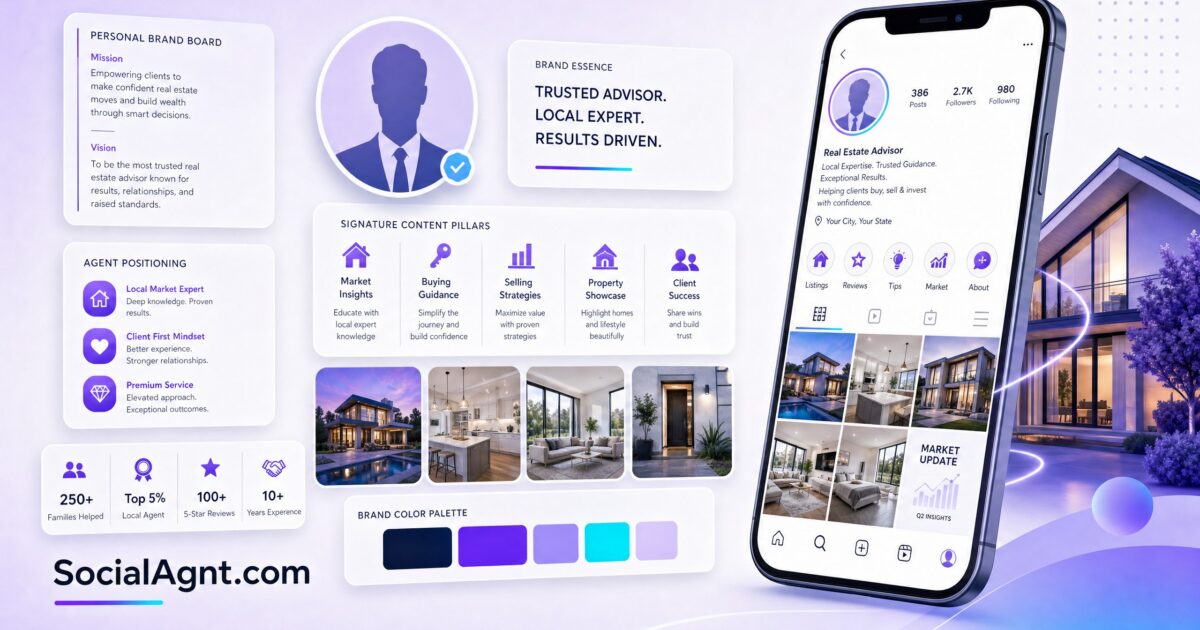
Key Takeaways: Personal branding on social media is how modern real estate agents differentiate themselves in a sea of competitors who all offer “great service” and “local expertise.” Your personal brand is the reason someone chooses you over the agent down the street — it’s the combination of your story, your expertise, your personality, and your visual identity that makes you recognizable, memorable, and trustworthy before a prospect ever shakes your hand. This guide covers how to define your personal brand, translate it into a social media presence that attracts your ideal clients, maintain consistency across platforms, and build the kind of online reputation that turns cold followers into warm leads who already feel like they know you.
Personal Branding vs. Brokerage Branding: Why You Need Both
Many agents make the mistake of letting their brokerage’s brand be their entire identity. They use the brokerage logo on everything, post brokerage-provided content, and lean on the brokerage name for credibility. While brokerage affiliation matters, it’s not what makes a client choose you over the other 50 agents at the same brokerage.
Your brokerage brand is a credibility signal — it says “I’m affiliated with a reputable organization.” Your personal brand is a differentiation signal — it says “Here’s who I am, who I serve, and why I’m the right agent for you specifically.” When you change brokerages (and most agents do at some point), your personal brand travels with you. Your brokerage’s brand doesn’t.
The agents who build the strongest businesses invest in personal branding first and use their brokerage affiliation as a supporting credential — not a crutch. On social media, this means your content, your voice, your visual identity, and your story should be distinctly yours, with your brokerage referenced as part of your professional background, not as the centerpiece of your online presence.
Defining Your Personal Brand Foundation
Before you post a single piece of branded content, you need to answer the foundational questions that define who you are as a professional and what makes you worth following.
Your Unique Value Proposition
What specific value do you bring that another agent in your market doesn’t? This isn’t about generic promises — it’s about the intersection of your skills, your experience, your personality, and the specific audience you serve. A strong value proposition is specific enough that someone can immediately understand what makes you different.
Weak: “I help people buy and sell homes.” (Every agent does this.)
Strong: “I help first-time buyers in Austin navigate the market without feeling overwhelmed — because I remember how intimidating my own first purchase was.”
Weak: “I provide excellent customer service.” (Every agent claims this.)
Strong: “I specialize in luxury waterfront properties on the Gulf Coast and bring fifteen years of marine construction knowledge to every transaction.”
Your value proposition should be specific enough to attract your ideal client and clear enough that a stranger could explain what you do after reading your Instagram bio.
Your Brand Personality
If your brand were a person at a party, how would they act? Are you the energetic, high-energy connector who knows everyone in the room? The calm, analytical advisor who people seek out for thoughtful counsel? The warm, nurturing guide who makes nervous first-timers feel at ease? The bold, no-nonsense negotiator who tells it like it is?
Define your brand personality with three adjectives. These adjectives should guide every piece of content you create. If your brand is “warm, knowledgeable, and straightforward,” then a caption that’s cold, vague, or overly polished doesn’t fit. If your brand is “energetic, fun, and community-focused,” then dry market data without personality misses the mark.
The most important rule of brand personality: it must be authentic. If you’re naturally introverted and analytical, don’t try to build a brand around being loud and flashy. If you’re naturally warm and conversational, don’t force corporate formality. Your brand personality should be your real personality — slightly amplified and consistently expressed.
Your Brand Story
Why real estate? What brought you here? What moment made you realize this was your calling? Your brand story is the narrative that creates emotional connection with your audience. It’s the answer to the question every potential client has but rarely asks: “Why should I trust this person with the biggest financial decision of my life?”
Great brand stories follow a simple arc: where you started (your background before real estate), the turning point (what drew you to the industry), the discovery (what you learned about yourself and the profession), and the mission (what drives you to show up for your clients every day). Share this story on your About page, in your social media bio, in your listing presentations, and through content that references your journey. People remember stories far longer than they remember credentials.
Translating Your Brand to Social Media
Visual Consistency
Your visual brand — colors, fonts, photography style, graphic templates — should be immediately recognizable across every platform. When someone scrolls past your Instagram post, sees your LinkedIn article, or notices your Facebook ad, they should recognize it as yours before reading a single word.
Professional photography: Invest in a professional headshot session and lifestyle photos that capture your personality and market. Use these consistently across all platforms — the same headshot for every profile photo, the same style of imagery in your content. Refresh your photos annually to stay current.
Color and design consistency: Choose two to three brand colors and use them in every graphic, template, and visual element. Your Instagram grid, your Facebook cover, your LinkedIn banner, your listing graphics, and your market update templates should all share the same visual language. This repetition is what builds recognition over time.
Template system: Create (or have created) branded templates for your recurring content types: listing announcements, just-sold posts, market updates, educational carousels, testimonials, and open house promotions. Templates ensure visual consistency without requiring you to make design decisions for every post.
Voice Consistency
Your writing voice — the way your captions, comments, and messages sound — should be consistent across every platform. It should sound like you. Not like a corporate press release, not like a generic agent, and not like a different person on each platform.
Develop a simple voice guide with examples: “I write in a conversational, first-person tone. I use contractions (I’m, you’ll, it’s). I explain real estate concepts in plain language, never jargon. I share opinions directly — ‘Here’s what I think about this market’ — rather than hedging. I use humor when it’s natural, not forced.”
Read your captions out loud before posting. If they don’t sound like something you’d actually say in a conversation with a client, rewrite them until they do.
Bio Optimization
Your social media bio is often the first thing a potential client reads about you. It needs to communicate your value proposition, your location, and what to do next — in very few characters.
Formula: What you do + Who you serve + Where + CTA
Example: “Austin real estate agent helping first-time buyers find their perfect home. 10 years local market expertise. Free home search below.”
Use the same core bio across all platforms, adjusted for character limits (TikTok is shorter than LinkedIn). Include your market area as a keyword — bios are searchable, and including “[City] real estate” or “[City] realtor” helps people find you.
SocialAgnt helps real estate agents maintain brand consistency across Instagram, Facebook, TikTok, LinkedIn, YouTube, and Google Business Profile with branded templates, AI captions in your voice, and unified multi-platform scheduling. Build recognition. Build trust. Build your business. Start free today.
Content That Builds Your Personal Brand
Not all content builds your brand equally. Some content establishes expertise. Some builds personal connection. Some creates trust through proof. A complete personal branding strategy includes all three.
Authority Content
Authority content proves you know what you’re talking about. It positions you as the expert — someone who doesn’t just sell houses but deeply understands the market, the process, and the nuances that matter to clients.
Types of authority content: market analysis with your professional interpretation (not just reposted data), educational content that explains complex topics simply, answers to common client questions that demonstrate depth of knowledge, predictions or opinions about market trends (backed by data), and comparisons or guides that showcase specialized knowledge (neighborhood vs. neighborhood, condo vs. house, new construction vs. resale).
The key to authority content is adding your perspective. Anyone can share a market statistic. What makes it brand-building is your analysis: “Inventory in [neighborhood] is up 15% this quarter. Here’s what that means if you’ve been waiting to buy, and here’s what it means if you’re thinking about selling.”
Connection Content
Connection content shows who you are as a person. It’s the content that makes followers feel like they know you — your personality, your values, your humor, your life beyond real estate. This is what transforms you from “a real estate agent I follow” to “the real estate agent I feel connected to.”
Types of connection content: behind-the-scenes of your work day, personal stories that relate to your professional life, your real reactions to properties (excitement, surprise, humor), family moments or lifestyle content that show the human behind the brand, your opinions and perspectives on industry topics, and vulnerable moments — sharing challenges, lessons learned, or mistakes that made you better.
Connection content requires vulnerability. It means sharing content that’s genuinely personal, not a performance of personality. The agent who shares a real story about their first terrible listing appointment and what they learned connects more deeply than the agent who only posts polished highlight reels.
Proof Content
Proof content validates everything your authority and connection content promises. It shows that real people have trusted you, worked with you, and been satisfied with the results.
Types of proof content: client testimonials (video and written), closing day photos with happy clients, transaction stories that detail the challenge and how you solved it, just-sold announcements with context (“This home received twelve offers in five days”), year-in-review posts with transaction volume and client count, and awards, certifications, or recognition from your brokerage or industry organizations.
The most effective proof content tells a story. Not just “Just sold!” but “My clients were first-time buyers who lost three offers before we found this home. We wrote a strong offer with an escalation clause and got it accepted in a market where they felt like giving up. This is why persistence matters.”
Building a Recognizable Content Style
The goal of personal branding on social media isn’t just to be present — it’s to be recognizable. When someone scrolls past your content, they should know it’s yours before they see your name. This recognition is built through consistent repetition of visual and verbal patterns.
Signature Content Formats
Develop one to two content formats that become associated with your brand. This could be a weekly market update video with a consistent format and intro, a “Neighborhood of the Week” carousel series with a consistent design template, a “Real Estate Myth” debunking series, a “What does $X get you in [city]” comparison format, or a signature sign-off phrase in your captions or videos. When you own a format — when your audience thinks of you when they see that type of content — you’ve built brand recognition that transcends individual posts.
Content Consistency Calendar
Tie your personal brand to a consistent content schedule. When your audience knows that every Monday they’ll get a market update, every Wednesday they’ll see a neighborhood feature, and every Friday they’ll get a tip — that predictability builds a relationship. They start to expect your content, look forward to it, and notice when it’s missing. That’s brand loyalty built one post at a time.
Managing Your Online Reputation
Your personal brand isn’t just what you post — it’s the total perception people have of you online. That includes your reviews, your search results, your responses to comments, and how people talk about you when you’re not in the room.
Reviews and Testimonials
Actively solicit reviews on Google, Zillow, Realtor.com, and your social media platforms. After every successful closing, ask your client for a review — and make it easy by sending them direct links to your review profiles. Respond to every review, positive and negative, professionally. A thoughtful response to a negative review can actually strengthen your brand by demonstrating accountability and grace under pressure.
Search Result Management
Google your own name regularly. What comes up? Your social profiles, your website, your reviews, and any press or mentions should dominate the first page of results. If they don’t, invest in SEO for your website, keep your social profiles active and complete, and create content on platforms that rank well in Google (YouTube, LinkedIn, your blog).
Engaging with Your Community Online
Personal branding isn’t just about broadcasting — it’s about participating. Comment on local businesses’ posts. Share community news. Engage with other professionals’ content. When you’re an active, positive presence in your local online community, you become associated with that community in people’s minds. That association is priceless for a real estate agent whose entire value proposition is local expertise.
Common Personal Branding Mistakes
Being everything to everyone. The fear of narrowing your brand is the biggest barrier to building a strong one. “If I brand myself as a first-time buyer specialist, won’t I lose luxury clients?” Maybe. But you’ll gain a clear identity, a loyal audience, and a referral network built around your specialty. Generalist brands are forgettable. Specialist brands are memorable.
Inconsistency across platforms. A professional headshot on Instagram, a selfie on Facebook, a brokerage logo on LinkedIn, and different bios on each platform. This creates confusion and undermines trust. Audit your profiles quarterly and ensure visual and verbal consistency across every platform.
Only posting about real estate. If every single post is a listing, a market update, or a real estate tip, your brand is one-dimensional. The personal brand that generates the most business is the one that includes the full picture — expertise and personality, professional and personal, data and stories.
Copying another agent’s brand. It’s natural to be inspired by agents who’ve built strong brands, but directly copying their aesthetic, their content formats, or their voice produces a weaker version of their brand, not a stronger version of yours. Study what works for others, then filter it through your own personality, story, and market.
Neglecting the offline brand experience. Your social media brand creates expectations. If your brand promises warm, attentive service but your actual client experience is disorganized and unresponsive, the brand collapses. Personal branding starts online but must be validated by the real experience of working with you. Ensure your offline delivery matches your online promise.
Your Personal Branding Action Plan
Week 1 — Define your foundation: Write your unique value proposition (one to two sentences). Choose three brand personality adjectives. Draft your brand story (200–300 words). Ask five past clients: “If you were describing me to a friend, what would you say?” Their answers reveal your brand as others perceive it.
Week 2 — Build your visual identity: Book a professional photo session. Choose your brand colors and fonts. Create or commission templates for your recurring content types. Update your profile photos and banners across all platforms to be consistent.
Week 3 — Optimize your profiles: Rewrite your bio on every platform using the formula: what you do + who you serve + where + CTA. Ensure your visual branding is consistent across all platforms. Update your Featured sections, highlight categories, and pinned posts to showcase your best brand content.
Week 4 — Launch your branded content: Begin posting content that intentionally reflects your brand foundation — a mix of authority, connection, and proof content, delivered in your brand voice and visual style. Commit to your content schedule and let the compound effect of consistent, branded content build your recognition over time.
Personal branding on social media is a long game. It’s built through hundreds of small, consistent choices about what you share, how you present yourself, and how you interact with your community — day after day, week after week, until your name becomes synonymous with the real estate experience your clients deserve. The agents who start this work today are building businesses that will outperform their unbranded competitors for years to come.
SocialAgnt is the social media platform built for real estate agents who take their personal brand seriously. Branded templates, AI-powered content in your voice, multi-platform scheduling, and MLS integration — everything you need to build a recognizable, professional brand across every channel. Try SocialAgnt free.
Ready to save 5+ hours per week on social media?
SocialAgnt helps real estate agents schedule posts, create AI content, and grow their brand across 7 platforms. Try it free for 14 days.
