
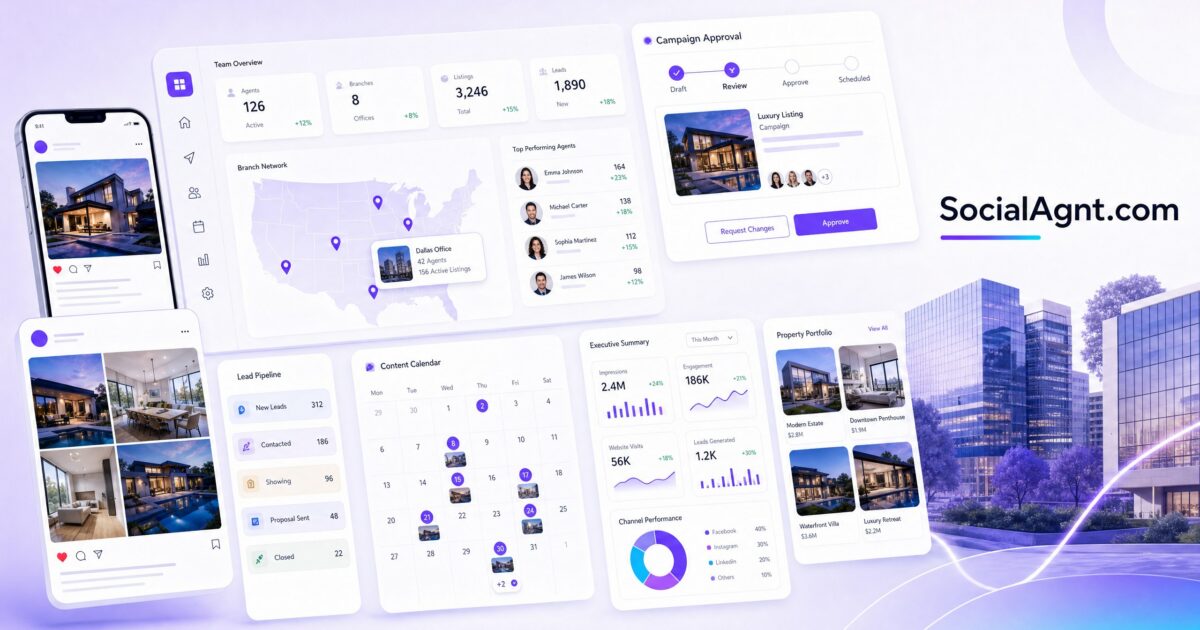
Key Takeaways: Social media marketing for a real estate company — a brokerage, team, or property management firm — is fundamentally different from marketing as an individual agent. When you’re marketing a company, you’re building a brand that transcends any single person. You’re attracting agents to recruit, clients to serve, and industry partners to work with — simultaneously. The content strategy, brand voice, platform priorities, and success metrics are all different from what works for individual agents. This guide covers exactly how real estate companies should approach social media: building a company brand that generates business and attracts talent, choosing the right platforms for B2B and B2C goals, creating content that serves multiple audiences, managing the relationship between company accounts and individual agent accounts, and measuring the metrics that matter at the company level.
Why Company-Level Social Media Is Different From Agent-Level
An individual real estate agent markets themselves — their personality, their expertise, their local knowledge, their transaction track record. The content is personal, the brand is the person, and the goal is generating leads that convert into clients for that specific agent.
A real estate company has multiple audiences and multiple goals. The company needs to attract potential buyers and sellers who will choose the brokerage, recruit talented agents who want to join the firm, build relationships with industry partners (lenders, title companies, inspectors, attorneys), establish market authority that elevates every agent under the brand, and create a professional reputation that clients trust before they ever meet an individual agent. Serving all these audiences from a single social media presence requires a fundamentally different strategy than what any individual agent would use.
Building a Company Brand That Works on Social Media
Brand Identity Foundation
Before posting anything, establish the brand elements that make your company recognizable across platforms. This means defining your visual identity (consistent logo placement, color palette, typography, and photo/video style), your brand voice (professional but approachable, data-driven but not dry, authoritative but not arrogant), your core brand pillars (the three to five themes your company consistently communicates — these might include market expertise, agent development, community involvement, technology leadership, and client outcomes), and your value proposition (what makes your company different from competing brokerages in your market).
These elements need to be documented in a simple brand guide that anyone creating content for the company can reference. Without this foundation, your social media presence will feel inconsistent and unfocused — especially when multiple people contribute content.
Company Voice vs. Agent Voices
One of the biggest challenges in real estate company social media is balancing the company’s institutional voice with the individual personalities of your agents. The company account should sound professional and authoritative — it represents the entire organization, not one person’s perspective. It should feel like a trusted institution speaking, not an individual agent promoting themselves.
Individual agent accounts, by contrast, should feel personal and authentic. The company’s role is to provide brand guidelines, content resources, and amplification — not to dictate every word agents post on their personal accounts. The most effective approach is clear brand standards (what agents must include — logo usage, brokerage mention, compliance language) combined with creative freedom (letting agents express their personality within those standards).
Platform Strategy for Real Estate Companies
LinkedIn: The Recruiting and B2B Powerhouse
LinkedIn is the single most important platform for real estate company social media — not because it generates the most consumer leads, but because it serves the company’s B2B and recruiting goals better than any other platform. Your company LinkedIn page should showcase your brokerage’s culture, agent success stories, market analysis, industry thought leadership, and business milestones. This content attracts agents considering a brokerage move, mortgage and title partners who want to build referral relationships, corporate relocation contacts, commercial clients, and industry professionals who elevate your company’s reputation.
Post two to four times per week on your company LinkedIn page. Content should include agent spotlight features (celebrating individual agents’ achievements builds both recruiting appeal and agent retention), market reports and analysis (establishing the company as a data-driven market authority), company news and milestones (transaction volume records, new office openings, awards), industry thought leadership from company leadership (the managing broker or CEO sharing perspectives on market trends), and recruiting-focused content (why agents choose your brokerage, what your value proposition is for agents).
Instagram: The Visual Brand and Culture Showcase
Instagram serves a dual purpose for real estate companies: attracting consumer attention through listing content and lifestyle imagery, and showcasing company culture for recruiting and retention. Your Instagram should balance listing highlights and property content (showing the quality and range of your inventory), agent and team spotlights (putting faces and personalities to the brand), community involvement (charitable events, local sponsorships, neighborhood engagement), behind-the-scenes company culture (training sessions, team events, office life), and market updates in visual formats (carousels and Reels with market data).
Post four to five times per week on the feed plus daily Stories. Instagram Stories are especially valuable for real-time company content — sharing agent wins, open house previews, and day-in-the-life content that humanizes the brand.
Facebook: Community Building and Advertising
Facebook remains valuable for real estate companies primarily through two channels: Facebook Groups and paid advertising. Create or manage a company-branded Facebook Group for your local market — a community space where the company provides market insights, answers real estate questions, and positions itself as the go-to local resource. Facebook’s advertising platform is also where most real estate companies get the best return on paid social media spend, thanks to detailed targeting options for both consumer and recruiting campaigns.
YouTube: The Long-Form Authority Platform
A company YouTube channel is a long-term asset that builds searchable authority. Create content that serves multiple audiences: market update videos (monthly or quarterly analysis of your local market), neighborhood and community guides (targeting relocation searches), educational series (home buying process, selling preparation, investment basics), agent training content (publicly sharing expertise builds credibility and attracts recruits), and company story content (why agents join your firm, your company’s history and mission). YouTube videos rank in Google search, making them a powerful tool for capturing high-intent prospects who are actively searching for real estate information in your market.
Google Business Profile: The Local Search Foundation
For any real estate company with a physical office, Google Business Profile is non-negotiable. It’s how consumers and agents find your brokerage when searching locally. Keep your profile updated with current office hours, photos, and contact information. Post weekly updates. Most importantly, actively manage your reviews — every satisfied client should be asked to leave a Google review, and every review (positive or negative) should receive a thoughtful response.
SocialAgnt lets real estate companies schedule and publish across Instagram, Facebook, TikTok, LinkedIn, YouTube, and Google Business Profile — with AI-powered captions built for real estate, branded templates, and multi-account management for company and agent accounts. Start your free account today.
Content Strategy for Multiple Audiences
The Three-Audience Content Framework
Real estate company social media must serve three distinct audiences simultaneously. The key is creating content that speaks to each audience without alienating the others.
Audience 1: Consumers (Buyers and Sellers). These are the people who will ultimately transact with your agents. They want to see that your company is active, knowledgeable, and successful. Content for this audience includes listings and property showcases, market updates and home value insights, buying and selling educational content, client success stories and testimonials, and community and neighborhood content. This content should make up approximately 50% of your company’s social media output.
Audience 2: Agents (Potential Recruits and Current Team Members). Recruiting is the lifeblood of brokerage growth, and social media is increasingly where agents discover and evaluate potential brokerages. Content for this audience includes agent spotlights and success stories, training and development highlights, company culture showcases, technology and support resources available to agents, and brokerage value proposition content. This content should make up approximately 30% of your output — and the good news is that agent-focused content also impresses consumers (seeing a brokerage that invests in its agents signals quality).
Audience 3: Industry Partners and B2B Contacts. Mortgage brokers, title companies, attorneys, inspectors, and other professionals who can send referrals or collaborate on marketing. Content for this audience includes market analysis and data, industry commentary and thought leadership, partnership spotlights (co-branded content with lending or title partners), transaction volume and market share achievements, and professional event coverage. This content should make up approximately 20% of your output.
The Content Calendar for Companies
A real estate company content calendar should map out recurring content themes across the week. A sample weekly structure might look like this: Monday features a market update or data post, Tuesday features an agent spotlight or team culture post, Wednesday features educational content for consumers, Thursday features a listing showcase or property content, and Friday features community involvement or a behind-the-scenes look. Layer in monthly themes: new listing inventory highlights, quarterly market reports, seasonal buying and selling content, recruiting campaigns during key industry transition periods (January, June, and September tend to see the most agent movement), and company milestones and anniversary celebrations.
Managing the Company-Agent Social Media Relationship
Providing Content Resources to Agents
The most effective real estate companies don’t just manage their own social media — they equip their agents to succeed on social media individually. This means providing branded templates agents can customize for their own accounts, a shared content library with professional photography, graphics, and video assets, social media training and best practices guidance, compliance guidelines that protect agents and the company, and access to social media management tools that make consistent posting easier.
When agents succeed on social media, the company benefits — every agent’s social media presence extends the company’s reach and brand visibility. Investing in agent social media success is one of the highest-ROI activities a brokerage can undertake.
Amplification Strategy
Create a cross-promotion system where company and agent accounts amplify each other. When the company account posts a new listing, agents share it to their Stories with personal commentary. When an agent posts a client testimonial, the company account reshares it. When the company publishes a market report, agents share key takeaways with their audiences. This reciprocal amplification multiplies the reach of every piece of content without requiring any additional content creation — it’s leverage that solo agents simply cannot replicate.
Social Media Policies for Agents
Every real estate company needs a written social media policy that agents acknowledge. This policy should cover required disclosures (brokerage affiliation, licensing information, fair housing compliance), prohibited content (discriminatory language, misleading claims, unauthorized use of company branding), approval processes for company-related content (when agents post about the company specifically), intellectual property guidelines (who owns content created during employment), and guidelines for handling negative comments or online controversies. The policy should be clear enough to protect the company but flexible enough that agents don’t feel micromanaged on their personal accounts.
Paid Social Media Advertising for Real Estate Companies
Consumer-Facing Campaigns
Company-level advertising budgets allow for more sophisticated campaigns than most individual agents can run. Effective company ad campaigns include listing promotion campaigns (showcasing the company’s full inventory to buyers in target demographics), seller acquisition campaigns (targeting homeowners in specific neighborhoods with home value content and market updates), brand awareness campaigns (building name recognition for the brokerage in the local market), and open house promotion (driving traffic to open houses across all company listings).
Recruiting Campaigns
Social media advertising is one of the most effective tools for agent recruiting. Run LinkedIn and Facebook ads targeting licensed real estate agents in your market with content about your brokerage’s commission structure, training programs, technology stack, and company culture. Agent testimonial videos perform exceptionally well in recruiting ads — seeing and hearing from successful agents who chose your brokerage is more persuasive than any brochure or careers page.
Budget Allocation
A starting point for company social media ad budgets: allocate 60% to consumer-facing campaigns (listing promotion, seller acquisition, brand awareness), 25% to recruiting campaigns (agent acquisition), and 15% to retargeting (re-engaging website visitors and social media engagers across all campaign types). Adjust these ratios based on your company’s current priorities — if agent recruiting is your primary growth lever, shift more budget there. If you have plenty of agents but need more inventory, increase seller acquisition spend.
SocialAgnt’s multi-account management, AI captions, and real estate templates make it easy for brokerages and teams to maintain a professional, consistent presence across all six major platforms. Schedule company content and equip your agents — all from one platform. Start free today.
Measuring Company-Level Social Media Success
Metrics That Matter for Companies
Company-level social media metrics go beyond likes and followers. Track brand reach and awareness (total impressions and unique accounts reached across all company platforms), lead generation (leads generated from company social media accounts — tracked through UTM parameters, DM inquiries, and “how did you find us” attribution), recruiting pipeline (agent inquiries, applications, and hires attributed to social media), agent engagement (how many of your agents actively use social media, share company content, and follow brand guidelines), website traffic from social media (sessions, page views, and conversions driven by social platforms), and review generation and reputation (Google review count, average rating, and response rate).
ROI Calculation for Companies
Company social media ROI combines consumer and recruiting returns. On the consumer side, calculate the revenue from transactions attributed to company social media leads. On the recruiting side, calculate the lifetime value of agents recruited through social media — each productive agent generates commission revenue (and company splits) for years. The recruiting ROI alone often justifies a company’s entire social media investment. An agent recruited through a social media campaign who produces $200,000 in annual GCI at a 20% company split generates $40,000 per year for the brokerage — far exceeding the cost of most social media programs.
Your Company Social Media Launch Plan
Month 1 — Foundation: Audit and optimize all company social media profiles across LinkedIn, Instagram, Facebook, YouTube, and Google Business Profile. Create your brand guide (visual identity, voice, content pillars). Set up your social media management platform with all company accounts. Build your initial template library for recurring content types. Draft your agent social media policy.
Month 2 — Launch and Establish Cadence: Begin posting on a consistent schedule across all platforms. Launch your agent content resource program (templates, shared library, training). Create your first quarterly market report as a multi-platform content piece. Start your company YouTube channel with three foundational videos. Begin building your Google Business Profile review generation system.
Month 3 — Amplify and Optimize: Launch paid advertising campaigns (start with Facebook and Instagram for consumers, LinkedIn for recruiting). Implement your cross-promotion system between company and agent accounts. Review first 60 days of analytics and adjust content strategy based on performance. Set quarterly goals for reach, leads, and recruiting pipeline from social media.
Real estate company social media marketing is a long-term investment that compounds over time. Every piece of content, every agent spotlight, every market report, and every community post builds the brand equity that attracts clients, recruits agents, and establishes your company as the market leader in your area. The companies that invest now will have an insurmountable advantage over those that wait — because brand awareness, once built, is nearly impossible for competitors to replicate quickly. Start building today with SocialAgnt managing your company’s multi-platform presence from a single dashboard.
Whether you’re a growing team or an established brokerage, SocialAgnt gives you multi-account management, AI-powered content, branded templates, and scheduling across Instagram, Facebook, TikTok, LinkedIn, YouTube, and Google Business Profile. Equip your company and your agents from one platform. Start your free account today.
Ready to save 5+ hours per week on social media?
SocialAgnt helps real estate agents schedule posts, create AI content, and grow their brand across 7 platforms. Try it free for 14 days.
