
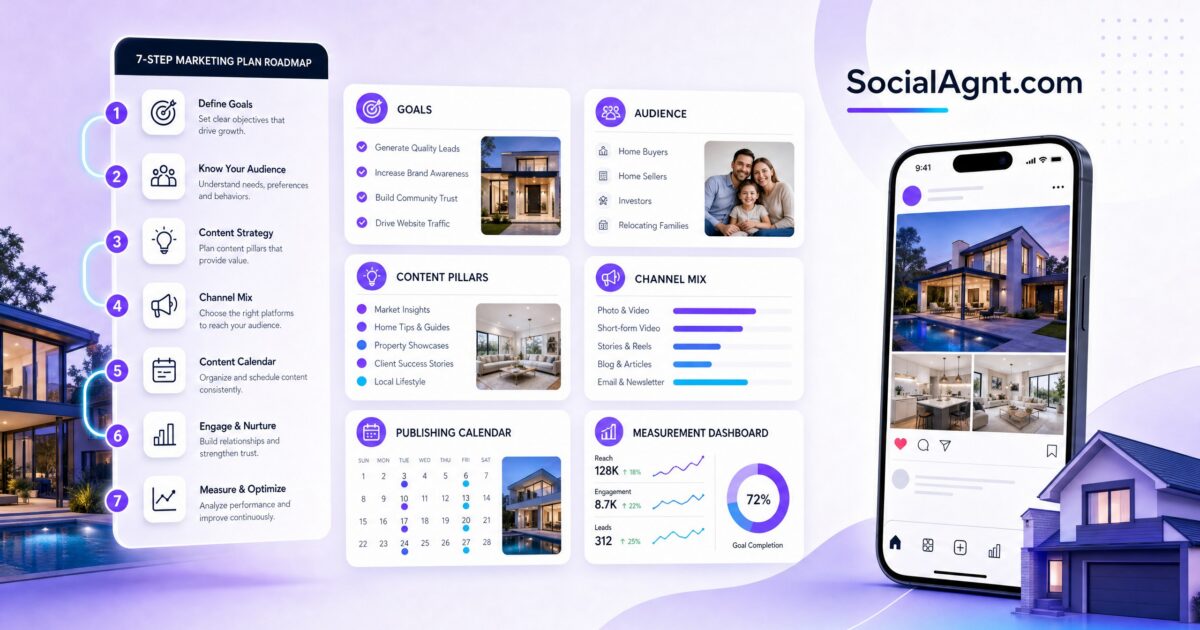
Key Takeaways: A real estate social media marketing plan isn’t just a list of things to post — it’s a strategic document that defines your goals, identifies your audience, selects your platforms, builds your content framework, establishes your posting cadence, and creates a measurement system to track what’s working. Most agents skip the planning step entirely and jump straight to posting, which is why most agents quit social media within six months. This seven-step framework gives you the complete plan, from goal setting through execution and optimization, so every post you publish serves a strategic purpose.
Why You Need a Plan Before You Post
Social media without a plan is content creation for its own sake — posting because you feel like you should, with no clear connection to business outcomes. You end up posting sporadically, chasing trends that don’t align with your brand, spending hours on content that reaches the wrong audience, and eventually burning out because the effort doesn’t seem to produce results.
A social media marketing plan changes the equation. When you know exactly what you’re trying to achieve, who you’re trying to reach, and how you’ll measure success, every piece of content has a purpose. You stop asking “What should I post today?” and start executing a strategy that builds momentum over time. The agents who generate consistent business from social media aren’t more creative or more talented — they’re more strategic. And that strategy starts with a plan.
This isn’t a theoretical exercise. By the end of this article, you’ll have a complete, actionable social media marketing plan you can start executing immediately. Each step builds on the previous one, so work through them in order.
Step 1: Define Your Social Media Goals
Every effective plan starts with clear goals — not vague aspirations like “grow my social media” but specific, measurable objectives that connect directly to your real estate business.
Business Goals vs. Social Media Goals
Start with your business goals and work backward to social media. If your business goal is to close 24 transactions this year, and you want social media to source 25% of those transactions (6 deals), then your social media needs to generate enough leads to produce six clients. If your typical lead-to-client conversion rate is 5%, you need 120 leads from social media this year — or 10 per month.
Now you have a measurable social media goal: generate 10 leads per month from social media. That’s specific, measurable, and directly tied to revenue. From there, you can work backward further: if 2% of your audience converts to leads, you need your content to reach 500 new people per month. If your average reach per post is 200 people, you need to post frequently enough to consistently reach new audiences.
Setting SMART Social Media Goals
Frame your goals using the SMART framework: Specific (what exactly will you achieve?), Measurable (how will you track it?), Achievable (is this realistic given your resources?), Relevant (does this connect to your business objectives?), and Time-bound (by when?).
Examples of strong social media goals for real estate agents: “Generate 10 leads per month from Instagram by Q3” or “Grow my local follower base to 2,000 by December” or “Book 4 listing consultations per month from social media by month 6” or “Increase website traffic from social media by 50% in 90 days.”
Write your goals down. Put them somewhere you’ll see them weekly. Goals that live only in your head get forgotten when business gets busy.
Step 2: Identify and Research Your Target Audience
The second step is understanding exactly who you’re creating content for. “Everyone who might buy or sell a home” is not a target audience — it’s everyone. The more specific you can be about who your ideal client is, the more effectively your content will resonate with them.
Creating Your Client Personas
Build two to three detailed personas representing your ideal clients. For each persona, define: demographics (age range, income level, family status, occupation), psychographics (values, priorities, concerns, lifestyle), their real estate situation (first-time buyer, move-up buyer, downsizer, investor, seller), their pain points (what worries them about buying or selling?), where they spend time online (which platforms, what content they consume), and what content would attract them (what questions do they have, what problems do they need solved?).
For example, a first-time buyer persona might be: “Sarah, 29, marketing coordinator making $75K. Renting an apartment, wants to buy her first home in the next 12 months. Worried about affording a down payment, confused about the buying process, overwhelmed by options. Spends time on Instagram and TikTok. Wants straightforward, non-judgmental guidance from someone who makes the process feel less intimidating.”
When you create content with Sarah in mind, your messaging becomes focused, relatable, and effective. A post about “3 down payment assistance programs you probably don’t know about” speaks directly to her pain point. A listing tour captioned “Here’s what $300K gets you as a first-time buyer in [city]” answers her core question. She feels seen — and she follows you because your content feels like it was made for her.
Research Where Your Audience Is Active
Don’t assume your audience is on every platform. First-time buyers aged 25–35 are likely most active on Instagram and TikTok. Luxury buyers and corporate executives are on LinkedIn. Move-up buyers with families are on Facebook and Instagram. Investors are on LinkedIn, YouTube, and Twitter. Research which platforms your specific personas use most, and prioritize those platforms in your plan.
Step 3: Choose Your Platforms Strategically
You don’t need to be on every platform. In fact, trying to maintain an active presence on six platforms simultaneously is the fastest way to burn out and produce mediocre content everywhere. Choose two to three platforms to focus on, with one being your primary platform where you invest the most time and energy.
Platform Selection Framework
Choose platforms based on three criteria: where your target audience spends time (this is the most important factor), which platform’s format matches your content strengths (if you’re great on camera, prioritize video-first platforms; if you write well, prioritize LinkedIn and Facebook), and which platforms offer the best organic reach opportunity in your market (if every agent in your city is on Instagram but nobody’s on TikTok, TikTok offers less competition).
For most residential real estate agents, the recommended starting stack is: Instagram as your primary platform (broadest real estate audience, best combination of content formats, strongest DM functionality for lead conversion), plus one secondary platform based on your niche (TikTok for first-time buyers, LinkedIn for luxury and corporate, Facebook for community engagement and groups, YouTube for long-form authority building).
Add Google Business Profile as a baseline for all agents — it’s a local SEO tool, not a time-intensive social platform, and it takes minimal effort for meaningful visibility benefits.
Step 4: Build Your Content Strategy
Your content strategy defines what you’ll post, why you’ll post it, and how it connects to your goals. This is the core of your plan.
Content Pillars
Define three to five content categories (pillars) that you’ll rotate through consistently. For most real estate agents, effective pillars include: educational content (25%) covering buying, selling, and market knowledge that establishes expertise; listings and market data (25%) featuring property showcases, market updates, and just-sold stories that demonstrate activity; community and local content (20%) with neighborhood spotlights, local business features, and community events that prove local expertise; personal and behind-the-scenes content (20%) showing your personality, daily life, and the human side of real estate; and social proof (10%) including testimonials, client stories, and results that build trust.
Content Themes and Series
Create recurring content series that your audience can anticipate: “Market Monday” (weekly market data), “Tip Tuesday” (educational bite), “Neighborhood Wednesday” (local spotlight), or “Listing of the Week.” Recurring series reduce creative decision-making, build audience expectations, and create a content rhythm that algorithms reward.
Content Formats by Platform
Map your content pillars to the formats that perform best on each platform. On Instagram, prioritize Reels for reach, carousels for saves and shares, and Stories for daily engagement. On TikTok, focus on short-form video (15–60 seconds). On LinkedIn, prioritize text posts and document carousels. On Facebook, mix video, images, and link posts, and engage in groups. On YouTube, create long-form educational and tour content. Your plan should specify which formats you’ll use for which pillars on which platforms.
SocialAgnt helps real estate agents turn their marketing plan into action with AI-powered content creation, multi-platform scheduling, real estate templates, and a visual content calendar. Plan your week, create your content, and schedule across Instagram, Facebook, TikTok, LinkedIn, YouTube, and Google Business Profile — all from one dashboard. Start free today.
Step 5: Create Your Posting Schedule
Your posting schedule turns your content strategy into a weekly routine. The goal is a consistent, sustainable cadence that you can maintain for twelve months — not an ambitious schedule you abandon in three weeks.
Building Your Weekly Calendar
Map your content pillars to specific days. A sample weekly schedule might be: Monday (Market update — Listings/Market pillar), Tuesday (Educational tip — Education pillar), Wednesday (Neighborhood or community feature — Community pillar), Thursday (Behind-the-scenes or personal content — Personal pillar), Friday (Featured listing or client testimonial — Listings or Social Proof pillar). Plus daily Instagram Stories showing real-time moments from your day.
This gives you five feed posts per week across your primary and secondary platforms, with content variety built into the schedule. Adjust the frequency based on your capacity — three posts per week on a consistent schedule is better than five posts per week that you can’t sustain.
Optimal Posting Times
Use your platform analytics to identify when your specific audience is most active. General guidelines as starting points: Instagram performs well at 7–9 AM and 6–8 PM on weekdays; Facebook engagement peaks mid-morning and early afternoon; LinkedIn is strongest Tuesday through Thursday, 8–10 AM; TikTok engagement is highest evenings and weekends. But your audience is unique — check your analytics after two weeks of consistent posting and adjust your schedule based on your own data.
Batch Creation Workflow
Don’t create content daily — batch it. Dedicate one two-hour session per week to creating all your content for the coming week. Write all captions, select all images, film all video clips in one sitting. Then schedule everything through your social media management platform. This batch approach is two to three times more efficient than creating one post at a time and eliminates the daily “What should I post?” decision.
Step 6: Set Up Your Lead Capture and Follow-Up System
Content without conversion is a hobby, not a strategy. Your marketing plan must include specific mechanisms for turning social media engagement into leads and leads into clients.
Lead Capture Mechanisms
Build at least two lead capture tools into your social media ecosystem: a link-in-bio landing page with multiple lead capture options (home search, buyer guide download, home valuation request, consultation booking), and at least one lead magnet (a free resource offered in exchange for contact information) that you promote regularly in your content.
Every week, at least one piece of content should include a direct CTA driving people to one of these lead capture points. “Free buyer’s guide in my bio,” “Comment REPORT and I’ll DM you our market analysis,” or “Link in bio to search homes in [city]” — these CTAs should be woven naturally into your content calendar.
Follow-Up Process
Define exactly what happens when a lead comes in. Who responds? How quickly? What’s the first message? Your plan should specify: DM response time (within 2 hours), lead magnet delivery (automated via email), first follow-up email (within 24 hours), CRM entry and tagging (immediately, tagged by source and interest level), and nurture sequence (automated email series over the following 30 days).
The best content strategy in the world fails without a follow-up system. Build this before you start posting, not after.
Step 7: Define Your Metrics and Review Cadence
The final step is defining how you’ll measure success and how often you’ll review your performance to make adjustments.
Key Performance Indicators (KPIs)
Select three to five KPIs that directly connect to your goals. If your goal is lead generation, track: leads generated per month (by platform), cost per lead (if using paid advertising), lead-to-consultation conversion rate, and consultations booked from social media. If your goal is brand building, track: follower growth rate, reach and impressions (month over month), engagement rate, and profile visits.
Don’t track everything — track the metrics that tell you whether you’re moving toward your goals. Everything else is noise.
Review Cadence
Build three levels of review into your plan: a weekly check (10 minutes) to review top-performing content and engagement trends, a monthly review (30 minutes) to analyze KPIs, compare to goals, and adjust your content mix or schedule, and a quarterly strategy review (60 minutes) to evaluate ROI, reassess goals, and make major strategic adjustments.
The monthly review is the most important. It’s where you identify patterns (“educational content outperforms listing content by 3x in engagement”), make data-driven adjustments (“shift from 25% educational to 35%”), and course-correct before small issues become wasted months.
Putting Your Plan Into Action
You now have a complete seven-step framework. Here’s how to turn it into a living document and start executing:
Day 1: Write your goals (Step 1) and define your target personas (Step 2). These are the strategic foundation everything else builds on.
Day 2: Choose your platforms (Step 3) and define your content pillars and series (Step 4). Set up or optimize your profiles on your chosen platforms.
Day 3: Build your weekly posting schedule (Step 5) and set up your lead capture system — landing page, lead magnets, and CRM integration (Step 6).
Day 4: Define your KPIs and set up your tracking dashboard (Step 7). Record your current baseline numbers so you can measure progress.
Day 5: Create your first week of content using the batch creation method. Schedule it through your social media management platform. You’re live.
Your plan is a living document — update it monthly based on what you learn from your data. The agents who succeed on social media aren’t the ones who create the perfect plan on day one. They’re the ones who create a good plan, start executing, and refine it continuously based on real results. SocialAgnt makes execution easier with AI-powered content creation, real estate templates, and multi-platform scheduling — but the plan comes first. Start today.
SocialAgnt turns your marketing plan into a content machine. AI-powered captions, real estate templates, a visual content calendar, and scheduling across Instagram, Facebook, TikTok, LinkedIn, YouTube, and Google Business Profile. Your plan provides the strategy. SocialAgnt provides the execution. Start your free account today.
Ready to save 5+ hours per week on social media?
SocialAgnt helps real estate agents schedule posts, create AI content, and grow their brand across 7 platforms. Try it free for 14 days.
