
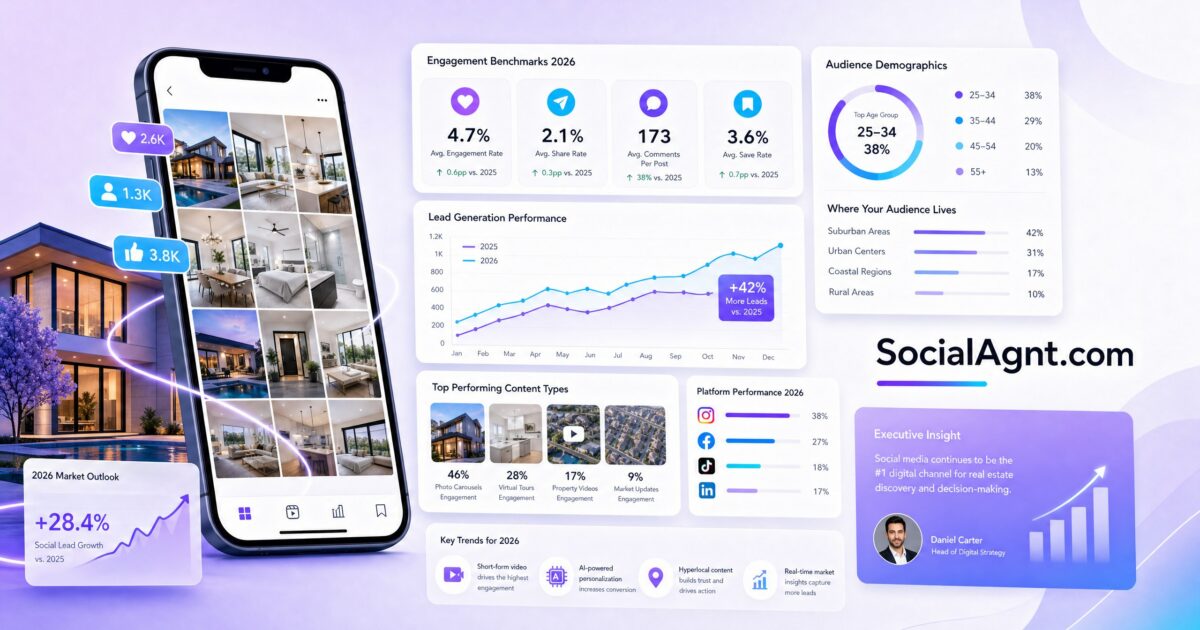
Key Takeaways: The data behind real estate social media marketing is clear: agents who use social media strategically close more deals, build stronger pipelines, and spend less per lead than those who rely on traditional marketing alone. But vague claims like “social media works” don’t help you convince your team, justify your time investment, or benchmark your performance. This article compiles the most important, up-to-date statistics about social media and real estate — from adoption rates and platform usage to engagement benchmarks, lead generation costs, and ROI data — sourced from the National Association of Realtors, industry research firms, and platform data. Use these numbers to guide your strategy, measure your progress, and make the case for investing in social media as a core business tool.
Real Estate Agent Social Media Adoption Statistics
Social media isn’t a niche tactic in real estate — it’s the norm. But there’s a significant gap between agents who are present on social media and agents who use it effectively, and that gap represents a massive opportunity for the agents who get it right.
According to the National Association of Realtors’ Technology Survey, 97% of real estate agents use social media for business to some degree. However, only a fraction use it strategically — with defined goals, consistent posting schedules, lead capture systems, and performance tracking. Most agents treat social media as an afterthought rather than a primary marketing channel, which means the agents who do invest seriously face far less competition than the raw adoption numbers suggest.
Facebook remains the most widely used platform among real estate agents, with approximately 89% of agents maintaining a business presence. Instagram follows at roughly 59%, LinkedIn at 53%, and YouTube at around 26%. TikTok adoption among agents has grown rapidly but still represents under 15% of agents — despite being the platform with the highest organic reach potential for new creators. These adoption rates highlight where the competition is (Facebook and Instagram) and where the opportunity is (TikTok, YouTube, and LinkedIn).
Consumer Behavior and Social Media in Real Estate
Understanding how buyers and sellers use social media in their real estate journey is essential for creating content that meets them where they are.
NAR’s data shows that 96% of all homebuyers use online tools during their home search, and social media is a significant part of that online experience. Among millennial buyers — the largest buyer demographic — 80% found their home on a mobile device, and social media platforms are among the top discovery channels for properties and agents.
Perhaps more telling: 44% of recent homebuyers searched for properties online as their first step in the home buying process, before contacting an agent. This means your social media content isn’t just branding — it’s often the very first touchpoint a future client has with you. The impression you make through your content shapes whether they reach out to you or to a competitor.
Video content has become particularly influential. Real estate listings with video receive 403% more inquiries than listings without video, according to industry reports. And 73% of homeowners say they’re more likely to list with an agent who uses video in their marketing. Buyers increasingly expect virtual tours, neighborhood video content, and video-based market updates as a standard part of the agent experience.
Platform-Specific Real Estate Statistics
Instagram for Real Estate
Instagram is the platform where real estate content most naturally thrives due to its visual format. Real estate is one of the top-performing industries on Instagram by engagement rate. The average engagement rate for real estate content on Instagram hovers around 1.5–2.5%, which is above the average for most industries. Reels consistently outperform static image posts in reach, with some real estate Reels generating 3–10x the reach of feed posts. Instagram Stories are viewed by approximately 500 million users daily, and the interactive features (polls, questions, quizzes) drive meaningful engagement for agents who use them strategically.
Facebook for Real Estate
Facebook’s organic reach for business pages has declined to an estimated 2–5% of page followers per post. However, Facebook remains the most effective paid advertising platform for real estate lead generation. The average cost per lead for real estate Facebook ads ranges from $4–$15, depending on the market, offer, and targeting — significantly lower than most paid lead sources. Facebook Groups remain a high-engagement format, with group posts receiving significantly more organic reach than page posts.
TikTok for Real Estate
TikTok offers the highest organic reach potential of any social platform for new creators. The average TikTok video from an account with fewer than 1,000 followers can reach 200–500 viewers — compared to single digits on Instagram for new accounts. Real estate content on TikTok has seen explosive growth, with hashtags like #realestate accumulating billions of views. The platform’s user base has matured significantly, with 25–34 year olds now representing the largest age group — directly overlapping with first-time homebuyer demographics.
LinkedIn for Real Estate
LinkedIn posts have an average organic reach of 5–10% of your connections — significantly higher than Facebook’s page reach. The platform’s audience has two times the buying power of the average internet audience. LinkedIn generates the highest visitor-to-lead conversion rate of any social platform at 2.74%, compared to Twitter at 0.69% and Facebook at 0.77%. For agents targeting high-income professionals, corporate relocations, and referral partnerships, LinkedIn’s engagement quality per post is unmatched.
YouTube for Real Estate
YouTube is the second-largest search engine in the world, and real estate is one of the most-searched content categories. Searches for “homes for sale in [city],” “moving to [city],” and “[neighborhood] tour” generate millions of annual queries. The key differentiator for YouTube: content has a long shelf life. A neighborhood tour published a year ago can still generate views, leads, and clients today — unlike social media posts that disappear from feeds within hours. Agents who invest in YouTube build a compounding content library that generates passive lead flow.
Lead Generation and ROI Statistics
The statistics that matter most to agents are the ones that connect social media activity to business outcomes: leads, clients, and revenue.
Social media generates leads at a significantly lower cost than most traditional sources. Industry data suggests: Facebook lead ads produce leads at $4–$15 per lead for real estate (compared to $20–$60+ for Zillow Premier Agent in competitive markets). Organic social media (no ad spend) generates leads at the cost of time invested — and agents who track this consistently report that social media leads convert at higher rates than purchased leads because the relationship was built before the inquiry.
Agents who use social media effectively report that social-sourced leads have a longer timeline but higher conversion rate than paid lead sources. A lead from a Zillow inquiry might be shopping four agents simultaneously. A lead from an Instagram DM conversation has likely been following your content for weeks or months and has already chosen you — they’re just making it official.
The revenue impact is substantial. According to NAR, the average real estate transaction generates approximately $8,000–$15,000 in gross commission (depending on the market and price point). If social media generates even three to four additional transactions per year, that represents $24,000–$60,000 in commission revenue — a significant return on an investment of time and a modest tool budget.
The data is clear: social media generates leads, builds trust, and drives revenue for real estate agents who use it strategically. SocialAgnt gives you the tools to execute — AI-powered content, real estate templates, multi-platform scheduling, and analytics across Instagram, Facebook, TikTok, LinkedIn, YouTube, and Google Business Profile. Start free today.
Content Performance Statistics
Understanding what types of content perform best helps you allocate your creative energy where it generates the most return.
Video content receives 1,200% more shares than text and image content combined on social media. For real estate specifically, listing videos, neighborhood tours, and educational content consistently outperform static images in reach and engagement across all platforms. Short-form video (under 60 seconds) has the highest completion rates, which is the primary signal for algorithmic distribution on Instagram Reels, TikTok, and YouTube Shorts.
Carousel posts on Instagram generate the highest average engagement rate of any feed post format — approximately 1.4x higher than single images and 1.2x higher than video feed posts (though Reels still dominate in reach). For real estate agents, carousels are ideal for educational content, market updates, and neighborhood guides that users save for later reference.
Educational content tends to outperform promotional content in engagement and reach. Posts that teach something — market insights, buying tips, selling preparation — generate more saves, shares, and comments than “Just listed!” announcements. The most effective content strategy balances educational content (which builds audience) with transactional content (which converts that audience).
Social Media Advertising Statistics for Real Estate
Paid social media advertising amplifies organic efforts and provides predictable, scalable lead generation. The advertising statistics for real estate are compelling.
Facebook remains the dominant advertising platform for real estate agents. The average click-through rate (CTR) for real estate Facebook ads is approximately 0.9–1.5%, with well-optimized campaigns achieving 2%+. The average cost per click (CPC) for real estate ads on Facebook ranges from $0.50–$2.50, depending on the market and targeting. Lead ad formats (with in-platform forms) typically produce 2–5x more leads at lower cost than traffic campaigns that drive people to external landing pages.
Retargeting campaigns consistently produce the highest ROI of any advertising strategy. Retargeting ads (shown to people who’ve already visited your website or engaged with your content) convert at 2–5x the rate of cold audience campaigns, at a lower cost per result. Installing a Meta Pixel and building retargeting audiences should be a priority for any agent running paid campaigns.
How to Use These Statistics
Statistics are only valuable if you act on them. Here’s how to apply this data to your real estate social media strategy:
Benchmark your performance. Compare your engagement rates, reach, and follower growth to the industry averages cited above. If your Instagram engagement rate is below 1%, your content may need improvement. If it’s above 3%, you’re outperforming most agents.
Justify your time investment. Use the ROI statistics to calculate the potential return on your social media efforts. If social media could generate even two additional transactions per year, what’s that worth in commissions? Compare that to the time and money you’re investing. For most agents, the math strongly favors increased social media investment.
Identify platform opportunities. The adoption statistics reveal where competition is highest (Facebook, Instagram) and where opportunity exists (TikTok, LinkedIn, YouTube). If you’re competing with hundreds of agents on Instagram in your market, consider investing in a platform where you might be the only agent creating quality content.
Double down on video. Every data point confirms that video content outperforms other formats in reach, engagement, and lead generation. If you’re not creating video content yet, the statistics make a compelling case to start — even imperfect smartphone video outperforms polished graphics in most metrics.
Invest in paid advertising. The cost-per-lead statistics for Facebook ads show that paid social advertising is one of the most efficient lead generation channels available to real estate agents. Even a modest $300/month budget can generate 20–30 leads — several of which may convert to clients generating thousands in commission. The math works.
These statistics aren’t just interesting — they’re a strategic roadmap. The agents who align their efforts with what the data says works will consistently outperform the agents who rely on intuition alone. Use SocialAgnt to execute on these insights — scheduling data-driven content across every platform from a single dashboard built specifically for real estate agents.
SocialAgnt combines AI-powered content creation with analytics across all six major platforms — so you can track the metrics that matter and adjust your strategy based on real data. Built exclusively for real estate agents. Start your free account today.
Ready to save 5+ hours per week on social media?
SocialAgnt helps real estate agents schedule posts, create AI content, and grow their brand across 7 platforms. Try it free for 14 days.
