
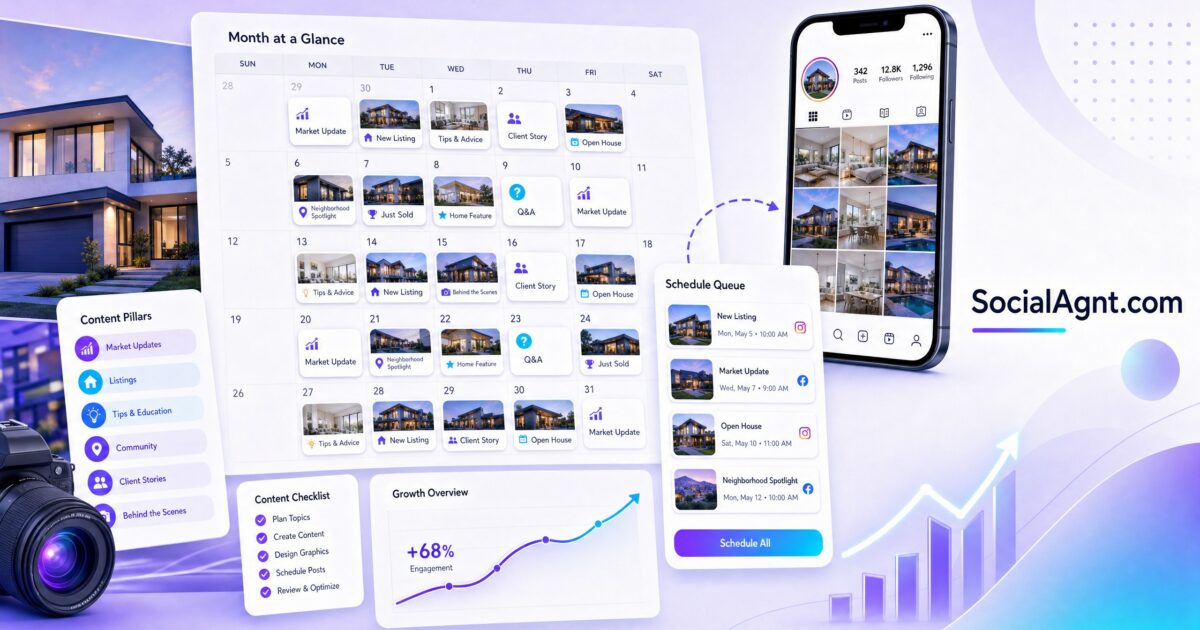
Key Takeaways: A real estate content calendar is the difference between posting randomly when inspiration strikes and executing a strategic content plan that builds your brand, generates leads, and grows your business consistently over time. Without a calendar, most agents post in bursts — three posts in one day, then nothing for a week — which confuses algorithms, frustrates followers, and wastes content potential. This guide walks you through building a real estate content calendar from scratch: defining your content pillars, establishing your posting frequency, planning content themes by week and month, incorporating seasonal and market-driven content, and using tools that make the entire process manageable alongside a full-time real estate career.
Why a Content Calendar Changes Everything for Real Estate Agents
The number one reason real estate agents fail at social media isn’t a lack of ideas, talent, or even time — it’s a lack of planning. Without a content calendar, every single day begins with the same draining question: “What should I post today?” That question leads to decision fatigue, rushed content, and eventually, silence. The agents who post consistently for months and years — the ones who build real audiences and generate real business — all have one thing in common: they plan their content in advance.
A content calendar solves multiple problems simultaneously. It eliminates daily decision-making by mapping out what you’ll post before you need to post it. It ensures content variety — without a plan, most agents default to posting the same type of content repeatedly (usually listings), which bores their audience and limits their reach. It creates accountability — when Tuesday’s post is planned and ready, you publish it. It enables batch creation, which is dramatically more efficient than creating content one post at a time. And it ensures you never miss important dates, seasonal opportunities, or timely market moments.
The business impact is measurable. Agents who use content calendars post two to three times more consistently than those who don’t, according to social media industry research. And consistency is the single greatest predictor of social media growth — because algorithms reward accounts that show up reliably, and audiences trust brands that are always present.
Defining Your Content Pillars
Before you map out a single post, you need to define the categories of content you’ll create. These are your content pillars — the three to five recurring themes that every piece of your content falls into. Content pillars ensure variety, prevent creative burnout, and give your audience a well-rounded experience of your brand.
The Five Content Pillars for Real Estate
Education (25% of content): Content that teaches your audience something valuable about real estate — the buying process, the selling process, market terminology, financing options, home maintenance tips, what to expect at closing, how inspections work. Educational content establishes your expertise and attracts people who are actively researching their next move.
Community and local (20% of content): Content that showcases your knowledge of and connection to your local market — neighborhood spotlights, local business features, community event coverage, restaurant recommendations, school district information, parks and recreation highlights. This content proves you don’t just work in your market; you live it.
Listings and market data (25% of content): Property showcases, new listing announcements, just-sold celebrations, market statistics, market updates with your analysis, price comparisons, and inventory reports. This is the bread and butter of real estate social media, but it should never dominate your feed at the expense of other pillars.
Personal and behind-the-scenes (20% of content): Content that shows who you are beyond the business — your daily routine, funny moments from showings, the human side of real estate transactions, your family, your hobbies, your values. People hire people they like and relate to. Personal content builds the emotional connection that leads to “I want to work with that agent.”
Social proof (10% of content): Client testimonials, reviews, success stories, closing day photos, client anniversary check-ins, and awards or recognition. Social proof validates everything your other content promises — it shows that real people have trusted you and been happy with the results.
These percentages are guidelines, not rigid rules. Adjust based on what resonates with your specific audience. But maintaining a mix across all five pillars ensures your content is varied, balanced, and strategically complete.
Setting Your Posting Frequency
How often should you post? The honest answer is: as often as you can sustain consistently for at least twelve months. A frequency you can maintain is infinitely more valuable than an ambitious frequency you abandon after three weeks.
Platform-Specific Frequency Guidelines
Instagram Feed: Three to five posts per week is the sweet spot for real estate agents. This keeps you visible in the algorithm without requiring you to produce an overwhelming volume of content. Prioritize quality and variety over sheer volume.
Instagram Stories: Daily. Stories are ephemeral (they disappear after 24 hours) and should be used for quick, casual, real-time content — showing a property you’re previewing, sharing a quick market thought, polling your audience, or showing behind-the-scenes moments. Stories take minimal effort and keep you at the top of your followers’ feeds.
Facebook: Three to five posts per week, similar to Instagram. If you’re cross-posting from Instagram (with caption adjustments), this doesn’t require additional creation time.
TikTok: Three to five videos per week. TikTok rewards consistent posting more than any other platform. If you can manage daily posting, do it — but three times per week is enough to build momentum.
LinkedIn: Two to three posts per week. LinkedIn’s algorithm gives content a longer lifespan than other platforms, so each post has more time to generate engagement. Focus on higher-quality, professional content rather than high volume.
YouTube: One video per week (or biweekly if weekly isn’t sustainable). YouTube rewards consistency but doesn’t require the volume of other platforms. One high-quality video per week builds a library that generates search traffic for years.
Google Business Profile: One to two posts per week. GBP posts contribute to your local SEO and keep your business profile active, which signals relevance to Google’s local search algorithm.
The Minimum Viable Frequency
If you’re just starting or if time is extremely limited, here’s the absolute minimum to maintain a meaningful social media presence: three Instagram/Facebook posts per week, daily Instagram Stories (even just reposting relevant content), one TikTok or Reel per week, one LinkedIn post per week, and one GBP post per week. This totals roughly eight to ten pieces of content per week, many of which can be cross-posted or repurposed from each other.
Building Your Monthly Content Calendar
Now let’s build the actual calendar. The most effective approach is to plan one month at a time — far enough ahead to be strategic, close enough to stay responsive to market conditions and timely content opportunities.
Step 1: Map Your Monthly Theme
Each month should have a loose theme that ties your content together and gives you creative direction. Themes can be based on seasonal events, market trends, or audience needs:
January: New year, new home — fresh start messaging, market predictions, goal setting for homebuyers. February: Love your home — home improvement, Valentine’s Day lifestyle content, reasons to love your neighborhood. March: Spring market launch — preparing to sell, spring cleaning, early market trends. April: First-time buyers — the buying process, financing 101, first-time buyer programs. May: Move-up buyers — upgrading your home, equity building, neighborhood comparisons. June: Summer selling season — curb appeal, outdoor living, market activity peaks. July: Community spotlight — local events, neighborhood features, summer activities. August: Back to school — school district guides, family neighborhoods, settling before fall. September: Fall market strategies — market transitions, autumn staging, year-end planning. October: Investment focus — real estate as investment, rental property content, market analysis. November: Gratitude — client appreciation, year in review, community giving. December: Year-end wrap — annual market recap, holiday content, looking ahead to next year.
Step 2: Assign Content Pillars to Days
Create a recurring weekly framework that assigns a content pillar to each posting day. This eliminates the “what should I post” question forever:
Monday — Market Monday: Market data, market updates, pricing trends, inventory reports. (Pillar: Listings and market data)
Tuesday — Tip Tuesday: Educational content, buyer tips, seller tips, home maintenance advice, process explainers. (Pillar: Education)
Wednesday — Community Wednesday: Neighborhood spotlight, local business feature, community event, restaurant recommendation. (Pillar: Community)
Thursday — Behind-the-scenes Thursday: Day in the life, personal content, showing stories, agent life moments. (Pillar: Personal)
Friday — Feature Friday: Featured listing, just sold story, open house promotion, or client testimonial. (Pillar: Listings or Social proof)
This is a starting framework — adjust the specific days and assignments to match your schedule and what your audience responds to. The point is having a structure that you follow consistently.
Step 3: Fill In Specific Content for the Month
With your monthly theme and weekly framework in place, spend one session (60–90 minutes) at the beginning of each month mapping out specific topics for each slot. For example, if your March theme is “Spring Market Launch,” your first week might look like:
Monday: Market update showing spring inventory trends compared to last year. Tuesday: “5 things to do before listing your home this spring.” Wednesday: Spotlight on a neighborhood that’s hot for spring buyers. Thursday: Behind-the-scenes of preparing a listing for spring photos. Friday: Featured new listing with spring curb appeal.
You don’t need to write the actual captions during this planning session — just identify the specific topic and angle for each post. The creation happens during your batch content creation sessions.
SocialAgnt’s built-in content calendar lets you plan your month visually, create posts with AI-powered captions, and schedule everything across Instagram, Facebook, TikTok, LinkedIn, YouTube, and Google Business Profile. Real estate templates and MLS integration make content creation faster than ever. Start free today.
Incorporating Timely and Reactive Content
A content calendar provides structure, but it shouldn’t make your social media rigid. Leave room for timely, reactive content that responds to what’s happening in real time — a new interest rate announcement, a viral real estate moment, a community event you attend, or a spontaneous showing that makes a great Story.
The 80/20 Rule
Plan 80% of your content in advance through your calendar. Leave 20% flexible for real-time content. This balance ensures consistency (your planned content goes out regardless of how busy your week gets) while maintaining authenticity (you’re still sharing spontaneous, in-the-moment content that feels genuine).
Timely Content Triggers
Keep a mental or written list of events that should trigger unplanned content: Federal Reserve interest rate decisions (share your analysis immediately), major local news that affects real estate (new employer moving to town, school redistricting, infrastructure developments), your own transaction milestones (just closed, got an offer accepted, a bidding war story), seasonal weather events that relate to homeownership (first snow, hurricane season preparation, spring storm preparation), and platform trends that have a natural real estate angle.
Content Batching: The Efficiency Multiplier
Content batching is the process of creating multiple pieces of content in one dedicated session rather than creating one piece at a time throughout the week. Batching is the single most important efficiency technique for real estate agents managing their own social media.
Why Batching Works
Context-switching is expensive. Every time you stop what you’re doing, open Instagram, think of a caption, find an image, write the caption, add hashtags, and post — you’ve lost 20–30 minutes of productive time and broken your focus on whatever you were doing before. Multiply that by five posts per week, and you’re spending two to three hours per week on social media in fragmented, inefficient bursts.
Batching consolidates that time. In a single two-hour session, you can create an entire week’s worth of content — or even two weeks if you’re efficient. You get into a creative flow, your captions are better because you’re focused on writing, and your visual content is more cohesive because you’re selecting images with the full week’s aesthetic in mind.
The Batching Session
Hour 1 — Content creation: With your calendar in front of you, create each post for the week. Write all captions. Select all images or create all graphics. Film all video clips. Don’t edit, schedule, or post — just create. Stay in creation mode.
Hour 2 — Editing and scheduling: Edit any videos or graphics. Load everything into your scheduling platform. Customize captions for each platform. Add hashtags. Set publish times. Review the week’s content as a whole — does it flow well? Is there good variety? Does the visual feed look cohesive?
Two hours, once per week. Your entire social media output for the week is done. For the rest of the week, your only social media task is the daily 15–20 minutes of engagement (responding to comments, DMs, and engaging with other accounts).
Seasonal and Annual Content Planning
Real Estate-Specific Calendar Events
Map these annual events into your content calendar so you never miss a timely content opportunity:
Q1 (January–March): New Year home goals, tax season implications for real estate, spring market preparation, first-time buyer season kickoff, “spring cleaning your finances” content.
Q2 (April–June): Peak listing season, school year ending (family relocation window opens), summer curb appeal, home maintenance tips for warm weather, outdoor living and lifestyle content.
Q3 (July–September): Summer market peak, back-to-school neighborhood guides, fall market transition, Labor Day weekend open house events, “settle in before school starts” messaging for families.
Q4 (October–December): Year-end market analysis, “is it a good time to buy/sell before year end” content, holiday home decorating, client appreciation content, tax-deadline purchase motivations, year-in-review content.
National and Local Events
Layer in national events (Fourth of July backyard content, Thanksgiving gratitude posts, New Year’s resolutions) and local events (your city’s festivals, farmers markets, community celebrations) to keep your content timely and locally relevant. These posts perform well because they tap into what your audience is already thinking about and experiencing.
Content Calendar Tools
You can build a content calendar in a simple spreadsheet, a project management tool, or a dedicated social media platform. The best tool is the one you’ll actually use consistently.
Spreadsheet (Google Sheets or Excel): Free and flexible. Create columns for date, platform, content pillar, topic, caption, image/video, hashtags, and status. Color-code by content pillar for visual planning. This works well for planning but requires a separate tool for scheduling and publishing.
Project management tools (Trello, Notion, Asana): More visual than a spreadsheet. Trello’s board view lets you drag cards from “Planned” to “Created” to “Scheduled” to “Published.” Notion offers database templates specifically for content calendars. These are good for planning and tracking but still require a separate scheduling tool.
Social media scheduling platforms: The most efficient option because planning and scheduling happen in the same tool. SocialAgnt’s visual content calendar lets you see your planned posts across all platforms in one view, drag and drop to reschedule, create content with AI assistance, and publish directly — eliminating the gap between planning and execution.
Common Content Calendar Mistakes
Planning too far in advance with too much detail. A quarterly content calendar with every caption pre-written sounds efficient, but it leaves no room for timely content, market changes, or creative inspiration. Plan themes and topics one month ahead. Write captions and create content one to two weeks ahead. This balance provides structure without rigidity.
Making the calendar too complicated. If your content calendar has fifteen columns, requires thirty minutes to update, and feels like another job in itself, you’ll stop using it. Keep it simple: date, platform, pillar, topic, status. That’s all you need. Add complexity only if it genuinely helps your workflow.
Not building in flexibility. A content calendar should guide your posting, not imprison it. If something exciting happens today — you just sold a home above asking, you saw a property with an incredible view, the Fed just cut rates — post about it. Bump tomorrow’s planned content to the next day. Your calendar should be a living document, not a rigid contract.
Ignoring performance data when planning. If your audience consistently engages with educational content and ignores behind-the-scenes content, adjust your calendar mix accordingly. Review your analytics monthly and let the data inform your content planning. Don’t keep posting what doesn’t work just because it’s in the calendar.
Planning content without considering the platform. A single post doesn’t work the same way everywhere. When you plan a topic, think about how it translates to each platform: Instagram might get a carousel, LinkedIn might get a text post, TikTok might get a quick video. Your calendar should note the format for each platform, not just the topic.
Your Content Calendar Action Plan
Day 1 — Define your pillars and frequency: Choose your five content pillars and assign percentages. Decide your posting frequency for each platform based on what you can realistically sustain. Write these down — they’re the foundation everything else builds on.
Day 2 — Build your weekly framework: Assign content pillars to specific days of the week. Create a repeating weekly structure that you’ll follow every week. This eliminates daily content decisions.
Day 3 — Plan your first month: Set your monthly theme. Fill in specific topics for each day based on your weekly framework. Leave 20% of slots flexible for timely content. Keep topic descriptions to one sentence — you’ll flesh them out during creation.
Week 2 — Batch create your first week of content: Dedicate a two-hour session to creating all content for the following week. Write captions, select images, film video clips. Schedule everything through your social media management platform.
Ongoing — Weekly batch and monthly review: Every week, spend two hours creating and scheduling the following week’s content. Every month, spend one hour reviewing what performed best and planning the next month’s calendar based on those insights. This rhythm — plan, create, schedule, review, repeat — is sustainable, efficient, and produces results that compound over time.
A content calendar doesn’t limit your creativity — it channels it. Instead of wasting creative energy on the question “What should I post?” you invest it in the answer: content that’s strategic, varied, consistent, and designed to grow your real estate business one post at a time.
SocialAgnt’s visual content calendar makes planning, creating, and scheduling your posts effortless. AI-powered captions, real estate templates, MLS integration, and multi-platform scheduling across Instagram, Facebook, TikTok, LinkedIn, YouTube, and Google Business Profile. Plan your month in minutes. Start free today.
Ready to save 5+ hours per week on social media?
SocialAgnt helps real estate agents schedule posts, create AI content, and grow their brand across 7 platforms. Try it free for 14 days.
