
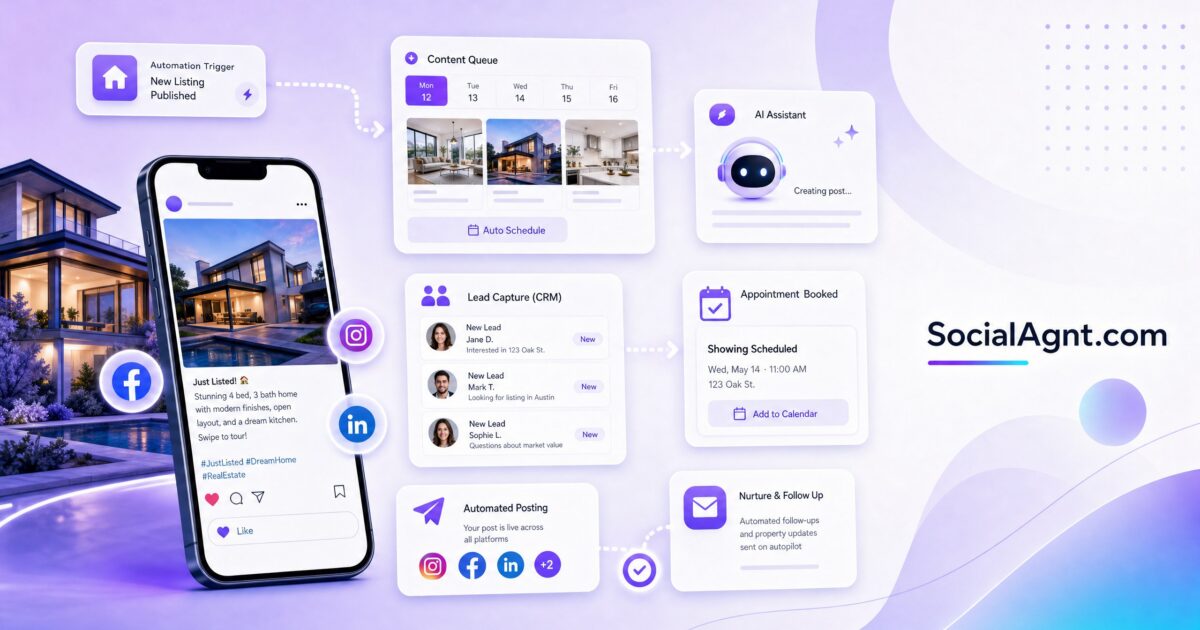
Key Takeaways: Social media automation for real estate agents is the bridge between knowing you should post consistently and actually doing it — without sacrificing every evening and weekend to content creation. The right automation strategy doesn’t make your social media feel robotic; it makes it feel more consistent, more professional, and more strategic by handling the repetitive tasks (scheduling, cross-posting, lead response, content distribution) so you can focus on the high-value work that only a human can do: building relationships, closing deals, and creating authentic content. This guide covers what to automate, what to keep manual, the best automation tools for real estate, workflows that save hours every week, and how to build an automation system that generates leads while you’re showing homes.
What Social Media Automation Actually Means for Real Estate
Social media automation isn’t about letting a robot run your accounts. It’s about using technology to handle the predictable, repetitive parts of social media management — scheduling posts, distributing content across platforms, triggering follow-up sequences, and tracking performance — so you can spend your time on the parts that require a human brain: connecting with leads, sharing your authentic perspective, and building relationships.
The average real estate agent who manages social media manually spends 6–10 hours per week creating content, writing captions, posting to individual platforms, responding to comments, and monitoring performance. An agent with an effective automation system spends 2–3 hours per week on the same output — or the same time with dramatically higher output. That’s 4–7 hours per week returned to your business. Over a year, that’s 200–350 hours — the equivalent of more than eight full workweeks — that you can redirect toward prospecting, client service, and closing transactions.
The agents who resist automation usually do so because they worry it will make their social media feel inauthentic. The opposite is true. Agents who try to manage everything manually typically post inconsistently, write rushed captions, forget to cross-post content, and eventually stop posting altogether when business gets busy. Automation ensures your content goes out on schedule, every time, across every platform — creating the consistency that builds trust and visibility over the long term.
The Automation Spectrum: What to Automate and What to Keep Human
Not everything about social media should be automated. The key is understanding which tasks benefit from automation and which require the human touch that builds genuine relationships.
Automate These Tasks
Content scheduling: The most fundamental automation — writing and scheduling your posts in batches (weekly or biweekly) rather than posting in real time. Scheduling ensures consistent posting even when you’re in back-to-back showings, traveling, or taking a day off. Most scheduling platforms let you queue weeks of content in advance, and AI-powered timing features can automatically publish at the times when your audience is most active.
Cross-platform distribution: Creating content once and distributing it across multiple platforms — with platform-appropriate adjustments to captions, hashtags, and formatting. Without automation, posting the same market update to Instagram, Facebook, LinkedIn, TikTok, YouTube, and Google Business Profile means logging into six different platforms and adapting the content manually each time. A cross-platform scheduling tool collapses this into a single action.
Listing content generation: When a new listing hits the MLS, automation can pull the listing data and photos and generate social media posts — ready for your review and approval. This eliminates the manual process of downloading photos, writing listing descriptions for social, and creating graphics for each new listing.
Analytics reporting: Automated weekly or monthly performance reports that aggregate data across all your social platforms, showing what’s working, what’s not, and where to adjust. Checking analytics manually on six platforms is tedious and easy to skip. Automated reports ensure you stay data-informed without the effort.
Email follow-up sequences: When a lead comes in through social media — a DM inquiry, a lead magnet download, a contact form submission — an automated email sequence can begin nurturing that lead immediately. The first email goes out within minutes, followed by a series of value-driven emails over days and weeks. This ensures no lead falls through the cracks during busy periods.
Comment-to-DM automations: When someone comments a specific keyword on your post (like “GUIDE” or “INFO”), an automation tool can instantly send them a DM with the promised content. This captures leads at the moment of highest interest without requiring you to manually monitor every comment.
Keep These Tasks Human
DM conversations: Automated DM greetings and responses feel generic and impersonal. When a potential client messages you, they want to talk to you — not a bot. Use automation to trigger a notification so you can respond quickly, but keep the actual conversation human. Personalized, thoughtful DM responses are where leads convert into clients.
Comment responses: Responding to comments on your posts should be genuine and personalized. A bot that replies “Thanks for your comment!” to every comment undermines trust. Take two minutes after each post goes live to respond thoughtfully to the first wave of comments — this boosts engagement metrics (improving reach) while building real connections.
Original content creation: AI can help you draft captions and generate content ideas, but the best-performing real estate content has your voice, your personality, and your specific market knowledge. Use AI as a starting point, then rewrite in your own words. The agents who copy-paste AI-generated content without editing it end up sounding generic — the opposite of building a distinctive personal brand.
Relationship building: Engaging with other people’s content — commenting on a referral partner’s post, congratulating a client on their home anniversary, sharing a local business’s update — should be genuine. These small interactions build the relationships that generate referrals and loyalty. They can’t be authentically automated.
Crisis management: If you receive a negative review, a public complaint, or a controversial comment, pause any scheduled posts and respond personally. Automated content going out while you’re dealing with a public issue can look tone-deaf. Always be ready to override your automation when the situation calls for it.
SocialAgnt automates the time-consuming parts of social media — scheduling, cross-platform distribution, and AI-powered content creation — while keeping you in control of your voice, your brand, and your relationships. Built specifically for real estate agents. Start free today.
Building Your Automation Workflow
An effective social media automation system isn’t just about picking a tool — it’s about building a workflow that turns your content strategy into a repeatable, efficient process. Here’s a week-by-week workflow that most agents can implement immediately.
The Weekly Batch Creation Workflow
Step 1 — Content planning (30 minutes, once per week): Review your content calendar and decide what you’ll post for the coming week. Map each day to a content type: Monday is a market tip, Tuesday is a listing showcase, Wednesday is a personal or behind-the-scenes post, Thursday is educational content, Friday is a community spotlight. Having a framework eliminates the daily question of “What should I post?” and makes the creation process dramatically faster.
Step 2 — Batch creation (90 minutes, once per week): Create all your content for the week in one sitting. Write all captions, select all images or create all graphics, film all video clips. Batching is more efficient than creating one post per day because you stay in a creative flow state rather than context-switching between content creation and every other task in your business.
Step 3 — Schedule and distribute (30 minutes, once per week): Load all your content into your scheduling platform. Customize captions for each platform (LinkedIn gets a more professional tone, TikTok gets a more casual caption, Instagram gets hashtags). Set publish times based on when your audience is most active on each platform. Review the week’s schedule one final time and approve.
Step 4 — Daily engagement (15–20 minutes per day): This is the human part. Check notifications, respond to comments, reply to DMs, engage with other accounts’ content. This shouldn’t take more than 15–20 minutes if your content is scheduled and you’re focused solely on interaction.
Total time investment: Roughly 3.5–4 hours per week, producing five to seven posts across six platforms — content that would take 8–10 hours to produce and publish manually.
The Monthly Review Workflow
Once per month, spend 30–60 minutes reviewing your automated analytics report. Identify your top-performing posts by reach, engagement, and lead generation. Look for patterns: which content types perform best? Which platforms are driving the most profile visits and link clicks? Which posting times generate the most engagement? Use these insights to adjust your content plan for the following month. This data-driven iteration is what separates agents who are “posting on social media” from agents who are “running a social media strategy.”
Automation Tools and Platforms for Real Estate
Social Media Scheduling Platforms
Your scheduling platform is the central hub of your automation system. For real estate agents, the ideal platform should support all major social networks (Instagram, Facebook, TikTok, LinkedIn, YouTube, Google Business Profile), offer AI-powered caption generation for faster content creation, include real estate-specific features like MLS integration and property templates, provide analytics across all platforms in one dashboard, and fit within a solo agent’s budget.
SocialAgnt checks all these boxes as the only scheduling platform built specifically for real estate. Its MLS integration means new listings automatically become draft social posts — ready for your review and scheduling. The AI caption generator understands real estate terminology and creates platform-appropriate captions that you can edit and approve in seconds. And the multi-platform scheduling means one content session covers Instagram, Facebook, TikTok, LinkedIn, YouTube, and Google Business Profile simultaneously.
DM and Comment Automation Tools
Tools like ManyChat integrate with Instagram and Facebook to automate DM delivery when someone comments a trigger word on your post. For example, you post a market report with the caption “Comment REPORT and I’ll send it to your inbox” — ManyChat automatically DMs everyone who comments with the keyword, delivering your lead magnet and capturing their contact information. This turns every post into a potential lead capture mechanism without requiring you to monitor comments in real time.
Email Marketing Automation
Email platforms like Mailchimp, ConvertKit, or ActiveCampaign let you build automated nurture sequences that fire when a new lead enters your system. A social media lead who downloads your buyer guide gets a welcome email immediately, a follow-up with additional resources three days later, and a series of educational emails over the next month — all without you lifting a finger after the initial setup. The most sophisticated setups tag leads by source and interest (Instagram buyer lead, Facebook seller lead) and deliver customized email sequences based on those tags.
CRM Automation
Real estate CRMs like Follow Up Boss, kvCORE, and LionDesk can automate lead assignment, task creation, and follow-up reminders based on lead behavior. When a social media lead fills out a form on your website, the CRM can automatically create a contact record, assign a follow-up task, send an initial text message, and begin an email drip sequence. This speed-to-lead automation is critical because responding to new leads within five minutes dramatically increases conversion rates.
Advanced Automation Strategies
Content Repurposing Automation
One piece of pillar content — a blog post, a YouTube video, or a comprehensive market report — can automatically feed your social media for weeks. The workflow: publish a blog post on your website, use your scheduling tool to create platform-specific social posts promoting the blog post (a carousel for Instagram, a text post for LinkedIn, a video clip for TikTok), schedule these derivative posts over two weeks so one piece of content generates multiple touchpoints across multiple platforms. Some agents take this further by using AI tools to automatically generate social captions from blog content, creating a near-automated content pipeline from blog to social.
Lead Scoring and Routing
Connect your social media lead sources to your CRM with automated lead scoring. A lead who downloaded a home valuation report (high seller intent) gets a higher priority score and faster follow-up than a lead who downloaded a general market report (early-stage research). Automation routes high-priority leads to you immediately via text or phone notification, while lower-priority leads enter a longer-term nurture sequence. This ensures your limited time is spent on the leads most likely to convert.
Automated Listing Marketing
Build an automation that triggers when you add a new listing: day one — “Coming soon” teaser posts go to Instagram Stories and Facebook; day two — full listing announcement with photos and video posts to all platforms; day seven — “Open house this weekend” promotional posts; day fourteen — price update or feature highlight posts. This template-based listing marketing ensures every property gets consistent, comprehensive social media coverage without requiring you to build a marketing plan from scratch each time.
Common Automation Mistakes
Automating everything and engaging with nothing. Automation should handle distribution, not relationships. If your entire social media presence is scheduled content with zero human interaction in comments and DMs, your audience will feel it. The posts get you seen. The engagement gets you hired. Automate the first. Do the second yourself.
Setting it and forgetting it. Automation isn’t a “build once and walk away” system. You still need to review performance, update your content strategy, refresh your templates, and ensure your automation is actually producing results. Monthly reviews are the minimum — weekly is better when you’re first building your system.
Using generic automation without real estate context. A generic scheduling tool that doesn’t understand real estate will require more manual work to produce relevant content. Real estate-specific platforms save time because they’re designed for your workflow — MLS integration, property templates, compliance awareness, and industry-appropriate AI content generation.
Over-automating DMs. Automated “welcome” DMs that fire when someone follows you feel spammy and erode trust. Automated sales pitches in DMs are even worse. Reserve DM automation for delivering requested content (lead magnets triggered by comment keywords) and keep all other DM interactions personal.
Not testing your automations. Before relying on any automation, test it thoroughly. Follow your own comment-to-DM trigger. Submit your own lead form. Check that emails are delivering correctly and that content is posting to the right platforms with the right formatting. A broken automation — a lead magnet that doesn’t deliver, a scheduled post that publishes with the wrong image — damages trust and wastes the lead opportunity.
Your Automation Action Plan
Week 1 — Set up your scheduling platform: Choose a social media scheduling platform (SocialAgnt for real estate-specific features) and connect all your social accounts. Schedule your first week of content using the batch creation workflow. Experience the relief of knowing your posts are handled for the week.
Week 2 — Build your first lead capture automation: Set up a comment-to-DM automation on Instagram for one lead magnet (a buyer guide, market report, or home valuation offer). Create the trigger post and monitor how it performs. Set up your email platform and create a basic three-email welcome sequence for new leads.
Week 3 — Connect your CRM: Ensure every lead from social media (DM conversations, form submissions, lead magnet downloads) flows into your CRM with proper source tagging. Set up automated follow-up tasks so no lead goes uncontacted for more than 24 hours.
Week 4 — Build your listing automation: Create a template-based listing marketing sequence that activates for every new listing. Set up the “coming soon → launch → open house → update” post sequence as a reusable template in your scheduling platform.
Months 2–3 — Optimize and expand: Review your automation performance. Which automations are generating leads? Which need adjustment? Add advanced automations: lead scoring, content repurposing pipelines, and retargeting integrations. Continue refining your weekly batch workflow until it feels effortless.
Social media automation for real estate isn’t about replacing the human side of your business — it’s about amplifying it. When the repetitive tasks are handled by technology, you’re free to focus on the work that actually builds a real estate business: connecting with people, solving their problems, and earning their trust. The automation runs in the background. The relationships run your business.
SocialAgnt automates your social media with AI-powered content creation, MLS integration, multi-platform scheduling, and real estate templates — so your content runs on autopilot while you run your business. Instagram, Facebook, TikTok, LinkedIn, YouTube, and Google Business Profile, all from one dashboard. Start your free account today.
Ready to save 5+ hours per week on social media?
SocialAgnt helps real estate agents schedule posts, create AI content, and grow their brand across 7 platforms. Try it free for 14 days.
