
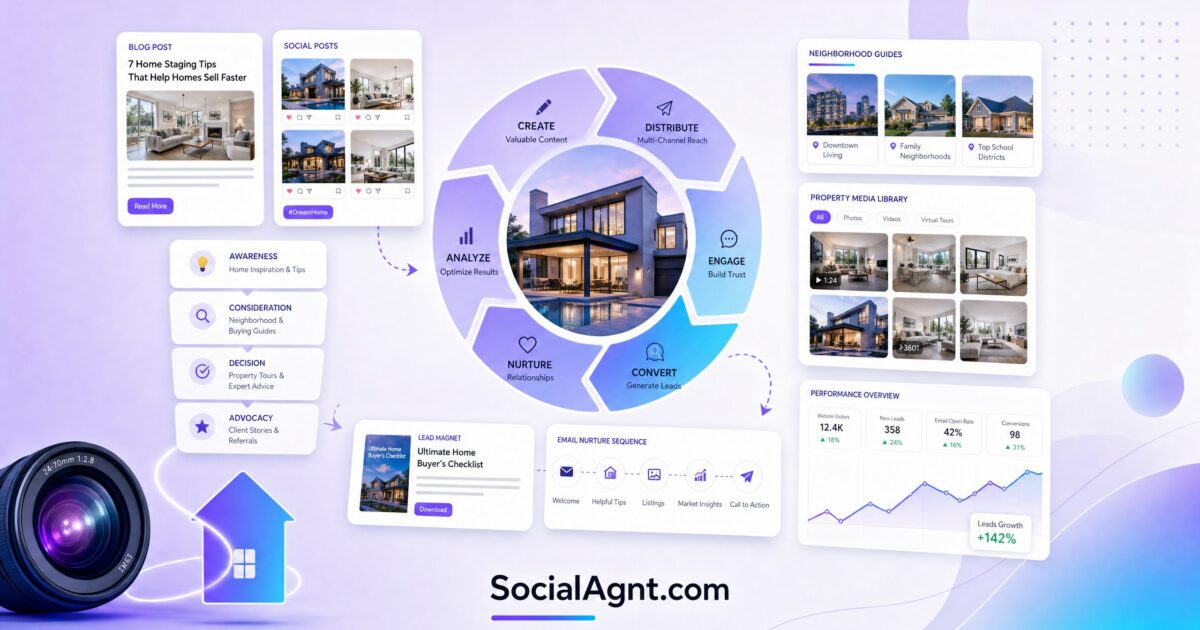
Key Takeaways: Real estate content marketing goes far beyond social media posts — it’s a complete ecosystem of blogs, videos, emails, podcasts, and downloadable resources that work together to attract, educate, and convert leads on autopilot. Agents who build a content marketing strategy generate three times more leads at a lower cost per acquisition than those who rely solely on paid advertising. This guide covers how to build a content engine that positions you as the local authority and creates a pipeline of warm leads who come to you — not the other way around.
What Is Real Estate Content Marketing (And Why It’s Different from Social Media)
Real estate content marketing is the strategic creation and distribution of valuable, relevant content designed to attract and retain a clearly defined audience — and ultimately drive profitable client relationships. Social media marketing is one channel within content marketing, but it’s not the whole picture.
Think of it this way: social media is the storefront window that catches people’s attention. Content marketing is the entire store — the blog posts that answer their questions, the email newsletters that keep you top of mind, the YouTube videos they watch when researching neighborhoods, the downloadable guides they trade their email address for, and the podcast they listen to on their commute. Each piece of content creates a touchpoint in the buyer’s journey, building trust incrementally until they’re ready to pick up the phone and call you.
The data supports this approach: according to the Content Marketing Institute, content marketing generates roughly three times as many leads as outbound marketing while costing 62% less. For real estate agents, this means that investing time in creating genuinely useful content — rather than purchasing leads from aggregators or running cold outreach — produces higher-quality leads that are more likely to convert, at a lower cost per acquisition.
The compounding effect is what makes content marketing transformative. A blog post you write today can generate leads for years. A YouTube neighborhood guide can attract relocating buyers month after month. An email newsletter builds a nurture database that converts over time. Unlike paid advertising — where leads stop the moment you stop spending — content marketing builds an asset that appreciates in value.
Building Your Real Estate Content Marketing Strategy
Effective content marketing doesn’t happen by accident. It requires a strategic framework that aligns your content creation with your business goals, target audience, and available resources.
Define Your Audience with Painful Specificity
The most common content marketing mistake is creating content for “anyone who might buy or sell a home.” That audience is too broad to create content that truly resonates. Instead, build a detailed profile of your ideal client — not a demographic sketch, but a real understanding of their fears, questions, motivations, and decision-making process.
A first-time buyer in their late twenties has fundamentally different content needs than a downsizing empty nester in their sixties. The first-time buyer needs content that demystifies the process: “What’s the difference between pre-qualification and pre-approval?” “How much do I actually need for a down payment?” “What happens at closing?” The downsizer needs different content: “How to declutter before selling,” “Downsizing timeline: when to start planning,” “Best low-maintenance home options for active adults.”
When you know exactly who you’re creating content for, every piece you produce becomes more relevant, more useful, and more likely to convert.
Map Content to the Buyer’s Journey
Not all content serves the same purpose. Map your content to three stages of the buyer’s journey:
Awareness stage: The prospect knows they might want to buy or sell eventually, but they’re not actively in the market. Content at this stage should be broadly educational and designed to attract them into your orbit: blog posts about the local market, neighborhood guides, homeownership tips, and social media content that builds familiarity with your brand.
Consideration stage: The prospect is actively researching and getting serious. They’re comparing neighborhoods, running numbers, and evaluating agents. Content at this stage should demonstrate your expertise and provide tools that help them make decisions: market reports, buyer checklists, home valuation tools, comparison guides, and video walkthroughs of communities.
Decision stage: The prospect is ready to choose an agent and take action. Content at this stage should build confidence in choosing you specifically: client testimonials, case studies, your process walkthrough, and clear calls to action for scheduling a consultation.
A complete content marketing strategy has content serving each stage. If you only create awareness content, you’ll attract attention but struggle to convert. If you only create decision-stage content, you’ll convert well but have nobody in the pipeline.
Choose Your Content Channels
You don’t need to be on every channel. Choose two to three primary channels based on where your audience spends time and what content formats play to your strengths. Here’s how each channel fits into a real estate content strategy.
Blog Content: Your SEO Foundation
A well-maintained blog on your real estate website is the backbone of organic lead generation. Blog content gets indexed by Google, appears in search results, and drives qualified traffic to your site for months or years after publication. For real estate agents, the best blog content targets questions your ideal clients are actively searching for.
Blog Topics That Drive Organic Traffic
Neighborhood and community guides: “The Complete Guide to Living in [Neighborhood]” — covering schools, restaurants, parks, commute times, home prices, and lifestyle. These guides rank well for “[neighborhood] homes,” “[neighborhood] real estate,” and long-tail queries like “best neighborhoods in [city] for families.” They’re also evergreen content that stays relevant with periodic updates.
Market reports and analysis: Monthly or quarterly market updates for your area with your professional analysis of what the data means for buyers and sellers. These position you as the local expert and attract people who are actively researching the market.
Process explainer articles: “How to Buy a Home in [State]: Step-by-Step Guide,” “What to Expect at Closing,” “Understanding Home Inspections.” These attract first-time buyers who are Googling every step of the process.
Financial and investment content: “How Much Home Can I Afford?”, “First-Time Buyer Programs in [State],” “Is It Better to Rent or Buy in [City]?” Financial questions drive some of the highest-volume real estate searches.
Seasonal content: “Spring Home Maintenance Checklist,” “How to Prepare Your Home for Sale in Winter,” “Best Time to Buy a Home in [City].” Seasonal content sees predictable traffic spikes every year.
Blog SEO Basics
Every blog post should target a specific keyword phrase that your audience is searching for. Include the keyword in your title, first paragraph, at least one subheading, and naturally throughout the content. Write comprehensive posts (1,500–2,500 words) that genuinely answer the searcher’s question better than competing results. Add internal links to your other blog posts and key website pages. Optimize your meta description to entice clicks from search results.
Consistency matters more than volume. Publishing two high-quality, well-optimized posts per month will outperform publishing ten mediocre posts. Each piece should be something you’d be proud to share with a prospective client.
Email Marketing: The Nurture Engine
Email marketing is the most underrated channel in real estate. While social media gets the attention, email quietly delivers the highest ROI of any digital marketing channel — $36 for every $1 spent, according to Litmus research. For real estate agents, email is how you nurture leads who aren’t ready to transact today but will be ready in 3, 6, or 12 months.
Building Your Email List
Your email list is an asset you own — unlike social media followers, which are rented from platforms that can change algorithms or disappear overnight. Build your list through lead magnets (discussed below), open house sign-in sheets, website contact forms, and social media DM conversations. Every person you interact with professionally should receive a “Can I add you to my monthly market update email?” request.
Email Content That Gets Opened
Monthly market newsletter: A concise summary of local market conditions, new listings, recent sales, and your expert analysis. Keep it short, visual, and focused on your specific market area. Include a personal note — something from your life or work that month — to keep it feeling human.
New listing alerts: Automated emails triggered when new properties matching a lead’s criteria hit the market. These are high-intent, time-sensitive, and demonstrate your value as an agent who’s on top of the market.
Educational drip sequences: A pre-written series of emails that educate new leads over several weeks. A buyer drip might include: email 1 (welcome + market overview), email 2 (how to get pre-approved), email 3 (what to look for in a neighborhood), email 4 (the offer process explained), email 5 (what happens at closing). Each email provides value while building trust and keeping you top of mind.
Anniversary and check-in emails: Send past clients a home purchase anniversary message, seasonal maintenance tips, or an annual home value update. These maintain the relationship and generate referrals — the most profitable lead source in real estate.
Video Content: The Trust Accelerator
Video content builds trust faster than any other format because it lets people see your face, hear your voice, and experience your personality before they ever meet you in person. For real estate specifically, video lets you show properties, neighborhoods, and communities in ways that photos and text simply can’t match.
Video Formats That Work
Neighborhood tours: Walk through a neighborhood, pointing out highlights, sharing insider knowledge, and giving viewers a sense of what it’s actually like to live there. These videos rank well on YouTube for “[neighborhood] tour” and “[city] neighborhood guide” searches.
Market update videos: Monthly video updates where you break down local market data on camera. These establish your expertise and give your audience a reason to come back every month.
Listing walkthroughs: Professional video tours of your listings. Listings with video receive 403% more inquiries than listings without, according to the National Association of Realtors.
Educational series: A recurring series on a specific topic — “First-Time Buyer Friday” or “Market Monday” — that creates appointment viewing and positions you as a consistent resource.
Don’t wait until you have perfect equipment. A smartphone, natural light, and genuine expertise are enough to start. The agents who win with video aren’t the ones with the best cameras — they’re the ones who started before they felt ready.
Lead Magnets: Converting Traffic into Contacts
A lead magnet is a free resource you offer in exchange for someone’s contact information — typically their name and email address. Lead magnets are the bridge between content consumption (someone reads your blog post) and lead capture (now you have their info and can nurture them).
Lead Magnets That Convert for Real Estate
Home valuation tool: “What’s your home worth? Get a free, instant estimate.” Home sellers love this, and it captures high-intent seller leads.
Buyer’s guide: A comprehensive PDF guide to buying a home in your market — covering the process, financing options, neighborhood overviews, and what to expect. This captures buyer leads who are in the research phase.
Market report: A detailed monthly or quarterly market report with data and analysis for your area. This captures both buyer and seller leads who want to understand market conditions.
Checklists: Moving checklists, home inspection checklists, selling preparation checklists. These are simple to create and highly actionable — which makes them appealing to download.
Neighborhood guides: Downloadable PDF guides for specific neighborhoods, covering everything a relocating buyer would want to know.
Promote your lead magnets everywhere: in blog posts, social media bios, Instagram Stories, email signatures, and on dedicated landing pages. Every content channel should funnel toward capturing contact information.
Every blog post, video, lead magnet, and market report you create needs an audience. SocialAgnt distributes your content across Instagram, Facebook, TikTok, LinkedIn, YouTube, and Google Business Profile — automatically, with AI-powered captions optimized for each platform. Create once, distribute everywhere. Start free today.
Content Repurposing: Work Smarter, Not Harder
The biggest efficiency gain in content marketing is repurposing. One substantial piece of content — a blog post, a video, or a market report — can be broken down into ten or more pieces across different formats and channels. This isn’t about being lazy or repetitive. Different audiences consume content in different formats on different platforms. Repurposing ensures your message reaches people wherever they prefer to consume content.
The Repurposing Framework
Start with one pillar piece of content — let’s say a 2,000-word blog post about “The Complete Guide to Buying a Home in [City].” Here’s what it becomes:
- The original blog post (SEO and website traffic)
- An Instagram carousel pulling the 8 key steps (visual education)
- A TikTok or Reel summarizing the top 3 tips (short-form video)
- A LinkedIn article adapting the content for a professional audience
- A Facebook post sharing one key insight with your commentary
- An email newsletter summarizing the guide with a link to the full post
- A downloadable PDF checklist derived from the content (lead magnet)
- 3–5 quote graphics pulling individual statistics or tips
- A Google Business Profile post highlighting a local angle
- A YouTube video where you present the content on camera
One piece of content. Ten touchpoints. Four hours of creation. Two weeks of distribution. This is how the most efficient real estate content marketers operate — and SocialAgnt’s multi-platform scheduling makes distributing all ten pieces effortless.
Podcasting for Real Estate
Podcasting is an emerging content channel for real estate agents who want to build deep authority in their market. A podcast lets you share in-depth market analysis, interview local business owners and community leaders, discuss market trends, and build a relationship with listeners that’s more intimate than any other content format.
You don’t need a massive audience to make a podcast valuable. A hyper-local podcast about your market — “Everything [City] Real Estate” or “Living in [Neighborhood]: The Insider’s Guide” — can attract a small but highly qualified audience of people who are actively interested in your area. When one of those listeners decides to buy or sell, you’re the agent they’ve been listening to every week. You’re not a stranger sending a cold email — you’re a familiar voice they trust.
Starting a podcast is simpler than most agents think: a decent USB microphone ($50–$100), free recording software (Audacity or GarageBand), and a hosting platform (Buzzsprout or Anchor). Record a 20–30 minute episode weekly or biweekly. The barrier isn’t technical — it’s the commitment to consistency.
Measuring Content Marketing ROI
Content marketing is a long game, and measuring its ROI requires patience and the right metrics. The agents who give up after 90 days because they “didn’t see results” are quitting right before the compound effect kicks in.
Metrics That Matter
Organic website traffic: Track total visits, traffic by source (organic search, social, direct, email), and which content pages drive the most visits. Use Google Analytics to monitor trends over time. Organic traffic from content marketing typically starts showing meaningful growth at the 3–6 month mark.
Lead generation: Track total leads captured through content (form fills, email signups, consultation requests) and trace them back to the content piece that brought them in. This tells you which content types and topics generate the most leads.
Email list growth: Track net new email subscribers per month. A healthy content marketing strategy should steadily grow your list through lead magnets, blog subscribers, and social-to-email conversion.
Engagement metrics: Blog comments, social shares, email open rates, and video watch time. These leading indicators tell you whether your content is resonating before the lagging indicators (leads, clients, commissions) show up.
Revenue attribution: The ultimate metric: how many closed transactions can you trace back to a content marketing touchpoint? This requires asking every lead “how did you find me?” and tracking the answer in your CRM. Over time, you’ll see patterns — and those patterns should inform where you invest more time and resources.
Your Content Marketing Action Plan
Month 1 — Foundation: Define your target audience. Choose two primary content channels (blog + one social platform is a strong starting point). Create your first lead magnet. Write and publish four blog posts targeting high-value keywords. Set up your email newsletter.
Month 2 — Expand: Add video to your content mix (start with market updates or neighborhood tours). Begin email nurture sequences. Repurpose your blog content across social media platforms. Promote your lead magnet in every piece of content.
Month 3 — Optimize: Review your analytics. Identify which content topics and formats drive the most traffic and leads. Double down on what works. Experiment with one new format (podcast, LinkedIn articles, YouTube). Build your repurposing workflow so one piece of content becomes ten.
Months 4–12 — Compound: Stay consistent. Publish on a regular schedule. Grow your email list. Build your content library. The agents who sustain this effort for a full year build a content asset that generates leads on autopilot — the ultimate competitive advantage in a business where most agents are still cold calling and door knocking.
SocialAgnt turns your content marketing strategy into a distribution machine. Schedule posts across Instagram, Facebook, TikTok, LinkedIn, YouTube, and Google Business Profile from one dashboard. AI-powered captions. MLS integration. Real estate templates. Content calendar. Start free today.
Ready to save 5+ hours per week on social media?
SocialAgnt helps real estate agents schedule posts, create AI content, and grow their brand across 7 platforms. Try it free for 14 days.
