
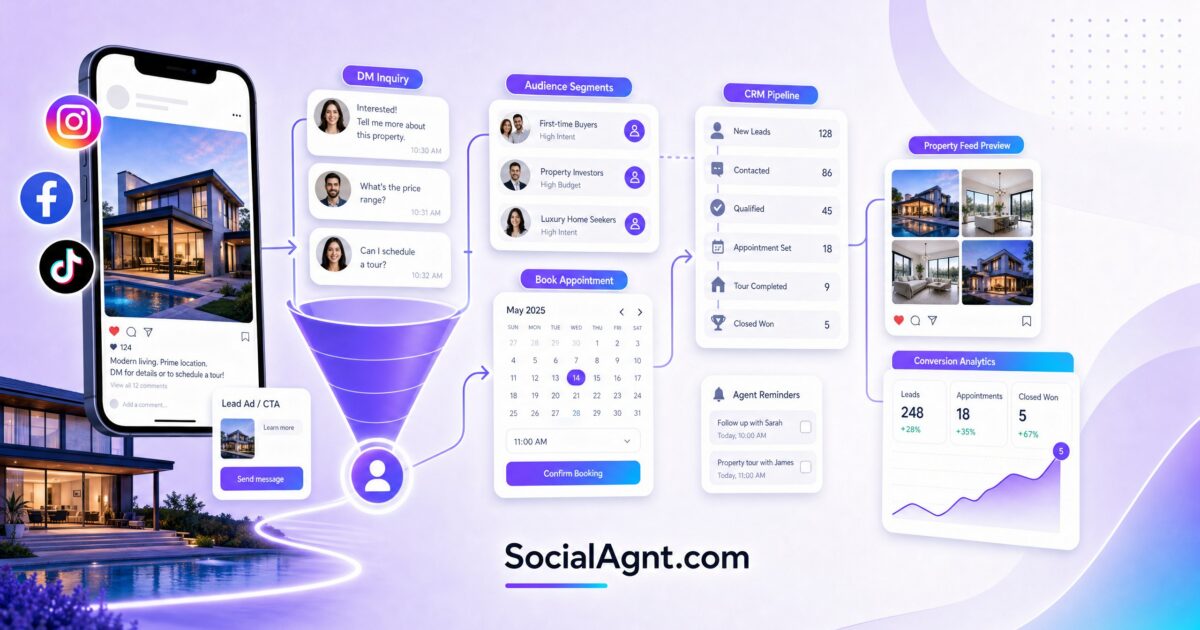
Key Takeaways: Real estate lead generation through social media isn’t about posting listings and hoping someone calls — it’s about building systems that consistently attract, capture, and nurture potential clients across every platform. Agents who treat social media as a lead generation engine (not just a branding exercise) report that social leads convert at higher rates and lower costs than purchased leads from aggregator sites. This guide covers the complete social media lead generation framework: platform-specific strategies, lead magnet funnels, DM conversion scripts, paid advertising basics, nurture sequences, and the metrics that actually predict closings — so you can build a pipeline that fills itself.
Why Social Media Is the Highest-ROI Lead Generation Channel for Real Estate
Real estate lead generation has changed fundamentally. The old playbook — cold calling expired listings, buying Zillow leads, door knocking subdivisions — still works, but the cost per acquisition keeps climbing while conversion rates keep dropping. Social media flips the equation. Instead of interrupting strangers and hoping a fraction of them are in the market, social media attracts people who are already interested and lets you build a relationship before they ever need an agent.
The numbers are hard to ignore. According to the National Association of Realtors’ Digital Age report, 96% of homebuyers use online tools during their search, and 52% found the home they ultimately purchased through the internet. Social media is the top of that funnel — it’s where people discover agents, evaluate their expertise, and decide who to trust with the biggest financial transaction of their lives.
But the real advantage of social media lead generation isn’t reach — it’s relationship. When someone follows you on Instagram, watches your TikTok videos for three months, reads your market updates on Facebook, and then DMs you when they’re ready to buy, that’s not a cold lead. That’s someone who already trusts you, already knows your personality and expertise, and has essentially pre-qualified themselves as a client who wants to work with you specifically. These leads convert at dramatically higher rates because the relationship started long before the transaction.
The agents who generate the most leads from social media don’t treat it as a broadcasting tool. They treat it as a system — with specific strategies for attracting attention, capturing contact information, nurturing relationships over time, and converting followers into clients when the timing is right.
The Social Media Lead Generation Funnel for Real Estate
Before diving into platform-specific tactics, you need to understand the lead generation funnel that underlies all successful social media strategies. Every piece of content, every interaction, every campaign should serve one of these four stages.
Stage 1: Attract — Get In Front of the Right People
The top of the funnel is about visibility. You need content that reaches people who might eventually buy or sell a home in your market — even if they’re not actively in the market today. The goal is to enter their world, provide value, and earn a follow or a save.
Attraction content includes: educational posts that answer common real estate questions, neighborhood spotlights that showcase local expertise, market data visualizations that demonstrate your knowledge, entertaining or relatable content that makes people want to follow you, and listing showcases that stop the scroll. The key metric at this stage is reach — how many new people are seeing your content for the first time.
Stage 2: Capture — Convert Attention into Contact Information
A follower is not a lead. A follower becomes a lead when you capture their contact information — typically an email address, phone number, or both — so you can communicate with them directly, outside the platform. This is the stage most agents skip entirely, which is why they have 5,000 followers and no pipeline.
Capture mechanisms include: lead magnets (free guides, checklists, market reports offered in exchange for an email), landing pages linked from your bio, DM conversations that naturally move to a phone call or email exchange, comment-triggered automations that deliver content via DM, and home valuation tools that require contact information. The key metric at this stage is conversion rate — what percentage of your audience is giving you their information.
Stage 3: Nurture — Build the Relationship Until They’re Ready
Most people who follow you on social media are not ready to buy or sell today. The average homebuyer researches for months before contacting an agent. During that window, you need to stay visible, stay valuable, and stay top of mind — so when they are ready, you’re the first person they think of.
Nurture activities include: consistent social media posting that keeps you in their feed, email newsletters with market updates and valuable content, personalized DM check-ins with warm leads, retargeting ads that keep your brand visible to website visitors, and community engagement that deepens the relationship. The key metric at this stage is engagement — are your leads opening your emails, watching your videos, and interacting with your content over time.
Stage 4: Convert — Turn Leads into Clients
Conversion happens when a nurtured lead signals they’re ready to take action — and you respond with the right offer at the right time. This might be a consultation booking, a listing appointment, a buyer strategy session, or simply a phone call where they say “I’m ready.”
Conversion triggers include: a DM asking about a specific listing or neighborhood, a response to a market update indicating they’re thinking about selling, a lead magnet download that suggests active intent (like a “what’s my home worth” request), or a direct inquiry through your website or social profile. The key metric at this stage is appointments booked — qualified conversations with potential clients.
Platform-Specific Lead Generation Strategies
Each social media platform has different strengths for lead generation. The best agents don’t use the same strategy everywhere — they adapt their approach to match how each platform works and how people behave on it.
Instagram Lead Generation
Instagram is the most versatile platform for real estate lead generation because it combines visual content (perfect for showcasing properties and neighborhoods) with strong DM functionality (perfect for private conversations with leads).
Stories with interactive features: Use Instagram Stories’ built-in tools — polls (“Are you thinking about buying in 2026?”), question stickers (“What’s your biggest question about selling?”), quizzes (“Guess the price of this home”), and sliders (“How much do you love this kitchen?”). These aren’t just engagement tricks. They’re lead identification tools. When someone responds to your poll saying they’re thinking about buying, that’s a lead signaling intent. Follow up in DMs.
The DM conversation framework: When someone engages with your content — likes a listing post, responds to a Story, comments on a Reel — start a genuine conversation. Not “Are you looking to buy?” That’s too aggressive. Instead: “Thanks for the love on that post! Are you in the [neighborhood] area?” Let the conversation develop naturally. Ask questions. Provide value. The goal is to understand their situation and, when appropriate, offer your help.
Comment-to-DM strategy: Post a piece of valuable content (a market report, a buyer’s guide, a neighborhood breakdown) and include a CTA: “Comment ‘GUIDE’ and I’ll DM you the full report.” This does three things simultaneously: it boosts your post’s engagement (more comments = more reach), it captures a lead (you now have a DM conversation open), and it delivers value (the person gets something useful). Tools like ManyChat can automate the DM delivery, but even doing it manually works at smaller scales.
Link in bio optimization: Your Instagram bio link should not go to your homepage. It should go to a purpose-built landing page with multiple lead capture options: a free home search tool, a downloadable buyer or seller guide, a home valuation request, and a consultation booking link. Services like Linktree or Stan Store work, but a custom landing page on your own website converts better because it keeps people in your ecosystem.
Facebook Lead Generation
Facebook’s organic reach for business pages has declined significantly, but it remains a powerhouse for real estate lead generation through Groups, Marketplace, and paid advertising.
Facebook Groups: Create or participate in a local community group related to your market. A group called “[City] Real Estate Questions” or “Moving to [City] — Tips & Advice” attracts people who are actively researching your area. As the group admin or an active contributor, you’re positioned as the local expert. Answer questions generously, share market insights, and let your expertise speak for itself. When members are ready to buy or sell, you’re the agent they already know and trust from the group.
Facebook Marketplace listings: Posting your listings on Facebook Marketplace is one of the most underrated lead generation strategies in real estate. Marketplace has massive visibility, and people actively browse it for homes. Every inquiry you receive through Marketplace is a lead — someone who saw a property and was interested enough to reach out. Many of these inquiries won’t be for the specific listing they clicked on, but they open a conversation about what they’re actually looking for.
Facebook Lead Ads: Facebook’s lead ad format lets you create an ad with a built-in contact form that auto-fills the user’s information. This means someone can express interest and submit their name, email, and phone number without ever leaving Facebook — which dramatically reduces friction and increases conversion rates. For real estate, the most effective lead ad offers include: free home valuations (“What’s your home worth in today’s market?”), buyer guides (“Download our free guide to buying in [city]”), and exclusive listing previews (“Get early access to new listings before they hit the MLS”).
TikTok Lead Generation
TikTok’s lead generation strength is top-of-funnel awareness — reaching massive audiences of potential buyers and sellers organically. The conversion path is less direct than Instagram or Facebook, but the reach potential is unmatched.
Organic reach to bio link: Create content that attracts your target audience (neighborhood tours, market commentary, educational tips, listing showcases) and direct viewers to your bio link with clear CTAs. “Free home search for [city] — link in bio” or “I made a complete first-time buyer checklist — it’s in my bio.” Because TikTok’s algorithm can show your videos to hundreds of thousands of non-followers, even one viral video can drive significant traffic to your lead capture page.
Comment engagement as lead identification: TikTok comments are public declarations of interest. When someone comments “I want to move to [your city]” or “How much is that house?” — that’s a lead identifying themselves. Respond publicly (to boost engagement metrics) and follow up in DMs with helpful information. The public response also shows other viewers that you’re responsive and knowledgeable.
LinkedIn Lead Generation
LinkedIn is the most overlooked lead generation platform for real estate agents. While other agents fight for attention on Instagram, LinkedIn offers a professional audience with high purchasing power and virtually no competition from other agents.
Content that attracts high-value leads: LinkedIn’s audience responds to data-driven market analysis, investment-focused content, professional relocation advice, and thought leadership about the real estate industry. A post breaking down “What $500K buys you in the top 5 relocation cities for tech professionals” can attract high-income buyers who are actively researching moves.
Connection-to-conversation strategy: Connect with professionals in your target market — people in industries with relocation patterns, HR managers who help employees relocate, financial advisors whose clients ask about real estate, and mortgage professionals who can become referral partners. After connecting, engage with their content before reaching out. When you do message them, lead with value: “I noticed you’re in tech in Seattle — I put together a relocation guide for professionals moving to [your city]. Would that be useful?”
SocialAgnt helps real estate agents maintain a consistent presence across Instagram, Facebook, TikTok, LinkedIn, YouTube, and Google Business Profile — the six platforms where your future clients are researching their next move. AI-powered captions, real estate templates, and smart scheduling keep you visible without consuming your entire day. Start free today.
Lead Magnets That Generate Real Estate Leads on Autopilot
A lead magnet is a free resource you offer in exchange for someone’s contact information. It’s the mechanism that turns a passive social media follower into an active lead in your database. The best lead magnets are specific, immediately useful, and directly relevant to someone who might buy or sell a home.
High-Converting Lead Magnets for Real Estate
Home valuation landing page: “What’s your home worth? Get a free, instant estimate.” This is the single highest-converting lead magnet for real estate because it targets sellers who are actively curious about their home’s value — a strong indicator of future listing intent. Promote it on every platform, in your email signature, and on your website. Tools like HomeBot, Cloud CMA, or a simple CMA request form can power this.
First-time buyer guide: A comprehensive PDF covering everything a first-time buyer needs to know: the buying process step by step, financing options and down payment programs, how to get pre-approved, what to look for in a home inspection, closing costs explained, and a timeline of the entire transaction. This attracts buyers in the research phase — people who are 3–12 months from purchasing but building knowledge now.
Neighborhood or relocation guide: A detailed guide to your market or a specific neighborhood, covering schools, restaurants, parks, commute times, home prices, lifestyle, and insider tips. This targets relocating buyers — often the highest-value leads because they’re making decisions with less local knowledge and more urgency.
Monthly market report: A concise, visually appealing breakdown of your local market: median prices, days on market, inventory levels, sales volume, and your professional analysis of what it means for buyers and sellers. Offer it as a monthly email subscription. This captures leads who are monitoring the market — people who may not be ready today but are getting closer.
Seller preparation checklist: A room-by-room guide to preparing a home for sale: decluttering, repairs, staging tips, photography preparation, and timeline recommendations. This attracts sellers who are in planning mode — they’re thinking about selling and want to know what’s involved. That’s a warm lead.
Promoting Lead Magnets on Social Media
Every lead magnet needs a distribution strategy. Create dedicated posts promoting each lead magnet. Include CTAs in your bio links. Mention relevant lead magnets in Stories and video content. Use the comment-to-DM strategy (“Comment ‘GUIDE’ to get this free”). Run paid ads driving traffic to your lead magnet landing pages. The goal is constant, multi-channel promotion so your audience has repeated opportunities to opt in.
DM Strategies That Convert Followers into Clients
Direct messages are where social media leads become real relationships. The public feed builds awareness and trust. DMs are where you have private, personalized conversations that move people toward working with you. The agents who generate the most business from social media are almost always the ones who are most active and strategic in DMs.
When to Start a DM Conversation
Not every interaction warrants a DM. Be strategic about when you initiate conversations to avoid feeling pushy. High-intent signals that justify a DM include: someone saves or shares one of your listing posts, someone responds to a Story poll indicating they’re thinking about buying or selling, someone comments asking a specific real estate question, someone follows you and their profile suggests they’re in your market, someone DMs you first with a question or comment, and someone downloads one of your lead magnets.
The DM Conversation Framework
Step 1 — Acknowledge and appreciate: Start by thanking them for the interaction that prompted your message. “Hey! Thanks for the comment on my post about [neighborhood] — great question.”
Step 2 — Add immediate value: Answer their question or provide additional information that’s genuinely useful. Don’t just respond with “Let me know if you need anything!” Give them something they can use right now.
Step 3 — Ask a qualifying question: Move the conversation forward with a question that helps you understand their situation. “Are you looking in [area] specifically, or are you exploring a few different neighborhoods?” or “What’s your timeline looking like — are you thinking this year?”
Step 4 — Offer next steps when appropriate: If the conversation reveals they’re an active or near-active buyer or seller, suggest a next step: “I’d love to set up a quick call to walk you through what’s available in that price range — would that be helpful?” The offer should feel like a natural extension of the conversation, not a pivot to a sales pitch.
The entire DM process should feel like a conversation between two people — not a script. Be genuinely curious about their situation. Provide value before asking for anything. Let the relationship develop at their pace.
Paid Social Media Advertising for Lead Generation
Organic social media builds your foundation. Paid advertising accelerates your results. For agents who are ready to invest money (not just time) into social media lead generation, paid ads offer targeting precision and scalability that organic content can’t match.
Facebook and Instagram Ads
Meta’s advertising platform (which runs ads on both Facebook and Instagram) is the most effective paid channel for real estate lead generation because of its targeting capabilities. You can target people by location, age, income level, life events (recently engaged, recently moved, new job), interests (home improvement, real estate, mortgage), and behaviors (likely to move).
The most effective ad campaigns for real estate agents include: lead generation campaigns using Facebook Lead Ads (built-in forms that auto-fill contact information), traffic campaigns driving people to your lead magnet landing pages, retargeting campaigns showing ads to people who’ve visited your website but didn’t convert, and just-listed or just-sold campaigns targeting a specific geographic area around a property.
Start with a modest budget — $10–$20 per day — and test different ad creatives, audiences, and offers. Track your cost per lead and focus your budget on the campaigns that generate leads at the lowest cost. Most agents find that a well-optimized Facebook lead ad campaign can generate leads for $3–$15 each, depending on the market and offer.
Retargeting: The Follow-Up Machine
Retargeting is advertising to people who have already interacted with your brand — visited your website, watched your videos, or engaged with your social profiles. These are warm audiences who already know who you are, which means they convert at much higher rates than cold audiences.
Install the Meta Pixel on your website to track visitors. Then create retargeting campaigns that show your ads to people who visited specific pages: your home search page (show them new listings), your home valuation page (show them a “Get your free valuation” ad), or your blog posts (show them related lead magnets). Retargeting keeps you visible to people who’ve already shown interest — and in real estate, where the buying cycle is long, that persistent visibility is what turns a website visitor into a client months later.
Building a Lead Nurture System That Works on Autopilot
Capturing a lead is only the beginning. The real value is in what happens after — the nurture system that keeps you top of mind with every lead until they’re ready to transact. Without a nurture system, most leads go cold within weeks. With one, leads convert over months and years, often when you least expect it.
Email Nurture Sequences
Every lead who gives you their email should enter an automated nurture sequence — a series of pre-written emails delivered over weeks or months that provide value and build the relationship. A buyer nurture sequence might look like: email 1 (immediate — welcome and deliver the lead magnet they requested), email 2 (day 3 — overview of your local market with your analysis), email 3 (day 7 — guide to getting pre-approved with lender recommendations), email 4 (day 14 — neighborhood comparison guide for your area), email 5 (day 21 — what to expect during the buying process), email 6 (day 30 — personal invitation to schedule a buyer consultation).
After the initial sequence, transition leads to your monthly newsletter — a consistent touchpoint that shares market updates, new listings, and your expert perspective. The newsletter keeps you visible to leads who aren’t ready yet but will be eventually.
Social Media Retargeting as Nurture
Use retargeting ads to stay visible to leads across social media. Someone who downloaded your buyer guide should see your Instagram ads featuring new listings in their price range. Someone who requested a home valuation should see Facebook ads with your recent sales and market expertise. This multi-channel nurture — email plus social retargeting — ensures that no matter where a lead spends their time online, your brand stays present.
CRM Integration
Every lead from social media should flow into a CRM (Customer Relationship Management system) where you can track their source, their interests, their engagement level, and their timeline. Tag leads by source (Instagram DM, Facebook lead ad, TikTok bio link) and by intent level (browsing, researching, ready to act). This lets you prioritize your follow-up and personalize your outreach. Popular real estate CRMs include Follow Up Boss, kvCORE, LionDesk, and Sierra Interactive.
Measuring Social Media Lead Generation Performance
You can’t improve what you don’t measure. Effective social media lead generation requires tracking the right metrics at each stage of the funnel — not just vanity metrics like followers and likes, but business metrics that predict revenue.
Top-of-Funnel Metrics
Reach and impressions: How many unique people are seeing your content. Growth in reach indicates your content is being distributed to new audiences — the first requirement for generating leads.
Profile visits: How many people visit your profile after seeing your content. A high ratio of profile visits to reach suggests your content is compelling enough to make people want to learn more about you.
Follower growth rate: Net new followers per week or month. Steady growth means your content strategy is attracting and retaining new audience members consistently.
Mid-Funnel Metrics
Link clicks: How many people click through from your social profiles to your website or landing pages. This is the bridge between social engagement and lead capture.
Lead magnet downloads: How many people exchange their contact information for your free resources. This is your primary conversion metric — the moment a follower becomes a lead.
DM conversations initiated: How many meaningful DM conversations you’re having per week. Track both inbound (leads messaging you) and outbound (conversations you initiate based on engagement signals).
Bottom-of-Funnel Metrics
Consultation appointments booked: How many leads from social media schedule a call, meeting, or consultation. This is the metric that most directly predicts future revenue.
Cost per lead (paid campaigns): For paid advertising, divide your ad spend by the number of leads generated. Compare this to your other lead sources (Zillow, Realtor.com, referrals) to evaluate relative efficiency.
Lead-to-client conversion rate: What percentage of social media leads ultimately become clients. Track this by source (Instagram vs. Facebook vs. TikTok) and by lead type (organic vs. paid) to understand which channels produce the highest-quality leads.
Revenue attribution: The ultimate metric — how much commission revenue can you trace back to social media lead generation. Ask every client “How did you first find me?” and track the answer in your CRM. Over time, you’ll build a clear picture of your social media ROI.
Common Social Media Lead Generation Mistakes
Treating social media as a billboard instead of a conversation. Agents who only post listings and “just sold” announcements without engaging in conversations, responding to comments, or building relationships in DMs are using the least effective strategy on these platforms. Social media is a two-way channel. The lead generation happens in the interactions, not just the broadcasts.
Not having a capture mechanism. Thousands of agents have engaged audiences but no way to capture lead information. If someone can’t easily go from your social content to giving you their email or phone number, you’re building an audience you don’t own on platforms you don’t control. Every profile should have a clear path from content to contact capture.
Following up too slowly. Social media leads are time-sensitive. A DM that sits unanswered for 48 hours is a lead that’s already moved on. A lead form submission that doesn’t get a response for a week is cold. Speed to lead matters enormously — studies show that responding within 5 minutes makes you 21 times more likely to qualify a lead than responding after 30 minutes. Set up notifications and commit to rapid response times.
Not nurturing long-term leads. Most social media leads aren’t ready to transact immediately. If your only follow-up is a phone call the day they submit a form, you’ll lose the vast majority of your leads. Build nurture systems — email sequences, retargeting campaigns, consistent content — that keep you present over the weeks and months it takes for leads to become clients.
Spreading too thin across platforms. It’s better to generate consistent leads from one or two platforms than to have a weak presence on five. Master one platform’s lead generation system before expanding to the next. For most agents, Instagram or Facebook is the best starting point because they offer the strongest combination of organic content and paid advertising tools.
SocialAgnt keeps your content flowing across Instagram, Facebook, TikTok, LinkedIn, YouTube, and Google Business Profile so you’re always visible to potential leads. AI-powered captions optimized for engagement, MLS integration for instant listing content, and real estate templates that make every post professional. Stop letting leads discover your competitors first. Start free today.
Your Social Media Lead Generation Action Plan
Week 1 — Build Your Foundation: Optimize your profiles on your primary platforms (professional photo, keyword-rich bio, clear CTA). Create or update your link-in-bio landing page with at least two lead capture options (home search, buyer guide, home valuation, or consultation booking). Set up your email marketing platform and create a basic welcome sequence for new leads.
Week 2 — Create Your First Lead Magnet: Build one high-value lead magnet — a buyer guide, neighborhood relocation guide, or home valuation page. Design a simple landing page for it. Create three social media posts promoting it across your platforms, including one using the comment-to-DM strategy.
Week 3 — Activate DM Conversations: Commit to initiating five DM conversations per day with people who engage with your content. Use the four-step framework: acknowledge, add value, ask a qualifying question, and offer next steps when appropriate. Track your conversations and outcomes.
Week 4 — Add Paid Amplification: Launch your first Facebook or Instagram lead ad campaign with a $10/day budget. Test a home valuation offer for sellers and a buyer guide offer for buyers. Set up your Meta Pixel for retargeting. Monitor cost per lead and adjust targeting and creative based on results.
Months 2–3 — Optimize and Scale: Review your metrics across all channels. Identify which platform, content type, and lead magnet generates the most and best leads. Double down on what works. Create additional lead magnets for different segments. Build out your email nurture sequences. Increase ad spend on winning campaigns. Add a second platform to your lead generation strategy.
Social media lead generation for real estate isn’t a hack or a shortcut — it’s a system. The agents who build this system and run it consistently for six to twelve months create a self-sustaining pipeline of leads that costs less, converts better, and compounds over time. The best day to start was six months ago. The second best day is today.
Ready to save 5+ hours per week on social media?
SocialAgnt helps real estate agents schedule posts, create AI content, and grow their brand across 7 platforms. Try it free for 14 days.
