
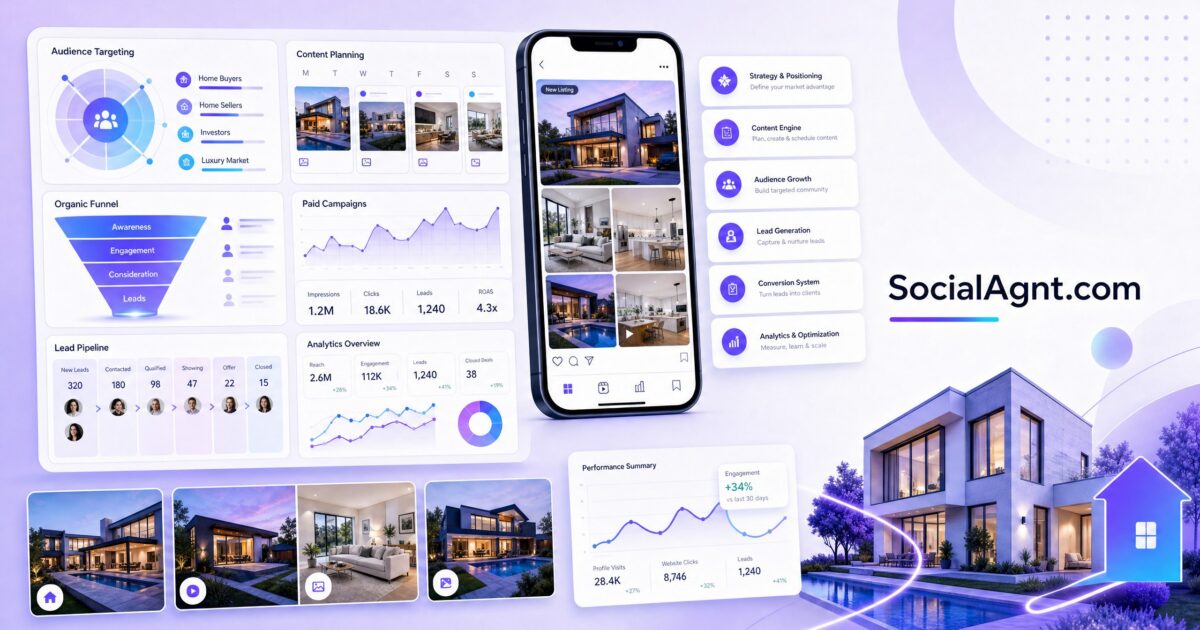
Key Takeaways: Real estate social media marketing is the single most effective digital strategy for agents who want consistent leads without cold calling. In this guide, you’ll learn exactly how to choose the right platforms, create content that attracts buyers and sellers, automate your posting schedule, and measure what’s actually working — all based on current data and proven strategies used by top-producing agents.
What Is Real Estate Social Media Marketing?
Real estate social media marketing is the practice of using platforms like Instagram, Facebook, TikTok, LinkedIn, and YouTube to promote your real estate business, build your personal brand, and generate buyer and seller leads. Unlike traditional advertising, social media lets you build relationships at scale — showing potential clients who you are, what you know, and why they should work with you, long before they’re ready to pick up the phone.
According to the National Association of Realtors’ 2025 Technology Survey, 75% of Realtors actively use social media for business, and it remains the number one lead-generating technology tool at 39% — outperforming CRM systems, MLS sites, and paid digital ads. Even more telling: 71% of buyers say they’re more likely to work with an agent who has a strong social media presence.
Yet most agents do it wrong. They post a listing photo, add a generic caption, and wonder why nothing happens. Real estate social media marketing isn’t about broadcasting — it’s about building a content ecosystem that positions you as the go-to local expert, keeps you top of mind, and creates a pipeline of warm leads who already trust you when they’re ready to buy or sell.
Why Social Media Marketing Matters for Real Estate Agents in 2026
The real estate industry has shifted dramatically. Buyers start their home search online months before contacting an agent, and the agent who shows up consistently in their social feed is the one who gets the call. Here’s why social media marketing has become non-negotiable for real estate professionals.
The Numbers Tell the Story
Consider this: 97% of homebuyers use the internet during their home search, and the average buyer spends 10 weeks searching before making a decision. During that time, they’re scrolling Instagram, watching TikTok, and checking Facebook daily. Real estate listings with video receive 403% more inquiries than those without. Agents who post consistently see a 300% increase in engagement compared to sporadic posters.
Social media isn’t supplemental anymore — it’s where your clients live, research, and make decisions about who to trust with the biggest financial transaction of their lives.
The Trust Factor
Unlike a billboard or a bus bench ad, social media gives potential clients a window into who you actually are. They see your market knowledge through educational posts, your track record through just-sold celebrations, your personality through behind-the-scenes content, and your local expertise through neighborhood spotlights. By the time they reach out, they already feel like they know you. That’s a massive competitive advantage over agents who rely solely on cold outreach.
The Compounding Effect
Every piece of content you publish works for you indefinitely. A well-optimized Instagram post or YouTube video can generate leads months or even years after you publish it. This is the compounding effect of content marketing — and it’s why agents who start now and stay consistent will have an insurmountable advantage over those who wait.
Choosing the Right Social Media Platforms
You don’t need to be everywhere. In fact, trying to maintain a presence on every platform is the fastest path to burnout. The key is choosing two to three platforms that align with your target market and going deep rather than wide.
Instagram: The Visual Powerhouse
Instagram is the most popular platform for real estate marketing after Facebook, and for good reason. It’s visually driven, has powerful discovery features (Reels, Explore, hashtags), and its audience skews toward the 25–44 age group — prime homebuying demographics. Use Instagram for property showcases, Reels walkthroughs, carousel educational posts, and Stories that show your daily life as an agent.
Facebook: The Community Builder
With 90% of real estate agents using Facebook, it remains the most widely adopted platform in the industry. Facebook’s strength lies in its community features — Groups, Marketplace, Events, and its unmatched advertising targeting capabilities. If your market includes move-up buyers, downsizers, or anyone over 35, Facebook should be a cornerstone of your strategy.
TikTok: The Reach Machine
TikTok’s algorithm gives new creators massive reach opportunities that other platforms simply don’t. For agents targeting first-time buyers, renters, or younger demographics, TikTok is arguably the highest-ROI platform available. The barrier to entry is low, the content is casual, and viral moments can put you in front of hundreds of thousands of potential clients overnight.
LinkedIn: The Referral Network
LinkedIn is often overlooked by residential agents, but it’s a goldmine for building referral partnerships with mortgage brokers, financial advisors, attorneys, and relocation specialists. It’s also the go-to platform for commercial real estate professionals and agents targeting luxury or investor clients. If B2B referrals are important to your business, LinkedIn deserves attention.
YouTube: The Long Game
YouTube is the second largest search engine in the world, and real estate is one of its most-searched verticals. Neighborhood tours, market updates, buyer/seller guides, and listing walkthroughs perform exceptionally well. The investment in video production is higher, but the content has the longest shelf life of any platform — a great neighborhood guide can drive leads for years.
Google Business Profile: The Local Essential
While not a traditional social platform, Google Business Profile is critical for local visibility. When someone searches “real estate agent near me,” your GBP listing is often the first thing they see. Regular posts, reviews, and photos on your profile directly impact your local search rankings.
The 5 Content Pillars Every Real Estate Agent Needs
Random posting leads to random results. The most successful agents organize their content around five core pillars, rotating through them to maintain variety while building a cohesive brand. Here’s the framework.
1. Listing Content (20% of Posts)
This is the content most agents default to — just listed, price reduced, open house, and just sold posts. It’s important, but it should be your smallest content bucket, not your only one. The key is making listing posts visually stunning and adding context beyond the basic specs. Share what makes the neighborhood special, tell the story of the home, or highlight a feature that photos alone can’t capture.
Pro tip: SocialAgnt integrates directly with your MLS to automatically generate just-listed and just-sold posts, so you never miss a listing announcement.
2. Educational Content (25% of Posts)
Educational content is your authority builder. This includes homebuying tips, market updates, mortgage rate explainers, home maintenance advice, and answers to common buyer and seller questions. When you consistently teach your audience something valuable, you position yourself as the expert they trust — not just another agent trying to sell them something.
Examples that perform well: “5 things first-time buyers don’t know about closing costs,” “What your home inspection report actually means,” and monthly market update graphics showing local price trends and inventory levels.
3. Personal and Behind-the-Scenes Content (25% of Posts)
People work with people they like. Behind-the-scenes content — showing a day in your life, your morning routine before showings, the chaos of a bidding war, or celebrating a closing with your clients — builds the human connection that polished marketing can’t replicate. This is the content that turns followers into fans and fans into clients.
4. Hyperlocal Content (20% of Posts)
You’re not just selling houses — you’re selling a lifestyle and a community. Spotlight local restaurants, feature upcoming community events, interview small business owners, share hidden gems in your neighborhoods, and highlight what makes your market unique. This content positions you as the ultimate local insider and attracts buyers who are researching areas to move to.
5. Social Proof Content (10% of Posts)
Testimonials, client success stories, before-and-after staging reveals, and milestone celebrations (100 homes sold, anniversary in the business) all build trust through proof. Share client reviews as designed graphics, post closing day photos (with permission), and tell the stories behind your transactions. SocialAgnt’s testimonial-to-graphic tool makes it easy to turn text reviews into polished, shareable social posts.
Creating a Real Estate Social Media Strategy That Works
Content pillars give you the “what.” A strategy gives you the “how.” Here’s how to build a repeatable system that generates results without consuming your entire week.
Step 1: Define Your Target Audience
Before you create a single post, get crystal clear on who you’re talking to. Are you targeting first-time homebuyers? Move-up buyers in the suburbs? Luxury clients? Real estate investors? Retirees downsizing? Each audience has different pain points, questions, and preferred platforms. Your content should speak directly to one primary audience — trying to appeal to everyone means resonating with no one.
Step 2: Audit Your Current Presence
If you’ve been posting sporadically, review what’s worked and what hasn’t. Check your analytics for your top-performing posts by engagement and reach. Look for patterns — do videos outperform photos? Do educational posts get more saves than listing posts? Use this data to inform your go-forward strategy.
Step 3: Build Your Content Calendar
A content calendar transforms social media from a daily scramble into a manageable system. Plan your content one month at a time, mapping each post to a content pillar and platform. Schedule at least three to five posts per week across your primary platforms. Use batch creation — set aside one day per week or month to create all your content at once, then schedule it out.
Tools like SocialAgnt come with pre-loaded content calendars featuring real estate holidays, awareness days, and seasonal posting themes — so you never stare at a blank screen wondering what to post.
Step 4: Create a Repeatable Production Workflow
Consistency beats perfection. Here’s a simple weekly workflow:
- Monday: Plan the week’s content and write captions
- Tuesday: Create or source visuals (photos, graphics, video clips)
- Wednesday: Schedule everything for the week using your social media management tool
- Daily (10 minutes): Respond to comments, DMs, and engage with your community
Alternatively, batch your entire month in one 3–4 hour session. Many agents find this more efficient than spreading content creation throughout the week.
Step 5: Engage, Don’t Just Broadcast
Posting is only half the equation. The agents who see the biggest returns from social media are the ones who actively engage with their audience. Respond to every comment. Answer every DM. Comment on posts from local businesses, past clients, and community members. Social media algorithms reward engagement, and genuine conversations are what turn followers into leads.
Real Estate Social Media Marketing by Platform: Quick-Start Strategies
Each platform has its own best practices, content formats, and audience expectations. Here’s a condensed strategy for each major platform — with links to our in-depth platform guides for the full playbook.
Instagram Strategy for Real Estate
Post Reels for reach (algorithm favors short video), carousels for saves (educational content), and Stories for daily engagement (polls, Q&As, behind-the-scenes). Optimize your bio with keywords and a clear call-to-action. Use 10–15 relevant hashtags mixing broad (#realestate) with hyperlocal (#AustinRealEstate). Post 4–5 times per week minimum.
Facebook Strategy for Real Estate
Focus on community building through Groups, use Facebook Live for virtual open houses, and leverage Facebook Marketplace for listing distribution. Post mix of video, carousel, and text-based content. Facebook Ads are essential for targeted lead generation — even $10/day can drive meaningful results with the right targeting.
TikTok Strategy for Real Estate
Embrace the casual, authentic vibe. Film quick listing tours, share “day in the life” content, participate in trending sounds and formats, and don’t overthink production quality. Post 3–5 times per week. TikTok’s algorithm tests your content with small audiences first and scales reach based on performance — so every post has viral potential regardless of follower count.
LinkedIn Strategy for Real Estate
Share market insights, industry commentary, and professional milestones. Write long-form posts (1,300+ characters perform best). Connect strategically with referral partners and past clients. Post 3–4 times per week. LinkedIn’s algorithm currently favors text posts and document/carousel posts over links and videos.
YouTube Strategy for Real Estate
Invest in neighborhood guides (evergreen content), buyer/seller educational series, and monthly market updates. Optimize titles and descriptions for search (YouTube is a search engine). Post 1–2 videos per week if possible. Longer videos (8–15 minutes) tend to perform best for real estate content.
Automating Your Real Estate Social Media Marketing
The number one reason agents abandon social media is time. Between showings, negotiations, paperwork, and client calls, who has hours to spend crafting posts and scheduling content? The answer is automation — and it’s a game-changer.
What to Automate
Automate the repetitive tasks that don’t require your personal touch: scheduling posts, generating listing announcements from your MLS feed, recycling evergreen content, posting to Google Business Profile, and pulling analytics reports. These are tasks that consume hours every week and can be handled entirely by the right tools.
What Not to Automate
Never automate engagement. Replies to comments, DM conversations, and community interaction should always be personal and authentic. Automated responses are obvious and off-putting. Your audience can tell the difference between a real conversation and a chatbot, and nothing kills trust faster than fake engagement.
Recommended Tools
SocialAgnt was built specifically for real estate agents and handles multi-platform scheduling, AI-powered caption generation, MLS integration for automated listing posts, Google Business Profile automation, and analytics — all from a single dashboard. Unlike generic social media tools, SocialAgnt understands the real estate workflow and comes pre-loaded with industry-specific content templates and posting calendars.
Other tools worth considering include Canva for graphic design, CapCut for video editing, and Google Analytics for tracking website traffic from social channels.
SocialAgnt automates your posting across Instagram, Facebook, TikTok, LinkedIn, YouTube, and Google Business Profile — with AI-powered content, MLS integration, and real estate-specific templates. Start your free trial today.
Measuring Your Real Estate Social Media Marketing Results
What gets measured gets improved. But most agents either ignore analytics entirely or obsess over vanity metrics like follower count. Here’s what actually matters.
Metrics That Matter
Engagement rate tells you how compelling your content is. Calculate it by dividing total engagements (likes, comments, shares, saves) by reach. A healthy engagement rate for real estate content is 1–3% on Instagram and 0.5–1% on Facebook.
Reach and impressions show how many unique people are seeing your content. If reach is declining, your content isn’t resonating with the algorithm — time to experiment with new formats.
Website clicks track how effectively your social content drives traffic to your listings, lead capture pages, or website. This is where social media starts to directly impact your business.
Leads generated is the ultimate metric. Track how many DMs, form fills, phone calls, and email inquiries originate from your social media channels. Use UTM parameters on links to trace leads back to specific platforms and posts.
Follower growth rate matters more than total followers. Are you gaining followers faster this month than last? Consistent growth indicates your content strategy is working.
Monthly Review Cadence
Set aside 30 minutes at the end of each month to review your analytics. Identify your top three performing posts, note any patterns (format, topic, time of day), and use those insights to inform next month’s content plan. SocialAgnt’s unified analytics dashboard pulls metrics from all connected platforms into one view, making this review process efficient and actionable.
Common Real Estate Social Media Marketing Mistakes to Avoid
After working with thousands of real estate agents, these are the most common mistakes we see — and they’re all fixable.
Only posting listings. If your feed is nothing but property photos and price tags, you’re a catalog, not a brand. Listings should be 20% or less of your content mix.
Inconsistency. Posting five times one week and disappearing for three weeks is worse than posting twice a week consistently. Algorithms and audiences both reward reliability. Set a sustainable pace you can maintain for months, not a sprint you’ll abandon in weeks.
Ignoring video. Short-form video is the highest-performing content format on every major platform in 2026. Agents who avoid video because they’re uncomfortable on camera are leaving massive reach and lead opportunities on the table. Start imperfect — your first 10 videos won’t be great, and that’s completely fine.
Not engaging with your audience. Social media is a two-way conversation. If you post and ghost, you’re missing the relationship-building that actually converts followers into clients. Dedicate at least 10 minutes daily to responding and engaging.
Trying to be on every platform. Master two platforms before adding a third. Mediocre presence across five platforms is far less effective than a strong presence on two.
No call to action. Every post should give your audience something to do — save this post, drop a comment, DM me for a free home valuation, click the link in my bio. Without a CTA, even great content fails to generate leads.
Real Estate Social Media Marketing Trends for 2026
The social media landscape evolves constantly. Here are the trends shaping real estate social media marketing right now.
AI-powered content creation is transforming how agents produce social media content. AI tools can now generate captions, hashtag sets, market update graphics, and even video scripts tailored to your local market and brand voice. The key is using AI as a starting point and adding your personal expertise and local knowledge — not publishing generic AI output without editing.
Short-form video dominance continues. Instagram Reels and TikTok remain the highest-reach content formats, and YouTube Shorts is growing rapidly. Agents who invest in short-form video will have a significant visibility advantage.
Searchable social media is replacing hashtag-only discovery. Instagram, TikTok, and YouTube all now function as search engines. Optimizing captions and descriptions with keywords (not just hashtags) is increasingly important for content discovery.
Authenticity over polish. Overly produced, stock-photo-style content is losing engagement to raw, authentic, personality-driven posts. Audiences want to see the real you — imperfections and all.
Voice search optimization is an emerging consideration as more buyers use smart speakers and voice assistants to search for homes and agents. Conversational, question-based content aligns well with voice search queries.
Your Real Estate Social Media Marketing Action Plan
Don’t let the scope of this guide overwhelm you. Real estate social media marketing is a marathon, not a sprint. Here’s your action plan to get started this week:
- Choose your platforms. Pick two platforms that align with your target audience. If you’re unsure, start with Instagram and Facebook.
- Optimize your profiles. Update your bio, profile photo, cover image, and contact information on each platform. Make sure it’s clear you’re a real estate agent and what market you serve.
- Plan your first two weeks of content. Map out 8–10 posts using the five content pillars. Aim for a mix of video, images, and text-based content.
- Set up a scheduling tool. Start a free SocialAgnt account to schedule your content, automate MLS posts, and track your analytics from day one.
- Commit to 10 minutes of daily engagement. Respond to comments, answer DMs, and interact with posts from people in your community.
- Review and adjust monthly. Check your analytics, identify what’s working, and refine your strategy based on real data.
The agents who win on social media aren’t the ones who are the most creative, the most tech-savvy, or the most photogenic. They’re the ones who show up consistently, provide genuine value, and build real relationships with their audience. Start today, stay consistent, and the results will follow.
SocialAgnt is the social media management platform built specifically for real estate agents. Automate your posting across 7 platforms, generate AI-powered content, sync with your MLS, and track your results — all for free to start. Get started with SocialAgnt free.
Ready to save 5+ hours per week on social media?
SocialAgnt helps real estate agents schedule posts, create AI content, and grow their brand across 7 platforms. Try it free for 14 days.
