
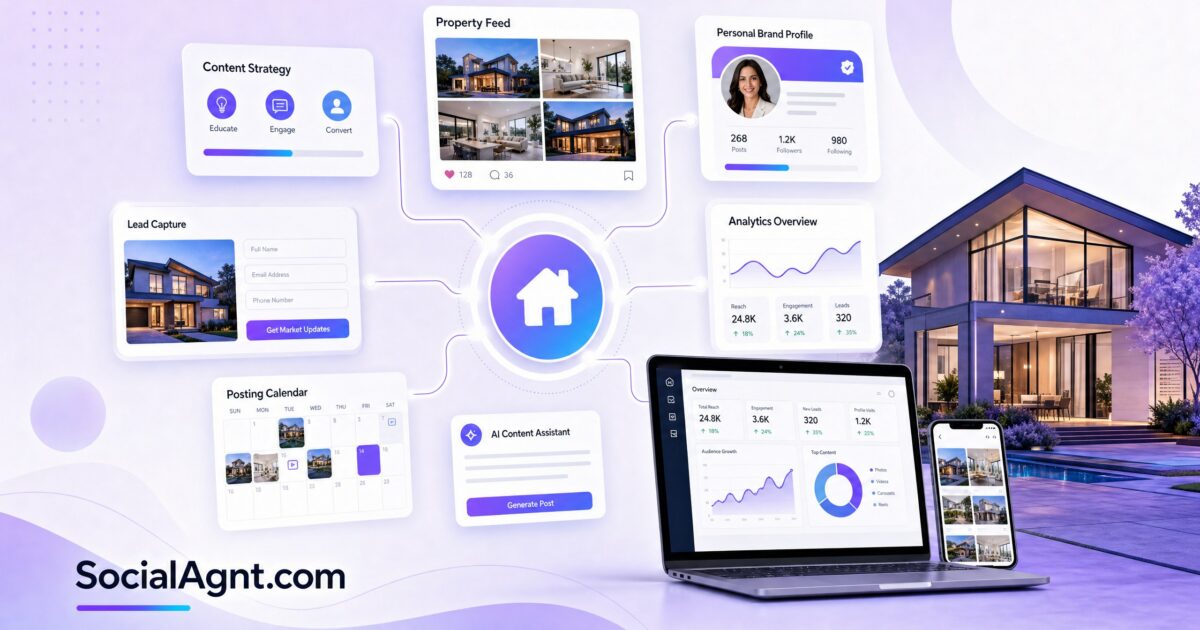
Key Takeaways: Social media for real estate agents isn’t optional in 2026 — it’s how your next clients find you, research you, and decide to trust you. This guide walks you through everything from choosing the right platforms and optimizing your profiles to posting consistently and turning engagement into actual closings, whether you’re brand new to social media or looking to level up your results.
Why Every Real Estate Agent Needs a Social Media Presence
Social media for real estate agents has evolved from a “nice to have” into the most effective way to build a personal brand, stay top of mind with your sphere, and attract new clients without relying on cold calls or purchased leads. The data is clear: according to the National Association of Realtors, social media is the number one technology tool for lead generation, used by 75% of active Realtors.
But here’s what the statistics don’t capture: the agent who shows up consistently in a buyer’s Instagram feed for three months has a massive trust advantage over the agent who sends an unsolicited mailer. Social media lets potential clients see your expertise, personality, and track record before they ever reach out. By the time they DM you or fill out a form on your website, they’ve already decided you’re someone worth talking to. That’s the real power of social media for real estate agents — it pre-sells your competence and character.
Whether you’re a brand-new agent building your first client base or a seasoned producer looking to modernize your marketing, this guide covers everything you need to know to make social media work for your real estate business.
Which Social Media Platforms Should Real Estate Agents Use?
The biggest mistake agents make is trying to be active on every platform simultaneously. That path leads to mediocre content, burnout, and eventually abandoning social media altogether. Instead, choose two platforms to master first, and add a third only when you’ve built a sustainable system.
How to Choose Your Primary Platforms
Your platform selection should be driven by three factors: where your target clients spend their time, which content formats you’re comfortable creating, and what your business goals are.
If you’re targeting first-time homebuyers (typically 28–36 years old), Instagram and TikTok are where they spend the most time. If your market skews older — move-up buyers, downsizers, or established professionals — Facebook remains dominant. For agents focused on luxury properties or investor clients, LinkedIn and YouTube deliver higher-quality leads. And for local visibility, Google Business Profile is essential regardless of your other platform choices.
Here’s a practical framework: choose one platform for reach (where you’ll attract new followers) and one for depth (where you’ll nurture relationships). Instagram Reels or TikTok are excellent for reach. Facebook Groups or LinkedIn are excellent for depth. This two-platform approach lets you cast a wide net while building genuine relationships.
Platform Breakdown for Real Estate Agents
| Platform | Best For | Ideal Audience | Post Frequency | Content Strength |
|---|---|---|---|---|
| Visual branding, discovery | 25–44 year olds, first-time and move-up buyers | 4–5x per week | Reels, carousels, Stories | |
| Community, advertising | 35–65 year olds, families, downsizers | 3–5x per week | Groups, Lives, Marketplace | |
| TikTok | Massive organic reach | 21–35 year olds, renters, first-time buyers | 3–5x per week | Short video, trends |
| B2B networking, referrals | Professionals, investors, referral partners | 3–4x per week | Long-form posts, articles | |
| YouTube | Evergreen search traffic | Active homebuyers researching areas | 1–2x per week | Neighborhood tours, guides |
| Google Business Profile | Local search visibility | “Real estate agent near me” searchers | 2–3x per week | Updates, photos, reviews |
Setting Up Your Real Estate Social Media Profiles for Success
Your profile is your first impression — and on social media, first impressions happen in under three seconds. A poorly optimized profile can undermine even the best content strategy. Here’s how to set up each element for maximum impact.
Profile Photo
Use a professional, high-quality headshot — not a selfie, not a full-body shot at a conference, and definitely not your brokerage’s team photo cropped to show just your face. Your photo should clearly show your face, use good lighting, and look like you (not a version of you from 10 years ago). Keep the same photo across all platforms for brand consistency.
Name and Bio
Your display name and bio are searchable — especially on Instagram and TikTok. Include your name plus a keyword that describes what you do: “Sarah Martinez | Austin Real Estate Agent” is far more discoverable than just “Sarah Martinez.” Your bio should communicate three things in seconds: what you do, who you serve, and how to contact you.
A strong real estate agent bio formula: [What you do] + [Who you help] + [Where you operate] + [Call to action]
Example: “Helping first-time buyers find their dream home in Denver. 🏡 DM me or tap the link below for a free home search.”
Link in Bio
Your bio link is prime real estate (pun intended). Don’t waste it on your brokerage’s generic homepage. Use a link-in-bio tool to create a landing page with multiple links — your current listings, home valuation tool, buyer guide download, and contact form. SocialAgnt includes a branded link-in-bio feature that keeps everything under your personal brand.
Cover Photo / Banner
On Facebook and LinkedIn, your cover photo is valuable branding space. Use it to reinforce your value proposition — a professional graphic showing your name, market area, and contact info, or a high-quality photo that represents your market (downtown skyline, suburban neighborhood, waterfront properties). Update it seasonally or when you have a new achievement to highlight.
Profile Highlights (Instagram)
Instagram Story Highlights function as a mini-website on your profile. Create organized highlights for: About Me, Testimonials, Buyer Tips, Seller Tips, Active Listings, Sold Properties, and your market area. New profile visitors will browse these to decide if they want to follow you.
What to Post: Content Strategy for Real Estate Agents
The question every agent asks is “What do I post?” The answer is simpler than you think: rotate through content pillars that balance value, personality, and proof.
The Content Pillar Framework
Organize your content around five pillars, and you’ll never run out of ideas:
Educational content positions you as the expert. Share homebuying tips, explain market trends, debunk myths, break down the closing process, or answer frequently asked questions. These posts get saved and shared, which signals to algorithms that your content is valuable.
Listing content showcases your active business. Just listed announcements, virtual tours, open house promotions, price adjustments, and just sold celebrations. Keep this to about 20% of your content — any more and you become a walking advertisement rather than a trusted resource.
Personal content builds human connection. Day-in-the-life videos, behind-the-scenes of showings, your morning coffee routine, hobbies, family moments (what you’re comfortable sharing), and your origin story of why you got into real estate. People hire people they like and relate to.
Hyperlocal content proves you’re the neighborhood expert. Spotlight local restaurants, review coffee shops, cover community events, interview local business owners, and share insider tips about different neighborhoods. This is some of the most powerful content a real estate agent can create because it directly serves both buyers and search algorithms.
Social proof content validates your track record. Client testimonials (as designed graphics or video), closing day photos, milestone celebrations, awards, and before-and-after staging reveals. This content is especially important for newer agents building credibility.
Content Ideas When You’re Stuck
Even with a pillar framework, creative blocks happen. Here are 15 evergreen ideas you can use any time:
- Myth-busting: “You DON’T need 20% down to buy a home”
- This vs. That: Compare two neighborhoods side by side
- Day in the life: Film yourself from the morning to the evening
- Client win story (with permission): Tell the journey from search to keys
- Market update: Monthly stats for your area with your analysis
- Home maintenance tip: Seasonal reminders homeowners need
- Local business spotlight: Feature a restaurant, gym, or shop you love
- FAQ answer: “What’s the first step in buying a home?”
- Just sold story: What made this transaction special or challenging?
- Poll or quiz: “Which kitchen style do you prefer?” using Stories
- Open house teaser: Build excitement before the weekend
- “If I were buying in [area] right now, here’s what I’d look for”
- Interest rate update: What today’s rates mean for buyers
- Moving tips: Packing hacks, timeline planning, utility checklists
- Personal milestone: Work anniversary, number of families helped, certification earned
How Often Should Real Estate Agents Post on Social Media?
Consistency matters far more than frequency. Posting once a day for a month and then disappearing for six weeks is worse than posting three times a week reliably for six months straight. Algorithms reward consistent accounts, and your audience will learn to expect and look for your content if you show up on a predictable schedule.
Recommended Posting Frequency by Platform
Instagram: 4–5 feed posts per week plus daily Stories. Reels should make up at least 50% of your feed posts — they get 2–3x the reach of static images.
Facebook: 3–5 posts per week. Mix of native video, photo carousels, and text posts. Avoid posting only links — Facebook’s algorithm deprioritizes posts that send users off-platform.
TikTok: 3–5 videos per week minimum. TikTok rewards frequency more than any other platform. More posts means more chances for the algorithm to test your content with new audiences.
LinkedIn: 3–4 posts per week. Quality over quantity here. Long-form text posts (1,000+ characters) consistently outperform short posts on LinkedIn’s algorithm.
YouTube: 1–2 videos per week if possible, but even 2–4 per month can build a substantial library over time. Consistency of schedule matters more than raw frequency.
The most important thing: choose a frequency you can actually sustain. It’s far better to post three times a week for a year than to post daily for two months and quit. If you’re starting from zero, begin with three posts per week and increase once you’ve built a production system.
Time Management: Social Media in 30 Minutes a Day
You became a real estate agent to sell houses, not to become a full-time content creator. The good news is that an effective social media presence doesn’t require hours of daily work — if you have the right system.
The Batch Creation Method
Instead of creating content every day, batch your content creation into one focused session per week (or even per month). Here’s the workflow:
Week start (60–90 minutes): Plan your content for the week. Write all captions. Create or source all visuals. Schedule everything using SocialAgnt or your preferred scheduling tool.
Daily (10–15 minutes): Check notifications. Respond to all comments and DMs. Engage with 5–10 posts from people in your community (past clients, local businesses, prospects). Post a quick Story if something interesting happens during your day.
That’s it. Ninety minutes of batch creation plus 10 minutes of daily engagement. Less time than most agents spend commuting to showings — and it compounds into a powerful marketing engine over weeks and months.
Automation Is Your Best Friend
The agents who maintain consistent social media presences aren’t doing it all manually. They’re using tools that handle the repetitive work so they can focus on the human elements that technology can’t replicate — genuine engagement, creative storytelling, and relationship building.
SocialAgnt automates the most time-consuming parts of social media for real estate agents: scheduling posts across all platforms from a single dashboard, generating AI-powered captions and hashtags, auto-posting just-listed and just-sold announcements from your MLS feed, posting to Google Business Profile, and compiling analytics reports. The platform was built specifically for real estate workflows — so it understands that your content needs to feature properties, market data, and local expertise in ways that generic social media tools don’t.
Growing Your Following as a Real Estate Agent
A large following means nothing if it’s full of bots and people who will never buy or sell a home in your market. Focus on attracting the right followers — people who live in or plan to move to your area, and who will eventually need a real estate agent.
Organic Growth Strategies
Use hashtags strategically. Mix broad real estate hashtags (#realestate, #homebuying) with hyperlocal hashtags (#AustinHomes, #DenverRealEstate, #BrooklynLiving). Local hashtags have less competition and attract the exact audience you want. Aim for 10–15 hashtags on Instagram, 3–5 on TikTok, and 3–4 on LinkedIn.
Leverage SEO on social platforms. Instagram, TikTok, and YouTube all function as search engines now. Include relevant keywords in your captions, video descriptions, and spoken content (TikTok and YouTube use speech-to-text for search indexing). Think about what someone would type when searching for an agent or information about your market.
Collaborate with local accounts. Partner with local businesses, photographers, interior designers, or mortgage lenders for joint content. You’ll each get exposed to the other’s audience — and these collaborations feel natural and valuable to viewers.
Engage before you expect engagement. The most effective growth strategy is also the simplest: be genuinely active in your community. Comment meaningfully on posts from local businesses, prospective clients, and community pages. Not “Great post! 🔥” but actual thoughtful comments that add to the conversation. This puts your profile in front of new people organically.
Cross-promote your content. Share your Instagram Reels on Facebook, your TikTok clips on YouTube Shorts, and your best posts as LinkedIn content. Repurposing lets you reach different audiences with the same core content — and SocialAgnt’s multi-platform scheduling makes this effortless.
What About Buying Followers?
Don’t. Purchased followers are fake accounts that will never buy a home. They destroy your engagement rate (making your content perform worse for real followers), they’re detectable by savvy clients and referral partners, and platforms actively purge fake accounts. There are zero scenarios where buying followers is worth it.
Turning Followers into Leads and Clients
Followers are great. Clients are better. Here’s how to bridge the gap between social media engagement and actual real estate business.
The Conversion Path
Most social media followers won’t become clients immediately — and that’s by design. The typical path is: discovery → follow → consume content over weeks/months → engagement (comments/DMs) → lead (inquiry about buying/selling) → client. Your content strategy should serve each stage of this journey.
At the discovery and follow stage, focus on reach-oriented content: Reels, trending topics, educational posts that get shared. At the content consumption stage, keep showing up with valuable content that builds trust and demonstrates expertise. At the engagement stage, encourage interaction through questions, polls, and calls to action. At the lead stage, make it easy for people to take the next step — DM you, click your link in bio, or attend an open house.
Calls to Action That Generate Leads
Every post should include a purpose-driven CTA. Match your CTA to the content type:
Educational posts: “Save this for when you’re ready to buy” or “Share this with someone starting their home search.”
Listing posts: “DM me for a private showing” or “Know someone looking in [neighborhood]? Tag them below.”
Market update posts: “Want a custom market report for your neighborhood? Drop a 🏠 in the comments.”
Personal posts: “What’s your favorite thing about living in [city]? Tell me in the comments.”
The key is making CTAs feel natural and conversational, not salesy. You’re inviting a conversation, not delivering a pitch.
DM Strategy
Direct messages are where followers become leads. When someone comments on your post or responds to a Story, follow up in the DMs with a genuine, non-pushy message. If someone comments on a listing post, send them additional details privately. If someone engages with a market update, ask if they’re thinking about buying or selling. These conversations happen naturally when you treat DMs as relationship-building, not sales calls.
Social Media Mistakes Real Estate Agents Make
Avoid these common pitfalls that hold agents back from seeing real results:
All listings, no personality. If your feed looks like an MLS search results page, you’re blending in with every other agent. Show who you are beyond the transactions.
Posting and ghosting. Publishing content without engaging with your audience is like hosting an open house and hiding in the back bedroom. Social media is social — show up for the conversations.
Perfectionism paralysis. Waiting until you have the perfect lighting, the perfect caption, or the perfect outfit keeps agents from ever starting. Done is better than perfect, especially with video. Your audience cares about authenticity, not production value.
Inconsistency. The most damaging mistake. Posting daily for a week, then nothing for a month, then a burst of five posts, then silence. Pick a sustainable pace and stick to it. Three posts per week, every week, for a year will transform your business.
Ignoring analytics. If you’re not checking what’s working and what isn’t, you’re flying blind. Spend 15 minutes each month reviewing your top-performing content and adjusting your strategy accordingly.
Copying other agents. Draw inspiration from successful agents, but don’t copy their content. Your unique perspective, market knowledge, and personality are your competitive advantages. Lean into what makes you different.
Getting Started: Your First 30 Days
If you’re starting from scratch or resetting your social media strategy, here’s a practical 30-day plan to build momentum.
Days 1–3: Choose two platforms. Optimize your profiles following the guidelines above. Follow 50 local accounts (businesses, community pages, potential clients).
Days 4–7: Plan your first two weeks of content. Write captions, create visuals, and schedule everything. Post your “introduction” or “reintroduction” post telling your audience who you are and what to expect from your page.
Days 8–21: Publish your scheduled content. Spend 10–15 minutes daily engaging with your community. Post Stories or spontaneous content from your daily real estate life. Pay attention to which posts get the most engagement.
Days 22–28: Review your first few weeks of analytics. What content types performed best? What topics resonated? Plan your next month based on these insights.
Days 29–30: Evaluate your workflow. Is your posting schedule sustainable? Do you need to adjust your batch creation process? Set up SocialAgnt if you haven’t already — the time you save on scheduling and content generation will be noticeable by now.
Social media for real estate agents is a long game. The agents who commit to showing up consistently, providing genuine value, and building real relationships will see compounding returns — more followers, more engagement, more leads, and ultimately more closings. Start where you are, use the tools available to you, and don’t stop.
SocialAgnt is the only social media platform designed from the ground up for real estate professionals. MLS integration, AI-powered content, multi-platform scheduling, and real estate-specific templates — all in one place. Start free today.
Ready to save 5+ hours per week on social media?
SocialAgnt helps real estate agents schedule posts, create AI content, and grow their brand across 7 platforms. Try it free for 14 days.
