
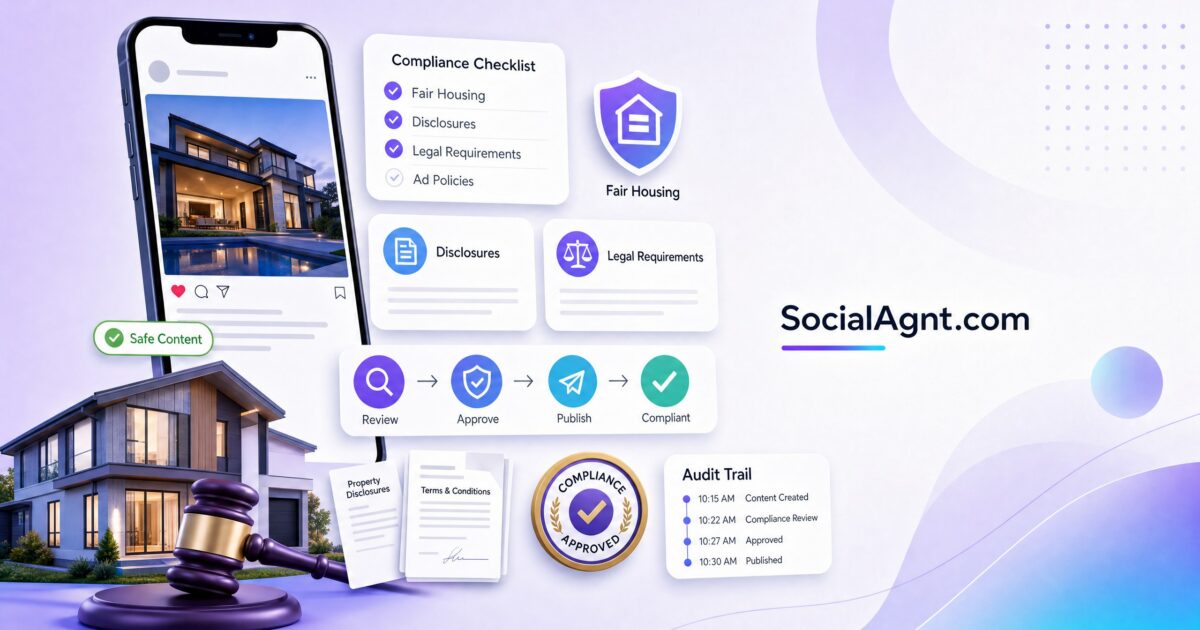
Key Takeaways: Social media compliance for real estate isn’t just about avoiding fines — it’s about protecting your license, your brokerage’s reputation, and your clients’ trust. The intersection of social media marketing and real estate regulation creates a compliance landscape that trips up agents and brokerages daily: Fair Housing Act violations in ad targeting and language, state advertising disclosure requirements, brokerage supervision obligations, intellectual property issues, data privacy regulations, and MLS rules about how listings can be displayed. This guide breaks down every compliance area that matters for real estate social media, with specific examples of what’s allowed, what’s not, and how to build a compliance framework that lets you market aggressively without crossing legal lines.
Why Social Media Compliance Matters in Real Estate
Real estate is one of the most heavily regulated industries in America — and social media doesn’t get a free pass from those regulations just because it feels casual and personal. Every Instagram post, Facebook ad, TikTok video, and LinkedIn article created by a licensed real estate agent is considered advertising under most state real estate commissions’ rules. That means the same regulations that govern your yard signs, print ads, and brochures apply to your social media content.
The consequences of non-compliance aren’t theoretical. Real estate agents have faced license suspension for failing to include required brokerage disclosures on social media. Agents and brokerages have been fined by the Department of Housing and Urban Development (HUD) for discriminatory advertising on Facebook. Teams have been sanctioned by their MLS for improper display of listing data on social platforms. And agents have faced lawsuits for using copyrighted images without permission on their social media accounts.
The good news: compliance isn’t complicated once you understand the rules. With a clear framework and consistent practices, you can market effectively on social media while staying well within legal and regulatory boundaries.
Fair Housing Act Compliance on Social Media
The Fair Housing Act prohibits discrimination in housing-related advertising based on race, color, religion, sex (including gender identity and sexual orientation), national origin, familial status, and disability. On social media, this affects both the content of your posts and the targeting of your ads.
Language and Content Compliance
The words and images you use in social media content must not express a preference for or against any protected class. This applies to listing descriptions, neighborhood descriptions, community features, and general marketing content.
Prohibited language examples: “Perfect for young professionals” (discriminates by age/familial status), “ideal family neighborhood” (implies a preference for families over non-families), “walking distance to [specific place of worship]” (implies religious preference), “exclusive community” (can imply discrimination based on race or national origin), “great bachelor pad” (discriminates by sex and familial status), “no children” or “adults only” (violates familial status protection, unless the property legally qualifies as senior housing).
Compliant alternatives: Describe the property’s physical features and the community’s amenities without describing the ideal resident. “Spacious three-bedroom home near parks and top-rated schools” describes features. “Perfect for a growing family” describes a preferred occupant. The difference is critical.
Inclusive imagery matters too. Your social media content — listing photos, graphics, website images, and video content — should reflect diverse communities. Using only images that depict one racial or ethnic group can be considered a violation of Fair Housing requirements.
Advertising Targeting Compliance
Meta (Facebook/Instagram) requires housing advertisers to use the Special Ad Category, which restricts targeting to prevent discrimination. Under this category, you cannot target by age (no minimum or maximum age targeting), gender, zip code (minimum 15-mile radius targeting), or certain detailed targeting categories related to protected classes.
These restrictions exist specifically because of enforcement actions against real estate advertisers who used Facebook’s targeting tools to exclude protected groups from seeing housing ads. Always select the housing Special Ad Category when running any real estate ad on Facebook or Instagram. Failure to do so can result in both platform policy violations and potential HUD enforcement action.
State and Local Fair Housing Laws
Many states and municipalities have fair housing laws that extend protections beyond the federal Fair Housing Act. Some jurisdictions add source of income (housing voucher recipients), immigration status, sexual orientation, gender identity, or marital status to their list of protected classes. Know the protected classes in your specific jurisdiction and ensure your social media content doesn’t reference or imply preferences regarding any of them.
State Advertising Disclosure Requirements
Every state real estate commission has advertising rules that govern how licensed agents must identify themselves in marketing materials — and social media posts are considered marketing materials. The most common requirement is that your brokerage name must appear in all advertising.
Common State Requirements
Brokerage identification: Most states require that your brokerage’s legal name (or registered DBA) appears in all advertising. Some states specify that the brokerage name must be at least as prominent as the agent’s name. On social media, this typically means including your brokerage name in your bio, your profile, and any listing advertisements. Some states accept having it in your bio rather than in every individual post — but this varies significantly by state.
License number display: Several states require your license number in all advertising. Check your state’s specific requirements — if your state mandates this, include it in your social media bios and any listing-related posts.
Team name requirements: If you operate under a team name, most states require that the brokerage name also appears and that the team name doesn’t mislead consumers into thinking your team is an independent brokerage.
“Advertisement” or “Ad” disclaimers: Some states require that paid promotions or sponsored content be clearly identified as advertising. This overlaps with FTC requirements for influencer disclosures (discussed below).
How to Implement Disclosures on Social Media
Include your brokerage name and (if required) license number in your social media bios on every platform. This creates a persistent disclosure that covers all your content. For individual listing posts, many compliance officers recommend including the brokerage name in the post itself (in the caption or as a watermark on images). For Instagram Stories and Reels, include a text overlay with your brokerage identification.
The safest approach: when in doubt, include more disclosure rather than less. Overidentifying yourself never causes regulatory problems. Underidentifying yourself can.
SocialAgnt helps real estate agents maintain compliant social media across every platform. Branded templates include brokerage identification, and the platform is designed with real estate advertising regulations in mind — so you can post with confidence. Start free today.
MLS Compliance and Listing Content
Your MLS has specific rules about how listing data can be displayed on social media. Violating these rules can result in fines from your MLS board and jeopardize your MLS access.
Common MLS Rules for Social Media
Permission to advertise: You can generally only advertise listings that you hold, listings you have explicit written permission to advertise from the listing agent, or listings displayed through an IDX (Internet Data Exchange) feed that complies with MLS IDX rules.
Photo usage: Listing photos are typically owned by the listing agent or the photographer they hired. Using another agent’s listing photos on your social media without permission is both an MLS violation and a potential copyright infringement. If you’re promoting another agent’s listing (with permission), clarify photo usage rights as part of that permission.
Status accuracy: Promoting a listing that’s already under contract, sold, or withdrawn as if it’s actively available is a common MLS violation on social media. If a listing’s status changes, update or remove your social media content about that listing promptly.
Required listing information: Many MLS boards require that listing posts include specific information: the listing brokerage’s name, the listing agent’s name, and the MLS number. Check your MLS’s specific social media advertising rules for exact requirements.
Other Agents’ Content and Cooperation
A growing issue in real estate social media: agents creating content about other agents’ listings — walking through open houses and posting video content, using listing photos in market update content, or discussing specific listings in their market analysis. While promoting another agent’s listing to your audience can be a good cooperative practice, ensure you have appropriate permissions and give proper attribution.
Intellectual Property Compliance
Copyright Issues
Copyright violations on real estate social media are more common than most agents realize. Using someone else’s photos, videos, graphics, or written content without permission or proper licensing is copyright infringement — regardless of whether you credit the source.
Common copyright pitfalls for agents: using listing photos from other agents’ listings without permission, downloading and using images from Google Image Search (most are copyrighted), using music in TikTok or Reel content that isn’t licensed for commercial use, and reposting other accounts’ content without permission (even with credit, reposting copyrighted content can be infringement).
Safe practices: Use only photos you’ve taken, hired a photographer to take (with a usage license), or obtained through a licensed stock photo service. Use music from royalty-free libraries or platform-provided commercial music libraries (TikTok’s commercial music library, for example). When reposting, use the platform’s native sharing features (like Instagram’s Share to Stories) rather than downloading and re-uploading content.
Trademark Considerations
Using brokerage logos, MLS logos, or trademarked brand names requires compliance with those organizations’ trademark usage guidelines. Your brokerage likely has specific rules about how their logo and brand name can be used in your personal marketing. Check with your brokerage’s marketing or compliance department before incorporating their branding into your social media content.
FTC Disclosure Requirements
The Federal Trade Commission requires that endorsements and testimonials in advertising be truthful and that material connections between advertisers and endorsers be disclosed. For real estate agents, this means:
Client testimonials: Testimonials you share on social media must reflect the honest opinions of the people giving them. You cannot fabricate, materially alter, or take out of context a client testimonial. If you incentivized a testimonial (a gift card for leaving a review, for example), that incentive must be disclosed.
Sponsored content and partnerships: If a vendor (mortgage lender, home inspector, title company) pays you or provides free products/services in exchange for social media promotion, you must disclose that relationship. Use clear language: “Paid partnership” or “Sponsored” rather than vague hashtags like #partner.
Results claims: If your social media content makes claims about the results you’ve achieved (“I sell homes 20% faster than the market average”), those claims must be truthful and substantiated by data.
Data Privacy and Lead Management
Collecting lead information through social media — lead forms, DM conversations, email opt-ins — creates data privacy obligations that vary by jurisdiction.
CAN-SPAM Act: If you add social media leads to your email marketing list, you must comply with CAN-SPAM requirements: include an unsubscribe mechanism in every email, honor unsubscribe requests within 10 business days, identify the message as an advertisement if it is one, and include your physical mailing address.
TCPA (Telephone Consumer Protection Act): If you text or call leads obtained through social media, you need appropriate consent. The rules around consent for marketing calls and texts are complex — consult with your brokerage’s compliance team or a legal advisor to ensure your lead follow-up practices comply.
State privacy laws: States like California (CCPA/CPRA), Virginia (VCDPA), and Colorado (CPA) have consumer privacy laws that may affect how you collect, store, and use lead data from social media. If you operate in a state with consumer privacy legislation, understand your obligations regarding data collection disclosures and consumer rights.
Brokerage Social Media Policies and Supervision
Brokerages have a legal obligation to supervise their agents’ advertising, including social media. If you’re a broker or team leader, establishing clear social media policies protects your brokerage from liability. If you’re an agent, understanding and following your brokerage’s policy keeps you in good standing.
What a Brokerage Social Media Policy Should Cover
Required disclosures and identification (brokerage name, license numbers), Fair Housing guidelines with specific language examples, approval process for listing advertisements on social media, rules for commenting on market conditions and making predictions, copyright and intellectual property guidelines, crisis communication procedures (how to handle a negative review, viral complaint, or public relations issue), personal content boundaries (what agents can and cannot post on the same accounts they use for business), data privacy and lead management requirements, and consequences for policy violations.
Supervision Best Practices for Brokers
Conduct quarterly audits of agents’ social media accounts for compliance issues. Provide annual training on social media advertising rules, with updates when regulations change. Create a reference guide with pre-approved disclaimers, disclosure language, and advertising templates. Establish a review process for paid social media advertising before campaigns go live. Use a social media management platform that includes compliance features — standardized templates with required disclosures, brokerage branding, and approval workflows.
Platform-Specific Compliance Considerations
Instagram and Facebook (Meta)
Use the housing Special Ad Category for all paid real estate advertising. Include brokerage identification in your bio and listing-related posts. Ensure fair housing compliance in all ad targeting and content. Review Meta’s advertising policies regularly, as they update frequently.
TikTok
TikTok’s advertising policies require housing ads to comply with fair housing laws, though their enforcement framework is less developed than Meta’s. Include brokerage disclosures in your bio and ensure listing content includes required identifiers. Be aware that TikTok’s algorithm may distribute your content beyond your intended geographic audience — ensure all content is compliant regardless of who sees it.
YouTube
YouTube video descriptions should include your brokerage identification, license number (if required by your state), and appropriate disclosures for any sponsored content. YouTube ads for real estate should comply with Google’s housing ad policies, which mirror Meta’s Special Ad Category restrictions.
LinkedIn has housing ad restrictions similar to Meta’s. Include professional identification (brokerage, license) in your profile. Ensure any content that constitutes advertising includes appropriate disclosures.
Building a Compliance Checklist for Every Post
Before publishing any social media content, run it through this quick compliance checklist:
Fair Housing: Does this content describe features rather than preferred occupants? Does the language avoid reference to protected classes? Are the images inclusive?
Disclosure: Does this post include the required brokerage identification? If your state requires it, is your license number included? If this is sponsored content, is the relationship disclosed?
MLS: If this features a listing, do you have permission to advertise it? Is the listing currently active and accurately represented? Does it include required listing attribution?
Copyright: Do you own or have a license for every image, video clip, and piece of music used? Is any reposted content shared through proper channels?
Accuracy: Are all claims truthful and substantiated? Are prices, statistics, and property details accurate?
This checklist takes thirty seconds per post. Build it into your content creation workflow and it becomes automatic — protecting you, your brokerage, and your clients without slowing down your marketing.
Your Compliance Action Plan
Day 1 — Audit your current social media: Review your profiles on every platform. Is your brokerage identified in every bio? Are any posts missing required disclosures? Are there any listing posts for properties that are no longer active? Identify and fix any issues immediately.
Week 1 — Review your state’s rules: Research your state real estate commission’s specific advertising requirements for social media. Note any disclosures, disclaimers, or identifiers required in your jurisdiction. Create a reference document with the exact language you need to include.
Week 2 — Build your compliance framework: Create your pre-publish checklist. Develop template captions that include required disclosures. Set up branded templates that incorporate your brokerage identification. If you’re a broker, draft or update your brokerage’s social media policy.
Ongoing — Quarterly reviews: Conduct a quarterly audit of your social media for compliance issues. Stay informed about regulatory changes that affect social media advertising. Update your compliance checklist as rules evolve. When in doubt about a specific post or campaign, consult your brokerage’s compliance department or a real estate attorney.
Compliance isn’t a barrier to effective social media marketing — it’s a framework that protects your business while you market confidently. The agents and brokerages who integrate compliance into their workflow from the start never have to worry about it. It’s the ones who ignore it who end up scrambling when a complaint, audit, or enforcement action arrives.
SocialAgnt’s real estate-specific templates include brokerage identification, and the platform is designed to help agents maintain compliant content across Instagram, Facebook, TikTok, LinkedIn, YouTube, and Google Business Profile. Market confidently. Post compliantly. Start your free account today.
Ready to save 5+ hours per week on social media?
SocialAgnt helps real estate agents schedule posts, create AI content, and grow their brand across 7 platforms. Try it free for 14 days.
