
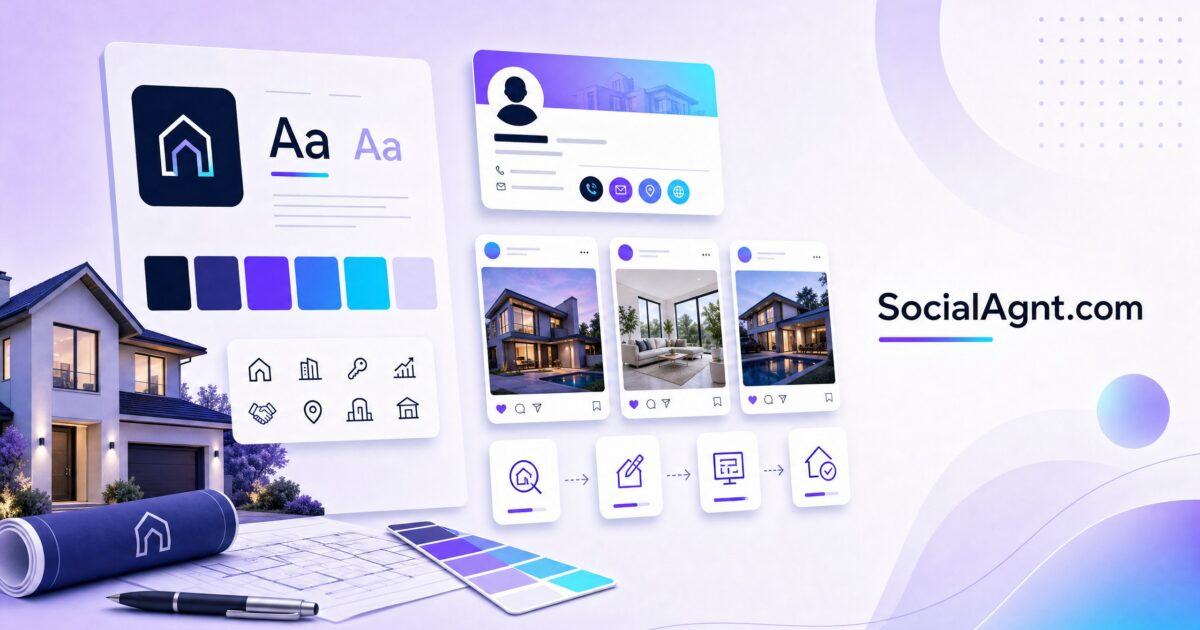
Key Takeaways: Your real estate brand is the single most important long-term asset in your business — more valuable than any individual listing, any single transaction, or any short-term marketing campaign. A strong brand creates recognition, builds trust before you ever meet a prospect, and generates referrals from people who associate your name with quality, expertise, and reliability. Yet most real estate agents skip brand building entirely, defaulting to their brokerage’s branding and competing on the same generic promises as every other agent in their market. The agents who invest in creating a distinctive, authentic brand identity stand out in a crowded field — and the data supports the investment: color schemes alone increase brand recognition by 80%, agents with strong social media brands earn four times more than those without, and one brokerage that underwent a strategic brand refresh saw 371% more leads within nine months. This guide walks you through creating a complete real estate brand identity from scratch — from defining your positioning and target audience to building your visual identity, establishing your brand voice, and implementing your brand consistently across every touchpoint where clients encounter you.
What Is a Real Estate Brand (and What It Isn’t)
Beyond a Logo and Colors
Most agents think of branding as a logo, a color palette, and maybe a tagline. Those elements matter — but they’re the surface expression of something deeper. Your brand is the complete perception that people have of you and your business: what you stand for, who you serve, how you make people feel, and what experience they can expect when working with you. It’s the reason someone chooses you over the fifteen other agents who serve the same market. A logo is a symbol of your brand; it’s not the brand itself.
The Feeling You Create
At its core, a brand is a feeling. When someone sees your name, your face, or your content, what emotion or thought arises? Trust? Expertise? Warmth? Luxury? Accessibility? That automatic association is your brand — and it’s shaped by every interaction a person has with your business: your social media content, your website, your business cards, your email signature, how you answer the phone, how you conduct showings, and how you communicate during transactions. Brand building isn’t a one-time design project; it’s the ongoing, intentional management of how people perceive you.
Why Branding Matters More Than Ever
In 2026, 96% of home buyers begin their search online, and 89% use mobile devices during their search. Before a prospect ever meets you in person, they’ve already formed an impression of you based on your online presence — your website, your social media profiles, your Google reviews, your content. That digital first impression is your brand at work. A cohesive, professional, distinctive brand makes that first impression positive and memorable. A generic, inconsistent, or nonexistent brand makes you invisible among the thousands of agents competing for the same attention.
Step 1: Define Your Brand Positioning
Identify What Makes You Different
Brand positioning starts with answering a fundamental question: why should someone choose you over every other agent in your market? The answer can’t be “I work hard” or “I care about my clients” — every agent says those things. Your positioning must identify a genuine differentiator: a specialization, a unique approach, a specific audience you serve exceptionally well, a geographic expertise that no one else matches, or a combination of qualities that creates a distinct value proposition.
Possible positioning angles include: geographic specialization (“The [neighborhood] expert — I’ve lived here for 20 years and sold 200 homes in this community”), audience specialization (“I help first-time buyers navigate [city]’s competitive market with confidence”), service model differentiation (“Full-service marketing with professional staging, photography, and video for every listing”), lifestyle alignment (“Helping active families find homes near [city]’s best outdoor spaces”), or experience-based authority (“15 years of local market data driving every pricing and negotiation decision”).
Define Your Target Audience
A brand that tries to appeal to everyone appeals to no one. Define your ideal client with specificity: What life stage are they in? What are their values and priorities? What concerns and questions do they have? Where do they spend time online? What kind of communication do they prefer? The more specifically you define your target audience, the more precisely you can tailor your brand messaging, visual style, and content to resonate with them. An agent branding toward luxury downsizers creates a fundamentally different brand than one targeting millennial first-time buyers — and both are more effective than a brand targeting “anyone who wants to buy or sell.”
Craft Your Unique Value Proposition
Your unique value proposition (UVP) is a one-to-two-sentence statement that communicates who you serve, what you provide, and why you’re the best choice. A strong UVP is specific, benefit-focused, and differentiated: “I help growing families in [city] find homes they’ll live in for decades — combining neighborhood expertise with a data-driven approach to finding the perfect fit.” This UVP identifies the audience (growing families), the geography (your city), and the differentiator (neighborhood expertise plus data-driven approach). Weak UVPs are vague and interchangeable: “I help people buy and sell homes in the greater [city] area.” Your UVP should make you immediately distinguishable from competitors.
SocialAgnt’s AI-powered content engine creates posts that reinforce your brand identity across Instagram, Facebook, TikTok, LinkedIn, YouTube, and Google Business Profile — maintaining brand consistency across every platform from one dashboard. Start your free account today.
Step 2: Build Your Visual Identity
Logo Design
Your logo is the visual anchor of your brand — appearing on business cards, yard signs, website headers, social media profiles, email signatures, and marketing materials. A strong real estate logo is simple (recognizable at small sizes), professional (communicates competence and trust), distinctive (doesn’t look like every other agent’s logo), and versatile (works in color, black and white, and at various sizes). Work with a professional designer or a design platform to create a logo that reflects your positioning — a luxury brand requires a different aesthetic than a community-focused family brand.
Color Palette
Choose three to five brand colors that you’ll use consistently across all materials. Color increases brand recognition by 80%, making your palette one of your most strategically important brand decisions. Color psychology matters in real estate: blue communicates trust and stability, green suggests growth and prosperity, black and gold signal luxury, warm neutrals feel approachable and inviting, and bold colors like red or orange convey energy and urgency. Your palette should align with your positioning — the colors a luxury agent uses differ from those of a first-time-buyer specialist.
Typography
Select one to two fonts that reflect your brand personality: a primary font for headers and feature text, and a secondary font for body text. Serif fonts (like Playfair Display or Merriweather) communicate tradition, elegance, and authority. Sans-serif fonts (like Montserrat or Lato) communicate modernity, clarity, and accessibility. Your font choices appear across your website, social media graphics, presentations, and marketing materials — consistency builds the visual recognition that strengthens your brand over time.
Photography Style
Define a consistent photography style for your brand: bright and airy, moody and dramatic, warm and inviting, or clean and modern. Apply this style to your headshots, property photography, lifestyle imagery, and social media content. Consistent photography creates the visual cohesion that makes your brand immediately recognizable across platforms. In an industry where 76% of home searches begin on smartphones, your visual quality is often the first quality signal prospects evaluate.
Step 3: Establish Your Brand Voice
What Is Brand Voice?
Your brand voice is how you sound in writing — the tone, vocabulary, and personality that comes through in your captions, website copy, emails, and conversations. A consistent brand voice makes every piece of communication feel like it comes from the same person, reinforcing familiarity and trust. Define your voice along key dimensions: are you formal or casual? Authoritative or approachable? Data-driven or story-driven? Educational or entertaining? The answers should align with your positioning and resonate with your target audience.
Voice Guidelines
Document your brand voice with specific guidelines and examples. If your voice is “warm, knowledgeable, and straightforward,” show what that sounds like: “On brand: ‘Here’s what the latest interest rate change actually means for your buying power — let me break it down.’ Off brand: ‘Pursuant to recent Federal Reserve policy adjustments, mortgage rate fluctuations may impact your purchasing capacity.'” Clear examples help you maintain consistency and enable anyone who writes on your behalf (assistants, team members, AI tools) to match your voice accurately.
Step 4: Build Your Online Presence
Website
Your website is your brand’s home base — the one digital property you fully control. Ensure your website reflects your brand identity through consistent use of your colors, fonts, photography style, and voice. Include your UVP prominently on the homepage, showcase testimonials and social proof, provide valuable resources (market reports, guides, neighborhood information), and make it easy for visitors to contact you or search properties. A mobile-optimized, fast-loading website is non-negotiable — 76% of home searchers start on smartphones.
Social Media Profiles
Apply your brand identity consistently across every social media platform: same professional headshot, same brand colors in graphics, same voice in captions, and same value proposition in bios. Each platform reaches a slightly different audience, but your brand should feel cohesive regardless of where someone encounters you. An Instagram visitor, a Facebook follower, and a LinkedIn connection should all have the same impression of who you are and what you offer.
Google Business Profile
Your Google Business Profile is often the first thing people see when they search your name or “real estate agent [city].” Optimize it with your brand-consistent headshot, accurate contact information, your service area, and actively managed reviews. Your Google presence extends your brand into the search environment where many prospects begin their agent evaluation.
Email Signature and Marketing Materials
Every touchpoint is a brand touchpoint. Your email signature should include your logo, brand colors, and key contact information in a professional design. Your business cards, listing presentations, buyer guides, and market reports should all use your brand templates. Consistency across these touchpoints creates the cumulative recognition that builds brand equity over hundreds of interactions.
Step 5: Create Brand-Building Content
Content as Brand Expression
Every piece of content you create — every social media post, every blog article, every video, every email — either reinforces or dilutes your brand. Content that aligns with your positioning (demonstrating your specific expertise, serving your target audience, reflecting your voice) strengthens your brand with every publication. Content that’s random, off-brand, or generic weakens the distinctive impression you’re trying to create. Plan your content strategy with brand consistency as a primary consideration, not an afterthought.
Storytelling and Authenticity
The most memorable real estate brands are built on authentic storytelling — sharing real experiences, genuine expertise, and honest perspectives rather than polished marketing speak. Share your origin story (why you chose real estate), your client stories (the challenges you’ve helped people overcome), your community connections (what you love about where you work), and your professional perspective (what you believe about the market and the industry). Authenticity resonates because people can sense it — and in an industry built on trust, authenticity is your most valuable brand asset.
Step 6: Implement and Maintain Consistency
The Brand Guide
Document everything in a one-page brand guide: your logo and usage rules, your color palette with hex codes, your fonts, your photography style, your voice guidelines, and your UVP. This guide ensures consistency whether you’re creating content yourself, working with a designer, delegating to an assistant, or using AI tools. Review and update your brand guide annually as your business evolves.
Consistency Compounds
Brand building is a compounding investment. The first month of consistent branding doesn’t produce dramatic results. Neither does the third month. But by month six, people start recognizing your content before they see your name. By month twelve, prospects tell you “I feel like I already know you” when they reach out for the first time. By year two, referrals come from people who recommend you based entirely on your brand reputation — people you’ve never personally met. This compounding effect only works if your brand is consistent over time. Every inconsistency — a post that doesn’t match your visual style, a message that contradicts your voice, a touchpoint that looks unprofessional — dilutes the compound effect.
Your real estate brand is the most valuable business asset you’ll ever build — outlasting any individual transaction, surviving market cycles, and appreciating in value with every consistent touchpoint. Start with positioning, build your visual and verbal identity, implement across every platform, and commit to the consistency that compounds into recognition, trust, and referrals. Let SocialAgnt maintain your brand consistency with AI-powered content that reflects your voice across Instagram, Facebook, TikTok, LinkedIn, YouTube, and Google Business Profile — so your brand builds equity with every post.
SocialAgnt’s AI adapts to your brand voice and creates consistent, professional content across Instagram, Facebook, TikTok, LinkedIn, YouTube, and Google Business Profile. Build your brand with every post. Start free today.
Ready to save 5+ hours per week on social media?
SocialAgnt helps real estate agents schedule posts, create AI content, and grow their brand across 7 platforms. Try it free for 14 days.
