
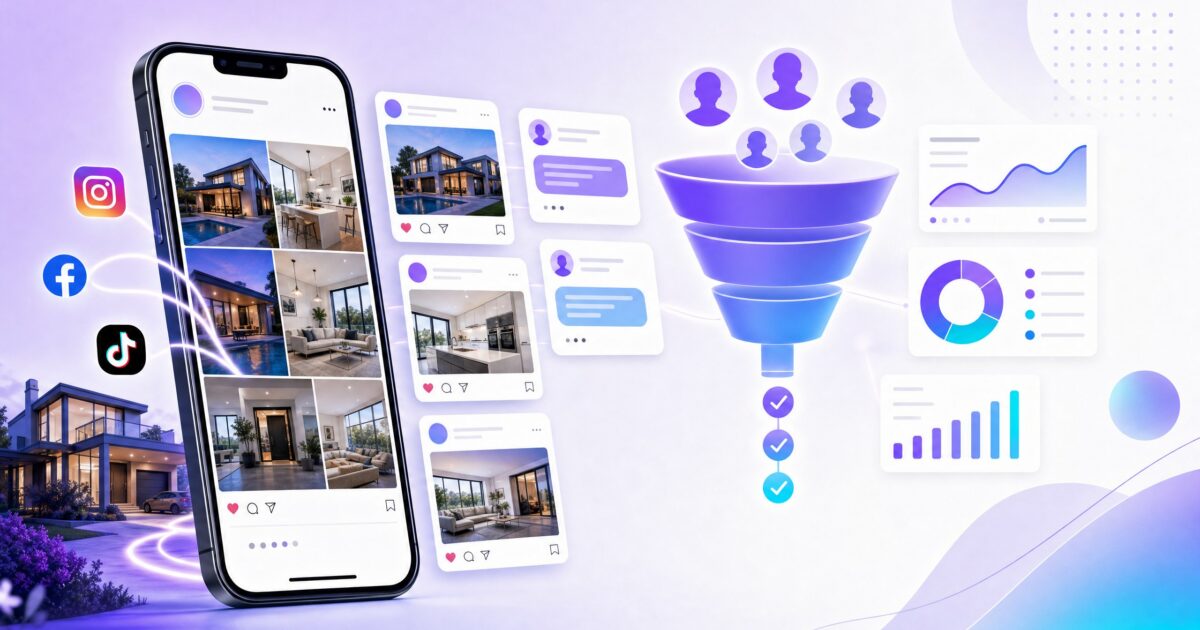
Key Takeaways: Social media is now the number-one lead-generating technology for real estate agents, with 38 percent of agents’ new clients coming directly from social platforms and 46 percent naming social media as their single best source of high-quality leads. Agents who use social media strategically earn four times more than those who do not, and 52 percent of social media leads are rated higher quality than MLS leads. The agents who consistently turn followers into clients share common practices: they treat every direct message as a potential lead and respond within minutes, they build lead magnets that capture contact information in exchange for genuine value, they maintain a content mix where listings represent only 20 percent of their posts, they integrate their CRM with social platforms so no lead falls through the cracks, and they implement retargeting campaigns that boost conversion rates by up to 400 percent. This guide covers every element of converting social media presence into actual real estate clients — from the content types that generate the most inquiries and the DM strategies that start real conversations to the lead funnels, nurturing sequences, paid advertising tactics, and retargeting systems that transform casual followers into closed transactions.
The Business Case for Social Media Client Acquisition
Real estate agents who dismiss social media as a vanity exercise are leaving significant revenue on the table. The numbers tell a clear story: 60 percent of agents report that social media delivers their highest return on investment of any marketing channel, 82 percent of real estate businesses now use social media for marketing, and agents who leverage social media strategically earn four times more than agents who do not.
These results do not come from casually posting listings or sharing motivational quotes. They come from treating social media as a client acquisition system — a structured process that attracts potential clients, captures their information, nurtures the relationship, and converts interest into transactions. The difference between agents who get clients from social media and agents who get nothing from social media is almost always the presence or absence of that system.
Social media’s advantage over traditional lead generation is the quality of the relationship it creates before the first conversation happens. When a buyer contacts you after following your Instagram for three months, consuming your market updates, watching your neighborhood tours, and reading your homebuying tips, they have already developed trust in your expertise. That lead converts at a fundamentally different rate than a cold call or a purchased lead list. This is why 52 percent of agents report that social media leads are higher quality than MLS leads — these are warm connections, not cold contacts.
The strategies in this guide work across every major platform and market type. Whether you are targeting first-time buyers on TikTok, luxury clients on Instagram, referral partners on LinkedIn, or community connections on Facebook, the principles of attracting, capturing, nurturing, and converting clients from social media remain consistent.
Content That Converts: What to Post to Attract Potential Clients
Not all content generates leads equally. Understanding which content types attract potential clients — as opposed to content that merely generates likes — is the foundation of any social media client acquisition strategy.
Short-Form Video: The Highest-Converting Content Format
Short-form video now accounts for 78 percent of social media engagement in real estate, and properties featuring video receive 403 percent more inquiries than static listings. Instagram Reels achieve a 3.7 percent engagement rate — the highest of any content format on the platform — and generate 3.2 times more saves and shares than carousel posts. These are not vanity metrics; saves and shares indicate that people found your content valuable enough to bookmark for future reference, which strongly correlates with buyer intent.
The video styles that generate the most client inquiries include property walkthroughs filmed in a casual, authentic style rather than overproduced cinematic tours. Point-of-view content like “POV: you hire me to sell your home” that helps prospects visualize working with you. Quick market updates that share relevant local data in 30 to 60 seconds. Neighborhood tours that showcase the lifestyle of specific areas rather than just the homes. And behind-the-scenes content that reveals the reality of the buying and selling process, building familiarity and trust.
The key insight about video content is that authenticity outperforms production value on every platform. A quick, unscripted video filmed on your phone while walking through a listing generates more engagement and inquiries than a professionally produced video that feels like a commercial. Viewers connect with the person, not the production — and that personal connection is what ultimately drives them to reach out.
Educational Content That Positions You as the Expert
Educational content — homebuying guides, market explanations, financing breakdowns, and process walkthroughs — attracts potential clients who are in the research phase of their real estate journey. These people are not ready to buy or sell today, but they are actively gathering information and forming opinions about which agent they will work with when the time comes.
First-time buyer education is particularly effective for lead generation because this audience has the most questions and the longest research phase. Content that explains down payment requirements, breaks down the closing process, demystifies mortgage pre-approval, or clarifies the difference between an inspection and an appraisal provides genuine value that builds trust and positions you as the knowledgeable guide they need for one of the biggest decisions of their lives.
Market update content serves a similar function for sellers and move-up buyers. Weekly or monthly posts sharing local inventory levels, median price trends, days on market, and seasonal patterns demonstrate that you actively monitor the market and understand the forces affecting your clients’ decisions. This expertise-driven content attracts followers who eventually become listing appointments and buyer consultations.
Neighborhood and Community Content With Lasting Value
Content about specific neighborhoods and communities has a longer lifespan and higher conversion potential than property-specific content. A listing post is relevant until the property sells. A neighborhood spotlight — covering the best restaurants, parks, schools, commute patterns, and community character of a specific area — remains relevant and continues generating profile visits and inquiries for months or years.
This content type is particularly powerful because it matches the search behavior of potential clients. People who are considering a move often search for information about neighborhoods before they search for specific properties. An Instagram Reel titled “Living in Westlake — 5 Things You Need to Know” or a YouTube video covering “Best Neighborhoods in Austin for Families” captures that early-stage interest and connects your name with the geographic expertise that clients need.
The Ideal Content Mix for Client Generation
Agents who generate consistent clients from social media follow a content ratio that balances value delivery with strategic promotion. Approximately 40 percent educational and informative content builds authority and trust. Thirty percent social proof and community content demonstrates expertise and connection. Twenty percent personal and engagement content builds relationships. And only 10 percent direct promotional content markets specific listings and services.
This ratio feels counterintuitive to many agents — only 10 percent of content is about selling. But the 90 percent of value-driven content is what builds the audience that makes the 10 percent of promotional content effective. When an agent who has educated and helped you for months announces a new listing, that announcement carries weight. When a stranger on the internet promotes a listing, it does not.
Generate Client-Attracting Content Automatically with SocialAgnt
Creating the right mix of educational, community, personal, and promotional content across multiple platforms takes hours most agents do not have. SocialAgnt uses AI to generate the exact content types that attract real estate clients — market updates with your local data, neighborhood spotlights for your farm areas, buyer and seller education tailored to your market, and listing showcases that convert browsers into inquiries. The platform maintains the ideal content ratio automatically and adapts to each platform’s format and algorithm. Start your free SocialAgnt trial and let AI create the content that turns followers into clients.
The DM Strategy: Turning Conversations Into Consultations
Direct messages are where social media followers become real estate clients. Every like, comment, and save is a signal of interest, but the conversion happens in private conversation. Agents who master the DM channel close more deals from social media than agents who rely on content alone.
Treating Every DM as a Lead
The most successful agents on social media treat their DM inbox with the same urgency as their email inbox and phone. When someone sends a message asking about a property, a neighborhood, or the buying process, that message represents a warm lead who has already consumed your content and chosen to engage. Responding within minutes — not hours or days — dramatically increases the likelihood that the conversation progresses toward a consultation.
Speed matters because social media operates on impulse. Someone sees your listing Reel, gets curious, and sends a DM. If you respond within five minutes, the conversation continues naturally while their interest is high. If you respond the next morning, their attention has moved on to something else and the window for meaningful engagement has narrowed significantly.
Starting Conversations That Lead Somewhere
Not every DM begins with the prospect reaching out first. Proactive outreach — initiated thoughtfully and personally — is a core practice of agents who consistently generate clients from social media. The most effective approach is sending three personal direct messages per day focused on building connection rather than pitching services.
Effective conversation starters emerge naturally from engagement. When someone consistently likes your posts, respond with a genuine message acknowledging their engagement and asking about their situation. When someone comments on a neighborhood post, follow up with a DM offering additional information about the area. When someone views your Story about the homebuying process and responds with a reaction, use that as an opening to ask about their timeline.
The key distinction is between conversation and sales pitching. Messages that ask “are you looking to buy or sell?” feel transactional and put people on the defensive. Messages that say “I noticed you’ve been engaging with my Austin neighborhood posts — are you considering a move to the area?” feel personal and invite an honest response. The goal is to start a dialogue, not deliver a pitch.
Qualifying Leads Through Conversation
Once a DM conversation is underway, gentle qualification determines whether the prospect is a potential client and where they are in their decision timeline. Questions like “what’s your ideal timeline for making a move?” and “have you been pre-approved for a mortgage yet?” and “what neighborhoods are you most interested in?” gather the information you need to assess lead quality without making the conversation feel like an interrogation.
For prospects who are early in their journey — exploring but not ready to act — the goal is to provide value and stay connected rather than push for a meeting. Send them relevant content, add them to your newsletter, or invite them to follow your Stories for market updates. For prospects who are ready to take action — pre-approved, actively searching, or considering listing — the goal is to move the conversation to a phone call or in-person meeting as quickly as possible.
Lead Magnets: Capturing Contact Information at Scale
Relying exclusively on organic content and DM conversations limits your client acquisition to one-on-one interactions. Lead magnets allow you to capture contact information from hundreds of potential clients simultaneously, building a database of prospects you can nurture over time through automated systems.
What Makes an Effective Real Estate Lead Magnet
A lead magnet is a piece of valuable content that you offer for free in exchange for a prospect’s contact information — typically their name, email address, and phone number. The best lead magnets solve a specific problem or answer a pressing question for your target audience. They must provide enough value that the prospect feels the exchange is worthwhile — generic content that could be found anywhere online will not convince someone to share their personal information.
For seller-focused lead magnets, home valuation tools are the highest-converting option. Homeowners are naturally curious about their property’s current value, and a well-designed automated valuation page captures that curiosity into a lead. One documented case study showed an agent generating 144 seller leads at just $24.50 per lead over 98 days using a home valuation landing page promoted through Facebook ads.
For buyer-focused lead magnets, neighborhood guides and homebuyer guides perform consistently well. A comprehensive guide to buying your first home in a specific market — covering the local process, typical costs, neighborhood comparisons, and step-by-step timelines — provides genuine value that first-time buyers cannot easily find elsewhere. The specificity to your local market is what makes these guides valuable rather than generic.
Promoting Lead Magnets Through Social Media
A lead magnet without promotion is invisible. The most effective promotion strategy uses at least three channels: organic social posts, paid social advertising, and your email list. On social media, create content that naturally leads to your lead magnet — a post about the five biggest surprises first-time buyers face, for example, ends with “I’ve put together a free guide that walks through the entire homebuying process step by step — link in bio to download it.”
Paid advertising dramatically accelerates lead magnet distribution. Facebook and Instagram Lead Ads are specifically designed for this purpose — they allow prospects to submit their information without leaving the platform, removing the friction of navigating to an external landing page. The combination of a compelling lead magnet, a targeted audience, and a frictionless capture mechanism is the most efficient paid lead generation system available to real estate agents.
The Critical Follow-Up Sequence
A lead magnet without a follow-up sequence loses most of its value. When someone downloads your homebuyer guide, they have expressed interest in buying a home. Without follow-up, that expressed interest fades as daily life takes over. With an automated nurture sequence, you maintain the connection and progressively deepen the relationship until the prospect is ready to take action.
An effective follow-up sequence begins immediately after the download with a welcome email that delivers the promised content and introduces yourself. Over the following weeks, automated emails provide additional value related to the lead magnet topic — market updates, buyer tips, neighborhood insights, and relevant listings. Each email includes a gentle call to action inviting the prospect to schedule a conversation when they are ready.
Text message follow-up is particularly powerful for real estate leads. Text messages have a 98 percent open rate compared to email’s 20 percent, and one real estate team that added automated text responses saw their contact rate jump from 35 percent to over 70 percent. A simple text thanking someone for downloading your guide and offering to answer any questions creates a personal touchpoint that email cannot match.
Paid Advertising: Accelerating Client Acquisition
Organic social media builds your brand and generates leads over time. Paid social media advertising generates leads on demand. The combination of both creates a client acquisition system that delivers results in the short term while building long-term brand equity.
Facebook and Instagram Lead Ads for Real Estate
Facebook and Instagram Lead Ads remain the highest-converting paid format for real estate agents. The average cost per lead for real estate on these platforms is approximately $16.61, with a click-through rate of 3.75 percent — strong performance considering that a single closed transaction can generate thousands of dollars in commission.
The most effective ad formats for real estate include carousel ads for showcasing multiple rooms or multiple properties in a single swipeable unit. Video tour ads that provide an emotional preview of properties and generate higher engagement than static images. And lead form ads that capture prospect information directly within the platform, minimizing the friction that causes drop-off when prospects are redirected to external websites.
Targeting capabilities on Facebook and Instagram allow you to reach specific demographics with precision: location targeting down to zip code level, age and income targeting that matches your buyer personas, interest-based targeting that reaches people who have shown interest in real estate, home improvement, or related topics, and behavioral targeting that identifies people likely to be in the market based on their online activity.
Retargeting: The Most Efficient Conversion Strategy
Retargeting shows ads to people who have already interacted with your brand — visited your website, viewed a listing page, watched a video, or engaged with your social profile — but have not yet converted into a lead. This audience is fundamentally different from a cold audience because they have already demonstrated interest in what you offer.
The performance data on retargeting is compelling: retargeted ads boost engagement by up to 400 percent, achieve 10 times higher click-through rates than standard display ads, and retargeted visitors are 70 percent more likely to convert. These numbers make retargeting the most efficient use of advertising budget available to real estate agents.
Implementation begins with installing tracking pixels — the Meta Pixel for Facebook and Instagram, the Google Analytics tag for Google Ads, and equivalent tracking for any other platform you advertise on. These pixels track visitor behavior across your digital properties, building audiences based on specific actions: people who viewed a listing page but did not submit an inquiry, people who started a lead form but did not complete it, people who watched at least half of a property tour video, or people who visited your home valuation page.
Allocate 10 to 20 percent of your total advertising budget to retargeting campaigns. This is not additional spend — it is a reallocation that typically produces better results per dollar than cold-audience campaigns because you are reaching people who already know who you are and have shown interest in your services.
CRM Integration: Ensuring No Lead Falls Through the Cracks
The gap between generating a social media lead and closing a transaction can span months. Without a system to track, organize, and nurture leads throughout that timeline, even the best lead generation strategy loses most of its potential. A CRM integrated with your social media platforms closes that gap.
Automating Lead Capture from Social Media
Modern real estate CRMs integrate directly with social media platforms to automatically capture lead information when someone fills out a lead form, sends a DM with specific trigger phrases, or engages with a lead magnet. This automation ensures that every lead enters your system immediately, tagged with the source platform and the content or ad that generated the lead.
Automatic capture eliminates the manual process of transferring contact information from social media to your CRM — a process that, when done manually, inevitably results in lost leads due to delayed entry, incomplete information, or simple forgetfulness during busy periods.
Segmentation and Automated Nurturing
Once leads are in your CRM, segmentation ensures each prospect receives relevant communication based on their situation. A first-time buyer who downloaded your homebuyer guide should receive different content than a homeowner who requested a property valuation or an investor who engaged with your market analysis content. Your CRM should segment leads by buyer type, stage in the decision process, geographic interest, and the content that originally attracted them.
Automated drip campaigns then nurture each segment with appropriate content. First-time buyer leads receive educational content that builds confidence and moves them toward pre-approval. Seller leads receive market data and staging tips that demonstrate your listing expertise. Investor leads receive analysis content and deal opportunities that speak to their financial objectives.
Lead Scoring: Identifying Ready-to-Act Prospects
AI-powered lead scoring analyzes behavioral data — website visits, email opens, social media engagement, listing views, and response patterns — to identify which leads are most likely to convert in the near term. A lead who has opened every email for three months, visited your website six times in the last week, and viewed listing pages in a specific neighborhood is signaling readiness to act. Your CRM should surface these high-scoring leads for immediate personal outreach.
Lead scoring transforms your follow-up strategy from random check-ins to targeted outreach based on actual buying signals. Instead of calling through your entire lead list hoping to find someone ready, you focus your personal attention on the leads whose behavior indicates they are closest to making a decision.
Avoiding the Mistakes That Kill Social Media Lead Generation
Understanding what not to do is as important as understanding what to do. These common mistakes explain why many agents invest time in social media without seeing client acquisition results.
Posting Without Engaging
Social media is a conversation, not a billboard. Agents who post content but never respond to comments, never reply to DMs, never engage with their audience’s content, and never participate in discussions are using a relationship-building tool as a one-way advertising channel. The agents who convert followers to clients are the ones who treat every interaction as a potential relationship — responding thoughtfully to comments, engaging with local businesses and community members, and showing up as an active participant in their online community rather than a passive content publisher.
Making Every Post About Listings
A feed that contains nothing but property listings feels like a real estate catalog, not a social media account worth following. People follow agents who provide value, entertainment, education, and personality — not agents who treat their Instagram like a classified ads section. The content ratio of 40 percent educational, 30 percent community, 20 percent personal, and 10 percent promotional exists because it reflects how audiences actually want to interact with real estate professionals on social media.
Ignoring Video Content
In 2026, refusing to create video content means deliberately opting out of the highest-performing content format across every major platform. Short-form video generates 78 percent of social media engagement in real estate, and people develop trust faster when they can see and hear you. Agents who resist video because they are uncomfortable on camera are choosing comfort over client acquisition — and their competitors who embrace video are capturing the leads that discomfort leaves on the table.
Chasing Followers Instead of Clients
Follower count is a vanity metric. An agent with 500 followers in their local market who converts five percent into consultations generates far more business than an agent with 50,000 followers from around the world who converts zero. Every content decision, engagement strategy, and advertising dollar should be optimized for attracting and converting potential clients — people in your market who are likely to buy or sell real estate — not for maximizing a number that impresses but does not pay.
Failing to Follow Up
The most expensive mistake in social media marketing is generating leads and then failing to follow up consistently. Every lead magnet download without a nurture sequence, every DM conversation that goes cold, and every website visitor who is not retargeted represents wasted effort and lost revenue. The system that captures and nurtures leads is just as important as the content that generates them — perhaps more so, because excellent follow-up can compensate for average content, but no amount of excellent content compensates for non-existent follow-up.
Turn Your Social Media Into a Client Acquisition Machine with SocialAgnt
Building the entire system described in this guide — content creation, lead magnets, DM management, CRM integration, automated nurturing, and performance tracking — is overwhelming for agents who are also managing listings, showings, and transactions. SocialAgnt brings it all together in one AI-powered platform designed specifically for real estate professionals. The platform generates client-attracting content, manages your posting schedule, tracks engagement quality and lead generation metrics, and integrates with your CRM to ensure every social media lead enters your nurture funnel automatically. Stop leaving clients on the table and start converting your social media presence into consistent, predictable business. Start your free SocialAgnt trial and see how many clients your social media should be generating.
Your Client Acquisition Roadmap: From Followers to Closings
Getting clients from social media is not a single tactic — it is a system with interconnected components that work together to move people from discovery to transaction. Here is how those components connect into a complete client acquisition roadmap.
The system begins with content that attracts your target audience. Educational videos, neighborhood spotlights, market updates, and behind-the-scenes content bring the right people to your profile and give them reasons to follow you. This content runs continuously, building your audience and authority over time.
Lead magnets capture contact information from the most interested members of your audience. Homebuyer guides, home valuation tools, and market reports provide enough value that prospects willingly exchange their contact information, creating a database of potential clients you can nurture systematically.
DM conversations convert engaged followers into active leads. Proactive outreach to engaged followers, responsive communication when prospects reach out, and thoughtful qualification of lead quality move relationships from passive following to active conversation.
Automated nurturing maintains relationships at scale. Drip email sequences, text message follow-ups, and retargeting campaigns keep you top of mind throughout the months-long decision process that characterizes most real estate transactions. When a lead is ready to act — whether that is three weeks or three years after first discovering you — your nurturing system ensures you are the first agent they contact.
CRM integration and lead scoring identify which prospects are ready for personal attention. Rather than spreading your limited time across hundreds of leads, your system surfaces the prospects whose behavior signals readiness, allowing you to focus your direct outreach where it has the highest probability of converting to a consultation and ultimately a closed transaction.
This system does not require massive budgets or full-time social media staffing. It requires consistent content creation on two to three platforms, a lead magnet with an automated follow-up sequence, disciplined DM engagement, a CRM that captures and segments leads, and a modest retargeting budget. Build each component one at a time, starting with consistent content and adding the lead capture, nurturing, and advertising layers as your system matures. Within six months, you will have a client acquisition machine that generates business predictably from the social media presence you have built.
Ready to save 5+ hours per week on social media?
SocialAgnt helps real estate agents schedule posts, create AI content, and grow their brand across 7 platforms. Try it free for 14 days.
