
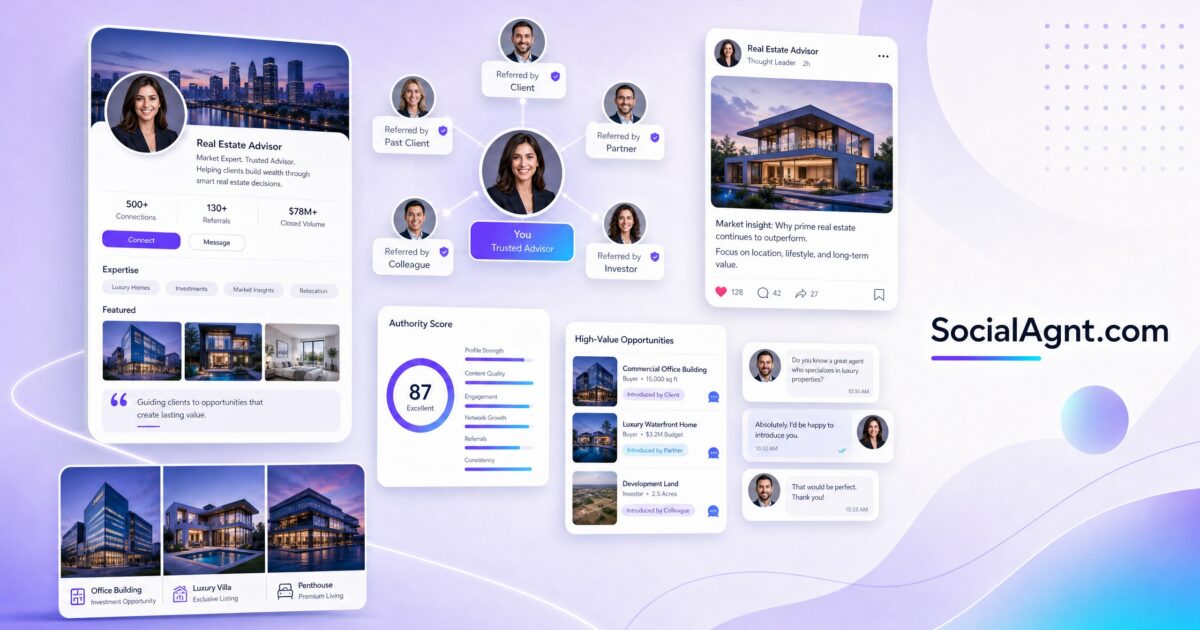
Key Takeaways: LinkedIn is the most underutilized social media platform in real estate — and for agents who learn to use it strategically, it’s a goldmine of high-income buyers, corporate relocation clients, referral partners, and professional credibility that no other platform can match. While most agents fight for attention on Instagram, LinkedIn offers virtually zero competition, an audience with significantly higher purchasing power, and an algorithm that still rewards organic content with massive reach. This guide covers how to optimize your LinkedIn profile for real estate, create content that attracts clients and referrals, build a referral network with mortgage brokers and financial advisors, and convert connections into closings.
Why LinkedIn Is a Hidden Advantage for Real Estate Agents
Ask most real estate agents about their social media strategy and they’ll talk about Instagram, Facebook, maybe TikTok. Ask about LinkedIn and you’ll get a blank stare or “Isn’t that for corporate people?” That dismissal is exactly what makes LinkedIn so valuable for the agents who do use it — there’s almost no competition.
LinkedIn has over 1 billion members globally, with more than 200 million in the United States alone. The platform’s user base skews professional, educated, and high-income — exactly the demographic profile of active homebuyers and sellers. According to LinkedIn’s own data, the platform’s members have two times the buying power of the average internet audience. These aren’t casual social media browsers — they’re professionals, executives, business owners, and high-earners who make significant financial decisions, including buying and selling real estate.
But the real advantage isn’t just the audience — it’s the lack of competition. On Instagram, every agent in your market is posting listing photos and market updates. On LinkedIn, you might be the only agent in your entire city creating consistent real estate content. That vacuum means your content faces less competition in the feed, reaches a larger percentage of your network, and positions you as the obvious real estate resource for a professional audience that other agents are completely ignoring.
LinkedIn also excels at something no other social platform does as well: professional referral networking. The mortgage brokers, financial advisors, CPAs, attorneys, HR managers, and corporate relocation specialists who refer real estate clients are all on LinkedIn. Building relationships with these professionals — on the platform where they’re already active and in a professional mindset — creates a referral pipeline that can sustain your business for years.
Optimizing Your LinkedIn Profile for Real Estate
Your LinkedIn profile is your digital first impression for every professional connection, potential client, and referral partner who finds you. Most agents have LinkedIn profiles that look like they were last updated when they got their license. A properly optimized profile converts profile visitors into connections, conversations, and clients.
Profile Photo and Banner Image
Use a professional headshot — the same one you use across all your social platforms for brand consistency. LinkedIn profiles with professional photos get 14 times more views than those without. Your banner image (the large horizontal image behind your photo) is prime real estate that most agents waste with a default blue background. Use it strategically: a high-quality image of your market’s skyline, a branded banner with your tagline and contact information, or a photo that represents your niche (luxury homes, waterfront properties, urban living).
Headline
Your LinkedIn headline is the single most important line of text on your profile. It appears everywhere — in search results, in the feed when you comment on posts, next to your name when you send connection requests. Most agents waste it with “Real Estate Agent at [Brokerage].” That tells people what you are, not what you do for them.
A strong LinkedIn headline follows this formula: what you do + who you do it for + where you do it. Examples: “Helping Austin professionals find their perfect home | Residential real estate specialist” or “Relocation expert for tech professionals moving to the Triangle | Real estate advisor” or “Luxury real estate in Manhattan Beach | Serving executives and entrepreneurs since 2015.” The headline should make a potential client or referral partner instantly understand your value and relevance to them.
About Section
The About section (formerly Summary) is your opportunity to tell your story, establish your expertise, and make it clear how you help people. Don’t write a resume. Write a narrative that answers: Who do you help? What problems do you solve? What makes you different? What should someone do if they want to work with you?
Start with a hook — a compelling first line that makes readers click “see more.” Then share your story: why you got into real estate, what drives you, and what you specialize in. Include specific achievements (transaction volume, years of experience, awards) but frame them in terms of client outcomes, not personal accolades. End with a clear call to action: “If you’re thinking about buying or selling in [market], let’s connect — send me a message or schedule a call at [link].”
Experience Section
List your current real estate position with a description that reads like a value proposition, not a job description. Instead of “Responsible for listing and selling residential properties,” write “I help families in [market] find homes that fit their lifestyle and budget. Specializing in [niche], I’ve guided over [X] families through the buying and selling process in the past [X] years.” Include media — listing photos, video tours, market reports, testimonials — in your experience section to make it visual and engaging.
Featured Section
The Featured section lets you pin content to the top of your profile. Use it strategically: pin your best-performing LinkedIn post (social proof that your content resonates), a link to your website or home search tool, a downloadable market report or buyer guide (lead magnet), and a testimonial video or client success story. This section is what profile visitors see immediately after your About section — make it count.
Skills, Recommendations, and Endorsements
Add relevant skills (real estate, negotiation, market analysis, first-time homebuyer guidance, luxury real estate, relocation services) and actively request recommendations from past clients and professional partners. Recommendations on LinkedIn carry significant weight because they’re public and attached to real people’s profiles. A dozen glowing recommendations from clients and referral partners is one of the most powerful trust signals you can have on the platform.
LinkedIn Content Strategy for Real Estate
Content is how you stay visible, build authority, and attract opportunities on LinkedIn. The platform’s algorithm currently favors original content — especially text posts and document carousels — and gives strong organic reach to creators who post consistently. Here’s what to post and how to make it resonate with LinkedIn’s professional audience.
Content Types That Perform on LinkedIn
Market analysis and insights: LinkedIn’s audience loves data. Share local market statistics with your professional analysis: “Median home prices in [city] rose 8% this quarter. Here’s what that means if you’re thinking about buying in the next 12 months…” Break down complex market trends into clear, actionable insights. Use specific numbers — LinkedIn audiences respond to data-driven content more than emotional appeals.
Professional storytelling: Share stories from your real estate practice that illustrate your expertise and values. The first-time buyer who was nervous about the process and how you guided them through it. The client who was relocating from across the country and how you made their transition seamless. The challenging negotiation that you navigated to save your client thousands. These stories showcase your skills while being genuinely engaging to read.
Educational content for professionals: Create content that’s specifically relevant to working professionals: “5 things your employer’s relocation package should cover,” “How to buy a home while managing stock options and RSU vesting schedules,” “What executives need to know about real estate in [city],” or “Tax implications of buying vs. renting for high-income professionals.” This content attracts exactly the audience you want — high-earning professionals who see you as the agent who understands their specific situation.
Local market guides: Professionals considering a move to your area are actively researching on LinkedIn. Posts like “What $600K buys you in [city] vs. [comparable city]” or “The 5 best neighborhoods in [city] for families relocating from [major metro]” attract relocation leads who are in active research mode.
Industry commentary: Share your perspective on real estate industry trends, policy changes, and market shifts. Interest rate changes, housing inventory trends, NAR settlement impacts, local zoning changes — your professional analysis positions you as a thought leader, not just a salesperson.
Content Format Best Practices
Text posts: LinkedIn’s algorithm currently favors text-only posts over link posts. Write posts that are 150–300 words, use line breaks for readability, start with a compelling first line (the hook that makes people click “see more”), and end with a question or call to action that encourages comments. Storytelling formats perform exceptionally well — open with a situation, describe the challenge, share the resolution, and close with the lesson or insight.
Document carousels: Upload a PDF as a “document” post and it becomes a swipeable carousel in the feed. These get very strong engagement on LinkedIn. Create carousels for: “7 steps to buying your first home,” “Market snapshot: [City] Q1 2026,” or “What to look for during a home inspection.” Each slide should have one key point with clean, readable design.
Video: Native video on LinkedIn gets priority in the feed. Record market updates, neighborhood tours, or professional tips directly to camera. Keep videos under two minutes. Add captions (most LinkedIn users browse with sound off in professional settings). LinkedIn video doesn’t need to be as polished as YouTube — authenticity and substance matter more than production value.
SocialAgnt lets you schedule and customize content for LinkedIn alongside every other platform — adapting your message for professional audiences while maintaining your presence everywhere else. AI-powered captions, real estate templates, and smart scheduling across all six major platforms. Start free today.
Building a Referral Network on LinkedIn
One of LinkedIn’s greatest strengths for real estate agents is building relationships with professionals who can send you referral business consistently. A strong LinkedIn referral network can become your most reliable and profitable lead source.
Who to Connect With
Mortgage brokers and loan officers: These are your most natural referral partners. They work with pre-approved buyers who need an agent. Connect with every active mortgage professional in your market. Engage with their content. Send referrals their way. The relationship becomes reciprocal over time.
Financial advisors and wealth managers: Their clients have investable assets and often ask about real estate — whether to buy, sell, invest, or downsize. Position yourself as the real estate expert they can confidently refer their clients to.
CPAs and tax professionals: Clients ask their CPAs about the tax implications of buying, selling, and investing in real estate. When a CPA knows and trusts a real estate agent, they refer naturally.
HR managers and corporate relocation specialists: Companies relocating employees need agents who understand the relocation process. Connect with HR leaders at companies that hire in your market. Offer to be a relocation resource — create a relocation guide specifically for their employees moving to your area.
Estate and family attorneys: They work with clients going through life transitions — divorce, inheritance, estate liquidation — that frequently involve real estate transactions. These referrals often come with urgency and high motivation.
Other real estate agents in different markets: Agents in other cities who work with clients relocating to your area are a referral goldmine. Connect with top agents in the cities that most commonly feed relocations to your market.
The LinkedIn Referral Nurture Process
Building referral relationships on LinkedIn isn’t about sending a connection request and immediately asking for business. It’s a long-game strategy built on genuine relationship development.
Phase 1 — Connect and engage: Send a personalized connection request that references something specific about the person (“I saw your post about mortgage rate trends — great insights”). After connecting, spend two weeks engaging with their content — meaningful comments, not just “Great post!” Show genuine interest in their expertise.
Phase 2 — Provide value first: Share something valuable with them before asking for anything. Send them an article relevant to their field. Refer a client their way. Offer to collaborate on content (“I’d love to do a joint post on how first-time buyers should work with their lender and agent together”). Leading with generosity builds trust and reciprocity.
Phase 3 — Establish the relationship: After providing value, suggest a brief call or coffee to learn more about each other’s businesses. The goal isn’t to pitch — it’s to understand how you can help each other’s clients. When you genuinely understand a mortgage broker’s ideal client, you can send them perfect referrals — and they’ll return the favor.
Phase 4 — Maintain and nurture: Stay visible in their feed through consistent content. Send occasional check-in messages. Continue to refer business when appropriate. Celebrate their wins publicly (comment on their achievements). The strongest referral relationships are maintained through ongoing engagement, not just an initial connection.
LinkedIn Lead Generation Strategies
Content-to-Conversation Pipeline
The most effective LinkedIn lead generation strategy is simple: create valuable content consistently, and when people engage, start conversations. When someone comments on your market analysis post with “This is so helpful — we’re thinking about moving to [your city] next year,” that’s a lead declaring themselves publicly. Respond to the comment, then follow up in a private message with additional value: “Thanks for the comment! I actually put together a relocation guide for people moving to [city] — would you like me to send it over?”
Direct Outreach That Doesn’t Feel Salesy
LinkedIn’s messaging feature lets you reach out to connections directly, but the key is doing it in a way that feels helpful rather than pushy. Never lead with a sales pitch. Instead, lead with relevance and value. A message like “I noticed you work at [company that just announced a local office expansion] — I put together a neighborhood guide for professionals relocating to [city]. Happy to share it if that would be useful for your team” is infinitely more effective than “Hi, I’m a real estate agent. Let me know if you need help buying or selling.”
LinkedIn Events and LinkedIn Live
Host virtual events through LinkedIn — market update webinars, first-time buyer Q&A sessions, relocation information sessions for specific companies or industries. LinkedIn Events get visibility in your connections’ feeds and can attract attendees who are actively interested in your market. These events position you as an authority and create a list of engaged, interested prospects you can follow up with afterward.
LinkedIn for Real Estate Team Leaders and Brokers
LinkedIn isn’t just valuable for individual agents — it’s a powerful platform for team leaders and brokers looking to recruit talent, build their brand, and establish thought leadership in the industry.
Recruiting: The best agents are on LinkedIn. Share content about your team culture, your value proposition for agents, your training and support systems, and your team’s results. When agents in your market see you consistently demonstrating leadership and success on LinkedIn, you become the team they think of when they’re ready for a change.
Brokerage brand building: Create a LinkedIn Company Page for your brokerage and encourage agents to list it as their employer. Share company updates, transaction milestones, community involvement, and market expertise from the company page. This creates a professional brand presence that enhances every individual agent’s credibility.
Industry networking: Connect with other brokers, industry vendors, technology providers, and real estate leaders. LinkedIn is where industry conversations happen at a higher level — partnerships, collaborations, and business development opportunities that don’t exist on consumer-focused platforms.
Common LinkedIn Mistakes Real Estate Agents Make
Treating LinkedIn like Instagram. The content that works on Instagram — lifestyle photos, dancing Reels, casual Stories — doesn’t translate to LinkedIn. LinkedIn’s audience expects professional, substantive content. Market data, business insights, professional stories, and educational content perform best. You can still show personality, but frame it within a professional context.
Having an incomplete or outdated profile. A LinkedIn profile without a photo, with a generic headline, or with an empty About section communicates that you don’t take your professional presence seriously. In a business where trust is everything, that’s a costly signal to send. Complete every section of your profile and update it quarterly.
Only connecting with other agents. Many agents’ LinkedIn networks consist entirely of other real estate agents. While industry connections have value, the real lead generation opportunity is connecting with potential clients and referral partners outside the real estate industry. Diversify your network intentionally.
Posting listings without context. A listing photo with “Just listed! 4 bed, 3 bath, $450K” is the lowest-effort content on LinkedIn and generates almost no engagement. If you’re going to share listings, add context: the story of the home, why the neighborhood is special, what the listing represents in the current market, or what the buyer eventually loved about it. Transform listing announcements into stories.
Ignoring messages and comments. LinkedIn’s algorithm boosts content that generates conversation. When someone comments on your post, respond thoughtfully — and quickly. When someone sends you a message, reply within 24 hours. Every interaction is a potential relationship, and every ignored message is a missed opportunity.
Your LinkedIn Action Plan
Week 1 — Profile overhaul: Rewrite your headline, About section, and Experience section using the guidelines above. Update your profile photo and banner. Add media to your Featured section. Request recommendations from three past clients and two professional partners.
Week 2 — Build your network: Send 20 personalized connection requests per day to professionals in your target categories: mortgage brokers, financial advisors, HR managers at local companies, attorneys, and CPAs in your market. Also connect with potential clients — professionals in your area who fit your ideal client profile.
Week 3 — Start creating content: Publish three LinkedIn posts this week: one market analysis, one professional story from your real estate practice, and one educational post for your target audience. Engage with ten other people’s posts per day with thoughtful comments.
Week 4 — Activate lead generation: Initiate five DM conversations per day with people who engage with your content or who fit your referral partner profile. Use the value-first approach: share something useful before asking for anything. Track your conversations and the relationships that develop.
Months 2–3 — Build momentum: Post three to five times per week consistently. Deepen your referral partner relationships with calls and in-person meetings. Host your first LinkedIn Event (a market update webinar or buyer Q&A). Measure your results: profile views, connection acceptance rates, DM conversations, and leads generated. Adjust your strategy based on what content and approaches produce the best results.
LinkedIn for real estate is a long game — but it’s a game with almost no competition, an audience with exceptional purchasing power, and a referral network potential that can transform your business. The agents who invest in LinkedIn now will own a channel that their competitors haven’t even started to explore.
SocialAgnt makes it easy to maintain your LinkedIn presence while managing Instagram, Facebook, TikTok, YouTube, and Google Business Profile — all from one dashboard. Create professional content with AI-powered captions, customize for each platform’s audience, and schedule everything in advance. Try SocialAgnt free.
Ready to save 5+ hours per week on social media?
SocialAgnt helps real estate agents schedule posts, create AI content, and grow their brand across 7 platforms. Try it free for 14 days.
