
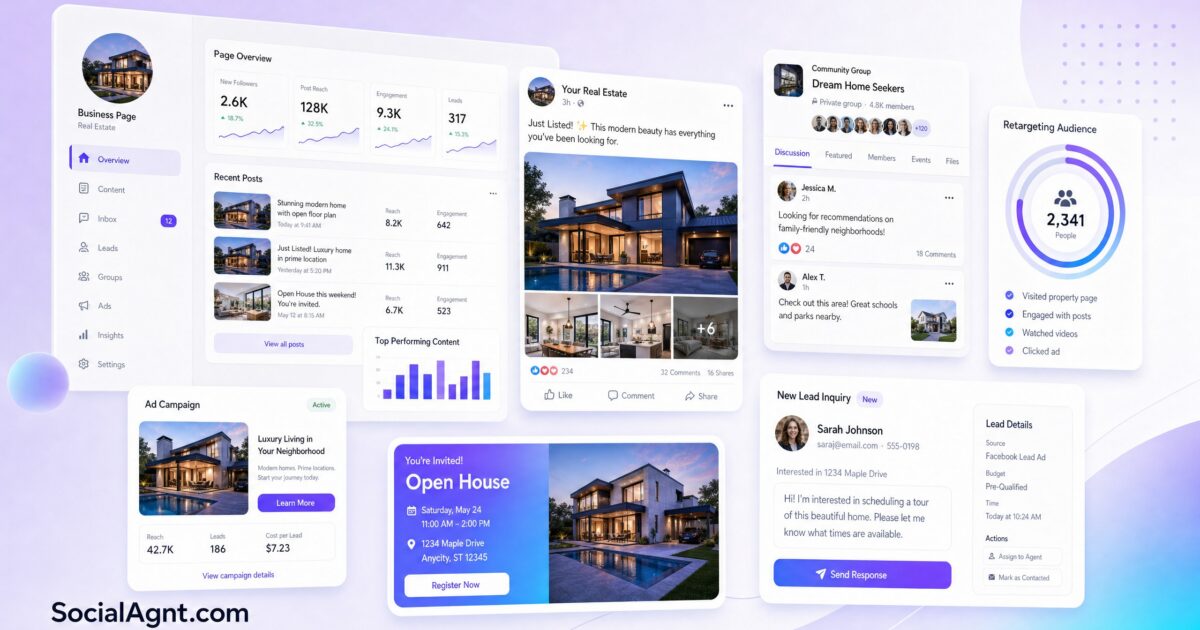
Key Takeaways: Facebook marketing for real estate remains one of the most powerful lead generation channels available to agents — and it’s not slowing down. With 90% of agents on the platform, the question isn’t whether to use Facebook, but how to use it better than your competition. This guide covers everything from optimizing your business page and creating content that actually gets engagement, to building community through Groups, running ads that generate real leads, and using Marketplace, Live, Events, and Messenger to build a complete Facebook marketing system.
Why Facebook Marketing for Real Estate Still Dominates in 2026
Every year, someone predicts Facebook’s decline. And every year, the National Association of Realtors’ Technology Survey tells the same story: 90% of real estate agents use Facebook — more than any other platform by a wide margin. Instagram is second at 52%. There’s a reason Facebook has staying power in this industry, and it goes beyond habit.
Facebook’s user base skews older and wealthier than Instagram or TikTok. The median homebuyer age is 36, and the median repeat buyer is 58 — both demographics that are deeply active on Facebook. More importantly, Facebook is the only major social platform that combines organic content, community features (Groups), a built-in marketplace, event promotion, live video, messaging, and the most sophisticated advertising platform in digital marketing. No other single platform gives real estate agents that many tools under one roof.
The agents who dismiss Facebook as “dying” or “for old people” are handing a massive competitive advantage to those who understand what the platform actually does well: build community, nurture relationships, and convert attention into leads at scale. Facebook marketing for real estate isn’t glamorous — it’s effective.
Setting Up Your Real Estate Facebook Business Page
Your Facebook Business Page is often the first thing a potential client sees when they Google your name or search for agents on Facebook. It needs to be complete, professional, and optimized for conversion — not an afterthought you set up three years ago and forgot about.
Page Name and Category
Use your real name plus your professional identifier: “Sarah Martinez | Austin Real Estate Agent” or “Sarah Martinez – Keller Williams Realtor.” This makes you discoverable in Facebook search and in Google results. For your category, select “Real Estate Agent” as the primary category, and add “Real Estate” and “Property” as additional categories.
Profile Photo and Cover Image
Your profile photo should be the same professional headshot you use across every platform — consistency builds recognition. Your cover image is prime branding real estate. Use a high-quality, professionally designed graphic that communicates your value proposition at a glance: your name, market area, a tagline, and contact information. Alternatively, use a stunning photo that represents your market — a skyline, a beautiful neighborhood, a waterfront view — with a subtle text overlay. Update your cover image seasonally or when you have a significant achievement to highlight.
About Section and Contact Info
Complete every field in your About section. Write a compelling description that includes your market area, specialties, years of experience, and what makes you different. Include your phone number, email, website link, and office address. Facebook uses this information for local search ranking — incomplete pages rank lower than fully optimized ones.
Add your service areas using Facebook’s location features. This helps Facebook show your page to people searching for real estate services in your geographic area.
Call-to-Action Button
Facebook lets you add a CTA button directly on your page. Choose one that aligns with your primary conversion goal: “Contact Us,” “Send Message,” “Book Now,” or “Learn More.” Link it to your most important conversion page — a home valuation tool, consultation booking page, or lead capture form. This button sits at the top of your page and is one of the highest-converting elements available to you. Don’t leave it as the default.
Reviews and Recommendations
Facebook Reviews (now called Recommendations) are visible on your page and influence both potential clients and Facebook’s algorithm. Actively request recommendations from past clients after closing. Send them a direct link to your Reviews section. The agents with 50+ positive reviews have a significant trust advantage over agents with zero or a handful. Make review collection a standard part of your post-closing workflow.
Facebook Content Strategy for Real Estate Agents
The Facebook algorithm in 2026 prioritizes content that generates meaningful interactions — comments, shares, and reactions — over content that generates passive consumption. This means your content strategy needs to be built around sparking conversations, not just broadcasting information.
Content Types That Perform Best on Facebook
Native video consistently outperforms every other content format on Facebook. Videos uploaded directly to Facebook (not YouTube links) get 10x more distribution than shared links. Keep videos between 1–3 minutes for feed content. Show your face. Speak directly to the camera. Authenticity outperforms polish on Facebook — your audience wants to feel like they’re having a conversation with you, not watching a commercial.
Photo albums and carousels drive strong engagement for listings and neighborhood features. A listing album with 10–15 professional photos, accompanied by a storytelling caption, outperforms a single-photo post with just the specs. Walk people through the home with your words while the photos do the visual work.
Text-only posts can be surprisingly effective on Facebook — especially long-form, personal stories or market commentary. A 200–300 word post sharing your honest perspective on the market, a lesson you learned from a difficult transaction, or a heartfelt client story can generate massive engagement because it feels authentic in a feed full of polished graphics.
Link posts (sharing a URL to your website or listing) get the lowest organic reach of any format. Facebook deliberately suppresses posts that send people off-platform. When you do share links, pair them with compelling native content — a strong opinion, a personal story, or a question — so the post has value even if the viewer doesn’t click.
What to Post: The Weekly Mix
A strong Facebook content calendar for real estate agents balances five content types across the week:
Monday — Market Insight: Share a local market stat, interest rate update, or economic indicator with your analysis. Not just the data, but what it means for buyers and sellers in your area. Ask a question to spark discussion: “Does this change your thinking about buying this spring?”
Tuesday — Educational: Teach something useful. First-time buyer tips, closing cost breakdowns, home maintenance checklists, or explanations of confusing real estate concepts (escrow, contingencies, appraisals). Make it the kind of content someone saves or shares with a friend who’s about to buy.
Wednesday — Personal/Behind the Scenes: Show the human side. A day in the life video. A funny showing story. A personal milestone. The view from a listing you toured today. Coffee and a candid thought about the business. This is the content that makes people feel like they know you.
Thursday — Listing or Local Spotlight: Feature an active listing with storytelling (not just specs) or spotlight a local business, restaurant, park, or event. Tag the businesses you feature — they’ll often share your post with their audience, giving you free exposure.
Friday — Engagement Post: Ask a question designed to generate comments. “What’s one feature your dream home MUST have?” or “Is it better to buy now or wait? Honest thoughts only 👇.” Opinion-based questions drive the most discussion because there’s no wrong answer.
Facebook Groups: The Underutilized Gold Mine
If there’s one Facebook feature that separates agents who generate real leads from agents who just post into the void, it’s Groups. Facebook Groups create community — and community creates trust, referrals, and repeat business in ways that feed posts simply can’t match.
Creating Your Own Group
Consider creating a local community group focused on your market area. Not a “Sarah Martinez Real Estate” group (nobody wants to join a group that’s just ads for your listings), but something like “[City] New Residents & Community” or “[Neighborhood] Neighbors” or “Moving to [City] — Tips & Advice.” Position yourself as the host and facilitator, not the advertiser.
Seed the group with valuable content: local restaurant recommendations, event announcements, neighborhood tips, and answers to common questions about the area. Invite past clients, sphere of influence contacts, and local business owners to join. As the group grows, you become the recognized local authority — the person everyone associates with knowing the community inside and out. When group members need a real estate agent (or know someone who does), you’re the obvious choice.
Participating in Existing Groups
Join every active local community group, neighborhood group, and buy/sell/trade group in your market. Don’t join to spam your listings — join to be genuinely helpful. When someone asks “What’s a good neighborhood for a family with young kids?”, provide a thoughtful, detailed answer. When someone posts “Looking for a real estate agent recommendation,” your name should already be familiar because you’ve been contributing value for months.
The golden rule of Facebook Groups: give ten times more than you promote. Answer questions. Share local knowledge. Be helpful without expecting anything in return. The business comes naturally when people trust your expertise.
Facebook Marketplace for Real Estate
Facebook Marketplace started as a place to sell used furniture, but it’s become a significant listing distribution channel for real estate agents. Properties listed on Marketplace get substantial visibility — especially among local searchers who browse Marketplace regularly.
Post your active listings on Marketplace with full details, professional photos, and your contact information. Include the address, price, bedroom/bathroom count, square footage, and a compelling description that highlights what makes the property special. Many buyers who aren’t actively working with an agent discover properties through Marketplace and reach out directly. It’s free, it takes five minutes per listing, and it puts your properties in front of a local audience that’s already in a shopping mindset.
Facebook Live for Real Estate
Facebook Live video gets 6x more engagement than pre-recorded video, and Facebook’s algorithm actively pushes Live content to the top of news feeds and sends notifications to followers. For real estate agents, Live is perfect for virtual open houses, neighborhood tours, market updates, and Q&A sessions.
Virtual Open House Format
Go Live from the property 30 minutes before or during an open house. Walk through the home room by room, narrating the features and answering questions from viewers in real-time. The interactive format lets out-of-town buyers experience the property, gives local buyers a preview before visiting in person, and creates urgency (“We’re here live and there are already three groups waiting to come through — don’t miss this one”).
Promote your Live sessions 24–48 hours in advance. Create a Facebook Event for the open house and share it. Post a teaser photo with the time you’ll be going Live. This pre-promotion dramatically increases viewership — going Live without warning to an unprepared audience results in low turnout.
Weekly Live Q&A
Consider a recurring weekly Live segment: “Ask Me Anything About Real Estate” or “Market Monday with [Your Name].” Consistency builds an audience. Over time, your Live sessions become appointment viewing for followers who are in the early stages of thinking about buying or selling. By the time they’re ready to act, you’re the agent they’ve been watching and learning from for months.
Facebook Events for Open Houses and Community Events
Facebook Events are an overlooked tool for driving open house attendance. When you create an Event, Facebook sends reminders to everyone who responds “Interested” or “Going.” The Event also appears in Facebook’s Events discovery section, making it visible to people beyond your existing followers.
Create a Facebook Event for every open house with: the property address, date and time, professional photos, a compelling description of the property, and your contact information for questions. Invite your local network. Share the Event to relevant local groups. Boost the Event with a small ad budget ($20–$50) targeting homebuyers in your area. The cost per attendee is often a fraction of what you’d spend on any other advertising channel.
Beyond open houses, create Events for community gatherings, buyer seminars, first-time homebuyer workshops, or neighborhood meet-and-greets. These events build your database while positioning you as a community leader — not just a salesperson.
SocialAgnt lets you plan, create, and schedule Facebook posts alongside Instagram, TikTok, LinkedIn, YouTube, and Google Business Profile — all from one visual calendar. AI-powered captions tailored for real estate and automatic MLS listing announcements. Start free today.
Facebook Advertising for Real Estate: A Strategic Overview
Organic Facebook reach has declined steadily for business pages — most posts now reach 2–5% of your followers organically. This is where Facebook advertising becomes essential. Even a modest budget, spent strategically, can generate consistent, measurable leads.
Ad Types for Real Estate
Lead generation ads include a built-in form that pre-fills with the viewer’s Facebook contact information. They have the lowest friction of any ad type — the user never leaves Facebook, and submitting their info takes two taps. Use these for offers like free home valuations, buyer guides, market reports, or consultation bookings.
Traffic ads drive visitors to a specific URL — your website, a listing page, or a landing page with a lead capture form. These work best when you have a compelling destination that gives the visitor a reason to provide their information.
Engagement ads boost your organic posts to a wider audience. Take a post that’s already generating strong organic engagement and amplify it with ad spend. This is the simplest way to start with Facebook advertising — you already know the content resonates, you’re just showing it to more people.
Retargeting ads show your ads to people who have already visited your website, viewed a listing page, or engaged with your Facebook content. These are some of the highest-converting ads because the audience already knows who you are. A retargeting ad showing a new listing to someone who visited your site last week is exponentially more effective than showing the same ad to a cold audience.
Targeting Strategy
Facebook’s targeting capabilities are the most sophisticated in digital advertising. For real estate, the most effective targeting parameters include:
- Geographic targeting: Target by city, zip code, or radius around a specific address. For hyperlocal campaigns, target a 10-mile radius around a listing or your primary market area.
- Life event targeting: Facebook identifies users who recently got engaged, married, had a baby, or started a new job — all trigger events for real estate decisions.
- Interest targeting: Target users interested in real estate, homebuying, home improvement, mortgage rates, or specific real estate platforms like Zillow and Realtor.com.
- Lookalike audiences: Upload your past client list and Facebook will find users with similar demographics, interests, and behaviors. This is one of the most powerful targeting tools available — you’re reaching people who look like your best clients.
Important compliance note: Real estate advertising on Facebook falls under the Special Ad Category for Housing, which restricts targeting by age, gender, and zip code to comply with Fair Housing laws. You must select the Housing category when creating real estate ads. Failure to comply can result in ad account suspension and legal liability.
Budget Guidelines
For individual agents, start with $10–$20 per day on a single campaign type (lead generation is the best starting point). Run the campaign for at least 7–14 days before evaluating results — Facebook’s algorithm needs time to optimize delivery. A monthly budget of $300–$600 is enough to generate meaningful leads in most markets. As you identify what works, reinvest in winning campaigns and pause underperformers.
Track cost per lead religiously. In most markets, real estate agents can expect to pay $5–$25 per lead from Facebook ads. Compare that to purchased leads from lead generation companies ($30–$100+ per lead) and the math becomes obvious.
Facebook Messenger for Real Estate Lead Response
Speed kills in real estate lead conversion. Studies consistently show that responding to an inquiry within five minutes makes you 21x more likely to convert the lead compared to responding after 30 minutes. Facebook Messenger is where many of these inquiries arrive, and how you handle them determines whether they become clients or disappear.
Setting Up for Fast Response
Enable Messenger on your business page and set up instant replies — an automatic message that goes out immediately when someone sends you a message. Something like: “Thanks for reaching out! I’m usually able to respond within a few minutes during business hours. In the meantime, what can I help you with — are you looking to buy, sell, or just have a question about the market?” This buys you time while keeping the conversation warm.
Turn on Messenger notifications on your phone and check them as frequently as you check text messages. A Messenger inquiry from someone who found your page and reached out proactively is one of the warmest leads you’ll get — treat it accordingly.
Conversation Strategy
When a lead messages you about a property or a general inquiry, follow the same framework you’d use for any lead conversation: acknowledge their message, add immediate value (answer their question or provide additional information), and ask a qualifying question to understand their needs. Keep it conversational, not scripted. Messenger conversations should feel like texting a knowledgeable friend, not filling out a form.
Understanding the Facebook Algorithm in 2026
The Facebook algorithm determines which posts appear in users’ news feeds and in what order. Understanding how it works helps you create content that gets distributed rather than buried.
Meaningful interactions trump passive engagement. Facebook prioritizes content that generates comments and shares (meaningful interactions) over content that generates likes or clicks (passive engagement). A post with 20 genuine comments outperforms a post with 200 likes in algorithmic distribution.
Friends and family content comes first. Facebook prioritizes personal connections over business page content. This means your business page posts are competing for limited news feed space. The way to win: create content that people engage with like they would a friend’s post — conversational, personal, and worth responding to.
Native content gets preferential treatment. Content created directly on Facebook (native video, photos, text posts) reaches more people than content that links elsewhere. Facebook wants users to stay on Facebook. When you share a YouTube link or a blog URL, you’re asking Facebook to send its users somewhere else — and the algorithm responds by limiting distribution.
Consistency and recency matter. Post regularly (3–5 times per week) and at times when your audience is most active. Check your Facebook Page Insights to find your specific peak engagement times. For most real estate audiences, weekday mornings (7–9 AM) and evenings (7–9 PM) tend to perform well, but your data should guide your schedule.
Measuring Your Facebook Marketing Results
Facebook Page Insights provides comprehensive analytics. Here’s what to monitor monthly:
Page reach: How many unique people saw any content from your page. Track the trend — is your reach growing, stable, or declining? Declining reach means your content isn’t resonating or you’re not posting frequently enough.
Engagement rate: Total engagements divided by reach. A healthy Facebook engagement rate for real estate content is 1–3%. Below 1% means you need to experiment with different content types and topics.
Top-performing posts: Identify your best content by engagement each month. Look for patterns — which topics, formats, and posting times consistently outperform? Double down on what works.
Page followers: Track net new followers per month. Organic follower growth on Facebook is slow for business pages — if you’re growing at all, that’s a positive signal. Significant growth typically comes from viral content, active Group participation, or paid promotion.
Actions on page: Website clicks, phone calls, messages sent, and direction requests. These are the metrics that directly connect Facebook activity to business outcomes. If you have high reach but low actions, your content is getting seen but not compelling enough to prompt the next step.
For advertising metrics, track cost per lead, click-through rate (CTR), and conversion rate. Set benchmarks based on your first month of data and work to improve them over time.
Common Facebook Marketing Mistakes for Real Estate Agents
Using a personal profile instead of a business page. Your personal Facebook profile is for friends and family. Your business page gives you access to Insights, advertising, Messenger automation, and professional features that a personal profile doesn’t have. Running your business from a personal profile also violates Facebook’s Terms of Service and limits your growth potential.
Only sharing links to your website. Link posts get the lowest organic reach of any content type. If your entire Facebook strategy is sharing Zillow links and blog posts, you’re getting a fraction of the reach you could be getting with native video, photos, and text posts.
Ignoring Groups. Business page posts reach 2–5% of followers. Group posts reach significantly more members — and the members are already opt-in, engaged, and community-minded. If you’re not active in local Facebook Groups, you’re missing the platform’s most powerful community feature.
Running ads without a strategy. Boosting random posts without clear objectives, targeting, or tracking wastes money. Every dollar of ad spend should have a goal (leads, traffic, engagement), a specific audience, and a measurement plan. Start small, test, measure, and scale what works.
Posting only listings. A Facebook feed that’s nothing but property photos looks like a classified ads section, not a personal brand. Mix your listings (20% of content) with educational, personal, local, and engagement content to build the trust that makes someone choose you over the ten other agents who also posted a listing today.
Neglecting Messenger. Unanswered messages are lost leads. Set up instant replies, turn on notifications, and commit to responding within minutes, not hours. Speed of response is one of the strongest predictors of lead conversion in real estate.
Your Facebook Marketing Action Plan
Here’s how to build a complete Facebook marketing system over the next 30 days:
Week 1 — Foundation: Fully optimize your business page (profile photo, cover image, About section, CTA button, contact info). Request recommendations from your last 10 clients. Join 5 active local community groups.
Week 2 — Content Launch: Plan and schedule two weeks of content following the Monday-through-Friday mix above. Post your first native video (even if it’s imperfect). Create a Facebook Event for your next open house. Start engaging in Groups daily — answer 2–3 questions per day.
Week 3 — Advertising: Set up your first lead generation ad campaign. Create a compelling offer (free home valuation, buyer guide, or market report). Set your targeting parameters. Budget $10–$15/day for a 14-day test. Create your follow-up system for incoming leads.
Week 4 — Evaluate and Optimize: Review your Page Insights. Identify your top-performing content. Check your ad campaign results and cost per lead. Adjust your content strategy based on what the data tells you. Plan month two with confidence.
Facebook marketing for real estate is a system, not a series of random posts. The agents who build a real system — organic content, community engagement through Groups, Events for open houses, Messenger for conversations, and advertising for scale — create a reliable, measurable lead generation engine that works month after month. SocialAgnt handles the scheduling and automation so you can focus on the strategy, the conversations, and the relationships that turn followers into clients.
SocialAgnt automates your Facebook posting schedule, generates AI-powered captions designed for real estate, syncs with your MLS for instant listing announcements, and tracks your results — alongside Instagram, TikTok, LinkedIn, YouTube, and Google Business Profile. One dashboard. Every platform. Try SocialAgnt free.
Ready to save 5+ hours per week on social media?
SocialAgnt helps real estate agents schedule posts, create AI content, and grow their brand across 7 platforms. Try it free for 14 days.
