
Key Takeaways: Scaling social media marketing across a real estate team introduces challenges that solo agents never face: maintaining brand consistency while allowing individual agent personalities, coordinating content across multiple people, managing approvals and compliance, distributing leads fairly, and justifying the investment of team resources. But teams that get social media right have a massive advantage — multiple voices, more content capacity, broader reach, and the ability to cover more platforms and niches simultaneously. This guide covers how real estate teams can build a scalable social media operation: team vs. individual branding, content workflows, role assignment, tools for team management, and strategies for amplifying your team’s collective reach.
The Team Brand vs. Individual Agent Brands
The first strategic decision every real estate team faces on social media: do you build one team brand or empower individual agent brands? The answer, for most teams, is both — but with clear guidelines about how they interact.
The Team Brand
Your team brand is the umbrella — it represents the team’s collective reputation, track record, and market presence. The team’s social media accounts (team Instagram, team Facebook page, team YouTube channel) should showcase: team transaction volume and success metrics, featured listings from all team members, market updates and analysis that represent the team’s expertise, team culture and behind-the-scenes content, client testimonials attributed to the team, and community involvement and charitable activities.
The team brand builds credibility through scale. “The Smith Team sold 150 homes last year” is more impressive than any individual member’s numbers. The team brand also provides a platform for listing marketing — showcasing the team’s full inventory in one place rather than spread across individual accounts.
Individual Agent Brands
Each agent on your team should also maintain their own social media presence. Personal brands are where individual personality, niche expertise, and direct client relationships live. An agent who specializes in first-time buyers creates different content than a team member who focuses on luxury. Individual accounts generate leads that convert at higher rates because the client built a relationship with a specific person, not a brand.
The key is establishing clear guidelines: individual accounts should reference the team affiliation (in bio and periodically in content), individual branding should be consistent with — not contradictory to — the team’s overall brand standards, and individual agents should share and amplify team content regularly.
The Content Ecosystem
The most effective team social media strategy creates a content ecosystem where team and individual accounts reinforce each other. The team account posts a new listing — individual agents share it to their Stories with personal commentary. An individual agent posts a client testimonial — the team account reshares it. The team publishes a market report — agents share it with their audiences. This cross-promotion amplifies every piece of content across multiple audiences.
Roles and Responsibilities for Team Social Media
Scaling social media requires clear role assignment. Without defined responsibilities, content creation becomes “everyone’s job” — which means it’s no one’s job.
The Marketing Coordinator / Social Media Manager
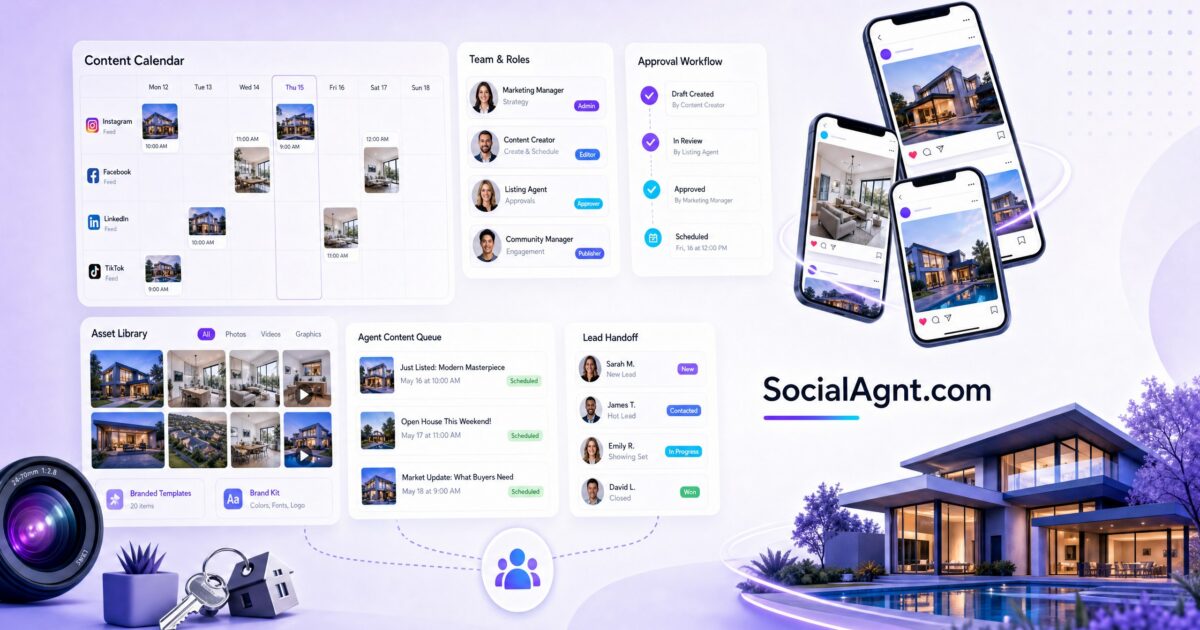
If your team has a dedicated marketing role, this person should own: the content calendar (planning what gets posted when on team accounts), brand consistency (ensuring all content meets visual and messaging standards), scheduling and publishing (using a management platform to queue content), analytics and reporting (tracking performance and sharing insights with the team), and compliance review (ensuring all content meets brokerage and regulatory requirements).
Team Leader
The team leader’s social media responsibilities include: setting the overall social media strategy and goals, approving major content initiatives and campaigns, creating high-visibility content (market updates, team announcements, thought leadership), and allocating budget for tools, advertising, and content creation.
Individual Agents
Each agent should be responsible for: maintaining their individual social media accounts per team guidelines, submitting listing content and client photos to the marketing coordinator for team account posting, sharing and amplifying team content on their individual accounts, engaging with comments and DMs on their own accounts, and contributing content ideas based on their client interactions and market experience.
Content Workflows for Teams
The Content Production Pipeline
Build a repeatable workflow that turns raw material into published content efficiently:
Collection: Agents submit raw content to a shared system — photos from showings, closing day photos (with client permission), listing details, market observations, and content ideas. A shared Google Drive folder, Slack channel, or team management tool works for this.
Creation: The marketing coordinator (or designated content creator) turns raw material into polished posts — writing captions, creating graphics, editing video, and preparing content for each platform.
Review: Content is reviewed for accuracy, brand consistency, and compliance before scheduling. For most teams, a quick review by the team leader or a designated reviewer is sufficient.
Scheduling: Approved content is scheduled across team and individual accounts using a multi-account social media management platform.
Distribution: When content publishes, agents are notified and encouraged to share, comment, and amplify.
Content Templates
Create branded templates for recurring content types: listing announcements, just-sold posts, open house promotions, market updates, agent spotlights, and testimonials. Templates maintain visual consistency while making content creation faster — the marketing coordinator fills in the specific details rather than designing from scratch each time.
SocialAgnt supports multi-account management, making it easy for real estate teams to schedule content for team and individual agent accounts from a single platform. AI-powered captions, real estate templates, and multi-platform scheduling across Instagram, Facebook, TikTok, LinkedIn, YouTube, and Google Business Profile. Start free today.
Tools for Team Social Media Management
Team social media requires tools that support multiple users, multiple accounts, and collaborative workflows. The essential capabilities include: multi-account management (scheduling content to team accounts and individual agent accounts from one platform), content approval workflows (review and approve content before it publishes), shared content libraries (templates, brand assets, and approved graphics accessible to all team members), role-based access (different permissions for the team leader, marketing coordinator, and individual agents), and unified analytics (performance data across all accounts in one dashboard).
SocialAgnt offers team-level features designed specifically for real estate teams, including multi-account scheduling, shared templates, and centralized analytics — eliminating the need for multiple tools or complicated workarounds.
Scaling Paid Advertising as a Team
Teams can leverage their collective budget and content volume for more effective paid advertising. Run paid campaigns from the team account that promote the team’s inventory, market expertise, and brand — then route leads to individual agents based on geography, specialization, or rotation. This centralized advertising approach is more efficient than each agent running their own ads because it consolidates budget (larger budgets allow better optimization), provides consistent branding, and allows sophisticated targeting and retargeting at a scale individual agents can’t achieve alone.
Measuring Team Social Media Performance
Track performance at both the team and individual level. Team-level metrics include: total reach and engagement across all accounts, leads generated from social media (team and individual accounts combined), conversion rates from social media leads, and total ROI (combined social media investment vs. combined social media-attributed revenue). Individual agent metrics include: posting consistency (is each agent maintaining their individual accounts?), engagement rates (which agents’ content resonates most?), leads generated per agent from social media, and content contribution (is each agent submitting raw material for team content?).
Review these metrics monthly as a team. Celebrate top performers, share what’s working, and address gaps. When social media is a team priority with visible metrics and accountability, adoption and performance improve across the board.
Your Team Social Media Action Plan
Week 1: Define your team brand vs. individual brand guidelines. Assign social media roles and responsibilities. Choose your team social media management platform.
Week 2: Build your content templates and shared asset library. Set up the content production pipeline (collection → creation → review → scheduling → distribution). Create the team content calendar for the first month.
Week 3: Launch team social media with your first week of coordinated content. Brief all agents on their individual responsibilities. Establish the cross-promotion expectation (agents share team content, team shares individual content).
Month 2: Review first month’s performance. Refine workflows based on what worked and what didn’t. Add paid advertising to amplify top-performing content. Begin tracking leads by source and attributing them to social media channels.
A real estate team that coordinates its social media has an exponentially larger reach, more content capacity, and stronger market presence than any individual agent — including the agents on competing teams who are each posting independently without coordination. Build the system, assign the roles, and execute consistently — and your team’s social media becomes a lead generation machine that scales with every agent you add.
SocialAgnt’s team features let you manage multiple agent accounts, share templates, and track performance from one dashboard — so your team looks polished, stays consistent, and generates leads across every platform. Start your team’s free account today.
Ready to save 5+ hours per week on social media?
SocialAgnt helps real estate agents schedule posts, create AI content, and grow their brand across 7 platforms. Try it free for 14 days.
