
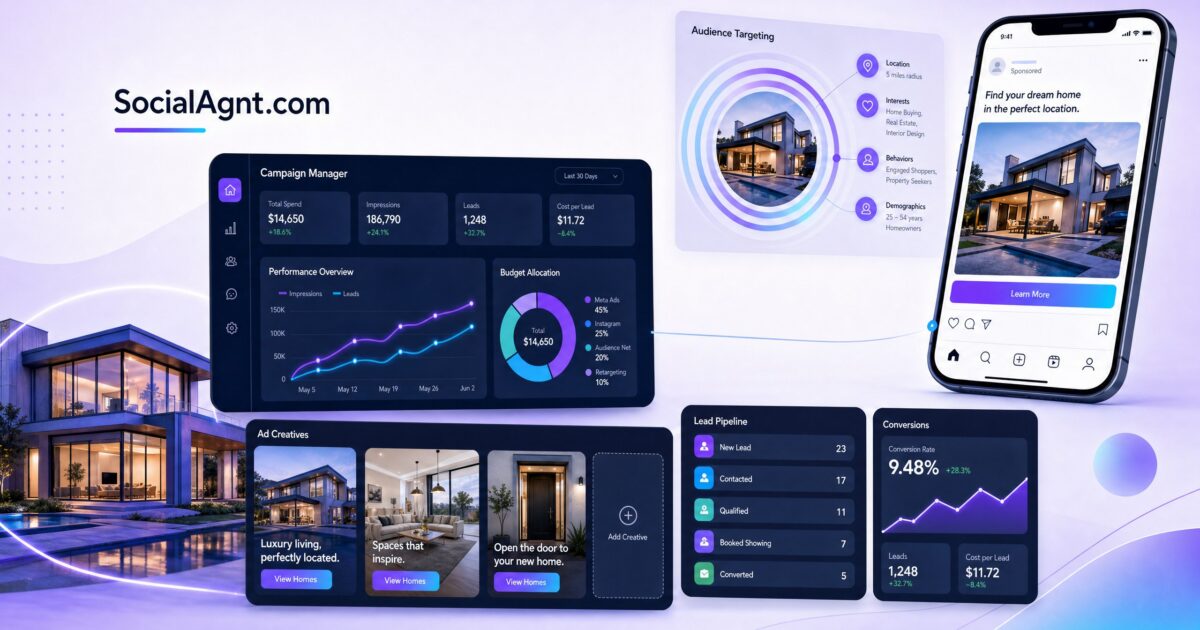
Key Takeaways: Social media advertising for real estate agents offers something no other advertising channel can match: the ability to target specific audiences based on demographics, interests, behaviors, life events, and geography — and then show them visually compelling ads for your listings, your services, and your brand at a fraction of the cost of traditional advertising. While organic social media builds your foundation, paid advertising accelerates your results and puts you in front of people who would never find you through organic content alone. This guide covers the fundamentals of paid social media strategy for real estate: platform selection, audience targeting, ad creative, budgeting, campaign types, retargeting, compliance, and measuring ROI — everything you need to run profitable ad campaigns that generate real leads.
Why Paid Social Media Advertising Works for Real Estate
Organic social media content reaches the people who already follow you. Paid social media advertising reaches everyone else — the vast majority of potential buyers and sellers in your market who haven’t discovered you yet. That distinction is fundamental to understanding why paid advertising is worth the investment.
Consider the math: even if you have 2,000 Instagram followers, organic reach means each post is seen by roughly 200–400 of them. In a market with 100,000+ potential homeowners, your organic reach represents a tiny fraction of your addressable audience. Paid advertising lets you reach the other 99,600 people — targeted specifically to those who are most likely to need a real estate agent.
The targeting capabilities of social media advertising are what make it uniquely powerful for real estate. Facebook and Instagram allow you to target people based on location (down to specific zip codes), age, income level, homeownership status, life events (recently engaged, recently moved, new job), interests (home improvement, real estate investing, interior design), and behaviors (likely to move, mortgage inquiries). No billboard, mailer, or newspaper ad can target this precisely.
And the economics are favorable. A well-optimized Facebook lead ad campaign can generate real estate leads for $3–$15 each, depending on the market. Compare that to Zillow Premier Agent ($20–$60+ per lead in competitive markets), direct mail ($1–$3 per piece with a 1-2% response rate), or print advertising (hundreds of dollars with no targeting and no tracking). Social media advertising offers the best combination of targeting precision, cost efficiency, and measurability available to real estate agents.
Choosing the Right Advertising Platform
Not all social media platforms are equal when it comes to advertising. Each has different strengths, audience profiles, and ad formats. For most real estate agents, the right approach is to start with one platform, master it, and then expand.
Facebook and Instagram Ads (Meta)
Facebook and Instagram share an advertising platform (Meta Ads Manager), which means you can run ads on both platforms from a single dashboard. This is the most powerful and versatile advertising platform for real estate agents, and it should typically be your first investment.
Strengths: The most sophisticated targeting options of any social platform. Lead ad formats with built-in forms that auto-populate user information (dramatically reducing friction). Retargeting capabilities through the Meta Pixel. Massive reach — Facebook and Instagram combined cover virtually every demographic relevant to real estate. Multiple ad formats: image, video, carousel, Stories, Reels. Detailed analytics and optimization tools.
Best for: Lead generation campaigns, listing promotion, brand awareness, retargeting website visitors, and reaching both buyers and sellers in your local market.
TikTok Ads
TikTok’s advertising platform is younger but maturing rapidly. TikTok ads appear natively in the For You Page feed, making them feel less like interruptions and more like content.
Strengths: High engagement rates — TikTok users are accustomed to watching full-screen video content, so ads get more attention than on scroll-heavy platforms. Strong with younger demographics (25–40), which includes the largest segment of first-time homebuyers. Video-native format is perfect for showcasing properties and neighborhoods.
Best for: Brand awareness and top-of-funnel visibility, particularly for agents targeting first-time buyers and younger demographics. Less proven for direct lead generation compared to Meta, but improving.
LinkedIn Ads
LinkedIn advertising reaches a professional audience with high purchasing power, but at a significantly higher cost per click than Facebook or Instagram.
Strengths: Precise professional targeting — you can target by job title, company, industry, income level, and seniority. Ideal for reaching corporate relocation clients, executives, and high-net-worth individuals. Less ad competition from other agents (most agents don’t advertise on LinkedIn).
Best for: Luxury agents, agents targeting corporate relocations, and agents who serve high-income professionals. Not cost-effective for general buyer or seller lead generation due to higher CPMs.
YouTube Ads
YouTube ads (managed through Google Ads) let you place video ads before, during, or alongside YouTube content. For real estate, this is particularly powerful because you can target people watching real estate-related content — home tours, market updates, and moving advice videos.
Strengths: Video format is ideal for real estate. Targeting by content topic means your ad reaches people already interested in real estate. Geographic targeting ensures you reach people in your market. Connection to Google’s broader advertising ecosystem.
Best for: Brand building and awareness campaigns, particularly for agents who already create video content and want to amplify it.
Facebook and Instagram Ad Campaigns for Real Estate
Since Meta’s platform is the most effective starting point for most agents, let’s dive deep into the campaign types that generate real results.
Lead Generation Campaigns
Facebook Lead Ads are the workhorse of real estate social media advertising. They include a built-in form that auto-fills with the user’s contact information (name, email, phone number) when they click, which means someone can express interest and submit their details without ever leaving Facebook or Instagram. This frictionless experience produces significantly higher conversion rates than sending people to an external landing page.
Best lead ad offers for real estate:
“What’s your home worth? Get a free instant estimate.” — Targets homeowners who are curious about their property value (high seller intent). This is consistently the highest-converting real estate lead ad offer because it promises immediate, personal value.
“Download our free guide to buying a home in [city].” — Targets potential buyers who are in research mode. The guide serves as both lead capture and a nurturing tool.
“See new listings before they hit the market.” — Appeals to active buyers who want a competitive advantage. Offer early access to new listings in exchange for contact information.
“Free 15-minute consultation: Is now the right time to sell?” — Targets sellers who are on the fence. The consultation offer is specific and low-commitment enough to generate responses.
Traffic Campaigns
Traffic campaigns drive people to your website, landing pages, or property listings. These are useful when you have a high-converting landing page with lead capture forms, a specific listing you want to promote (driving traffic to the property’s listing page), or content you want to amplify (driving traffic to a blog post that includes a lead magnet). Traffic campaigns don’t capture leads within Facebook — they send people to your website, where your own lead capture mechanisms (forms, chatbots, pop-ups) need to convert them.
Retargeting Campaigns
Retargeting is advertising to people who have already interacted with your brand — visited your website, watched your videos, engaged with your social posts, or are in your contact database. Retargeting audiences are warmer than cold audiences, which means they convert at higher rates and lower costs.
Install the Meta Pixel on your website to track visitors. Then create retargeting audiences: website visitors in the last 30 days (show them listing ads and testimonials), people who visited your home valuation page but didn’t submit (show them the valuation offer again), people who watched 50% or more of your videos (they’re interested — show them a lead gen offer), and your existing email list (upload it to Meta for matched audience targeting).
Retargeting keeps you visible throughout the long real estate buying cycle. Someone who visited your website in January and sees your retargeting ads throughout February, March, and April is far more likely to contact you when they’re ready to act than someone who visited once and forgot about you.
Just-Listed and Just-Sold Campaigns
Promote specific listings or recent sales to targeted geographic areas. A just-listed ad targeted to a one-mile radius around the property reaches the neighbors who are most likely to know someone who wants to move to the area — or who might be considering selling themselves. A just-sold ad (“Another home sold in [neighborhood] — wondering what yours is worth?”) targets homeowners in the surrounding area and generates seller leads by creating awareness of local market activity.
SocialAgnt builds your organic social media foundation across Instagram, Facebook, TikTok, LinkedIn, YouTube, and Google Business Profile — so when you’re ready to add paid advertising, you have high-performing content to promote and retarget. Start with organic. Amplify with ads. Start free today.
Audience Targeting Strategies
Geographic Targeting
For real estate, geographic targeting is your most fundamental targeting layer. You can target by city, zip code, radius around an address, or designated market area. For most campaigns, target the geographic areas where you actively work — casting too wide a net wastes budget on people outside your service area.
For just-listed campaigns, target a tight radius (1–5 miles) around the property. For general lead generation, target your entire service area. For relocation-focused campaigns, target people who live in other cities but have shown interest in your area (using interest targeting combined with geographic exclusion).
Demographic and Interest Targeting
Layer demographic and interest targeting on top of geography to narrow your audience to the most relevant prospects. For buyer leads, target ages 25–55, household income above the median for your market, interests in home improvement, real estate, mortgage, and home decorating. For seller leads, target homeowners (Facebook identifies homeownership status as a demographic), ages 30–65, and interests in home valuation, home improvement, and moving.
Life Event Targeting
Facebook allows targeting based on life events — recently engaged, recently married, new job, expecting a child, recently moved. Each of these life events is a strong predictor of a real estate transaction. A recently engaged couple is likely to buy a home within one to two years. A family expecting a child may need to upsize. Someone who recently started a new job in your city may need to relocate.
Lookalike Audiences
One of Meta’s most powerful targeting tools is lookalike audiences. Upload a list of your past clients (their email addresses) and Meta will find people who share similar characteristics — demographics, interests, and online behaviors. A 1% lookalike audience based on your past clients is a highly refined group of people who look like the people who’ve already hired you. These audiences typically produce the lowest cost per lead of any targeting strategy.
Custom Audiences for Retargeting
Build custom audiences from: your website visitors (via Meta Pixel), your email subscriber list (upload to Meta), people who’ve engaged with your Facebook or Instagram profiles in the last 90 days, and people who’ve watched a specific percentage of your videos. These audiences represent people who already know you, making them the most cost-effective to advertise to.
Ad Creative That Converts
Visual Best Practices
Real estate ads live and die by their visuals. Your ad creative needs to stop the scroll — compete for attention against friends’ photos, entertainment content, and other ads. Use high-quality, bright, well-composed images. For listing ads, use your best property photo — the shot that makes someone stop and say “I want to live there.” For agent brand ads, use a professional photo of you that conveys warmth and competence. For video ads, the first two seconds must be visually compelling — start with the most impressive shot, not a slow build.
Copy That Drives Action
Ad copy should be concise, benefit-focused, and include a clear call to action. Lead with the value to the viewer, not features about you. “Find out what your home is worth in today’s market — free, instant estimate” is stronger than “I provide free home valuations to homeowners in [city].” The first version is about the viewer. The second is about you.
Include a sense of urgency when appropriate: “Spring market is heating up — find out what your home could sell for before the rush.” End every ad with a clear CTA: “Get your free estimate,” “Download the guide,” “Schedule your consultation.”
Ad Formats That Work for Real Estate
Single image ads: Clean, simple, and effective. One beautiful property photo or a professional photo of you with a compelling headline. Works well for lead gen and brand awareness.
Video ads: Highest engagement rates. Use 15–30 second videos for feed placement and 60-second videos for longer-form storytelling. Property tours, market commentary, and agent introduction videos all perform well.
Carousel ads: Multiple images that viewers swipe through. Perfect for showcasing multiple rooms of a property, comparing neighborhoods, or presenting “before and after” staging transformations.
Stories and Reels ads: Full-screen, vertical format that feels native to the Stories and Reels experience. Use for listing teasers, quick market tips, and brand awareness. These placements often have lower costs than feed placements.
Budgeting and Optimization
Starting Budget
Start with $10–$20 per day per campaign. This is enough to generate data, test your targeting and creative, and start generating leads without a significant financial risk. At $10/day, you’re spending $300/month — and if your cost per lead is $10, that’s 30 leads per month. If one of those leads converts to a client, the ROI on a single commission far exceeds the ad spend.
Testing and Iteration
Never run a single ad and hope it works. Run two to three variations of each campaign — different images, different headlines, different audiences — and let the data tell you what works. After a week, pause the underperformers and increase budget on the winners. This testing discipline is what separates agents who get a great return on ad spend from agents who say “Facebook ads don’t work for me.”
Key Metrics to Monitor
Cost per lead (CPL): Your primary metric. Divide your ad spend by the number of leads generated. For most markets, a well-optimized real estate lead campaign should produce leads for $5–$15 on Facebook. If your CPL is above $20, your targeting, creative, or offer needs adjustment.
Click-through rate (CTR): The percentage of people who click your ad. A CTR below 1% suggests your creative isn’t compelling enough. Above 2% is strong for real estate.
Conversion rate: The percentage of people who click and then complete your desired action (fill out the form, download the guide, submit their information). Low conversion rates suggest friction in your lead capture process.
Cost per result by audience: Compare your CPL across different audience segments to identify which targeting strategies produce the most affordable leads. Shift budget toward your best-performing audiences.
Fair Housing Compliance in Social Media Advertising
Real estate advertising is subject to the Fair Housing Act, which prohibits discrimination based on race, color, religion, sex, national origin, familial status, or disability. On social media, this has specific implications.
Meta requires real estate advertisers to use their Special Ad Category for housing ads. This limits certain targeting options — you cannot target by age, gender, zip code (only a minimum 15-mile radius), or certain interest categories. These restrictions are designed to prevent discriminatory targeting. Ensure you select the housing Special Ad Category when creating any real estate ad. Failure to do so violates both Meta’s policies and potentially the Fair Housing Act.
Beyond targeting, your ad copy and imagery should be inclusive and avoid language that could be interpreted as discriminatory. Don’t use phrases that reference specific demographic groups (“perfect for young couples” or “great family neighborhood”) in ways that could exclude protected classes. Focus on property features and market information rather than descriptions of who should or shouldn’t live somewhere.
Common Advertising Mistakes
Running ads without a lead capture system. If someone clicks your ad and lands on a generic homepage with no clear next step, you’ve wasted the click. Every ad should lead to a purpose-built landing page or lead form with a single, clear call to action.
Not following up on leads. Generating a lead is only the beginning. If you don’t follow up within hours (ideally minutes), the lead goes cold. Before spending money on ads, ensure you have a follow-up system — automated email responses, text notifications, and CRM integration — that ensures every lead gets contacted quickly.
Giving up too early. A common pattern: an agent runs ads for two weeks, generates twenty leads, doesn’t close any of them immediately, and declares that ads “don’t work.” Real estate leads from social media often have longer timelines — many are three to twelve months from transacting. The leads you generate in March might convert in September. Build a nurture system and measure ROI over a twelve-month window, not a two-week sprint.
Not testing creative variations. Running one ad with one image and one headline gives you no information about what works best. Always test at least two to three variations so you can optimize based on performance data rather than guesswork.
Ignoring retargeting. Cold audience campaigns get all the attention, but retargeting campaigns almost always produce the best ROI. Install your Meta Pixel from day one and build retargeting campaigns as soon as you have enough website traffic. Retargeting is where the money is.
Your Social Media Advertising Action Plan
Week 1 — Set up your infrastructure: Install the Meta Pixel on your website. Create your Meta Ads Manager account. Set up a lead-capture landing page or form for your first campaign offer (home valuation or buyer guide). Ensure your CRM is ready to receive and tag leads from paid campaigns.
Week 2 — Launch your first campaign: Create a Facebook/Instagram lead ad campaign with your strongest offer. Set the housing Special Ad Category. Target your service area with appropriate demographic and interest targeting. Set a $10/day budget. Create two to three ad variations to test.
Weeks 3–4 — Optimize: Review your results after one week. Pause underperforming ad variations. Increase budget on winners. Test a new audience segment. Launch a retargeting campaign targeting your website visitors from the past 30 days.
Month 2 — Scale what works: Identify your best-performing campaign (by cost per lead and lead quality). Increase its budget gradually. Add a new campaign type — a just-listed promotion, a different lead magnet offer, or a video campaign. Build a lookalike audience from your existing client list.
Month 3 and beyond — Systematize: Social media advertising should become a consistent part of your marketing budget, not a one-time experiment. Allocate a monthly ad budget, maintain your campaigns, and continuously test and optimize. The agents who commit to paid advertising for six to twelve months build sophisticated, data-driven campaigns that produce predictable lead flow at a known cost per acquisition — the foundation of a scalable real estate business.
The best advertising strategy starts with a strong organic presence. SocialAgnt helps you build that foundation across Instagram, Facebook, TikTok, LinkedIn, YouTube, and Google Business Profile with AI-powered content, real estate templates, and smart scheduling — creating the content and audiences that make your paid campaigns more effective. Start free today.
Ready to save 5+ hours per week on social media?
SocialAgnt helps real estate agents schedule posts, create AI content, and grow their brand across 7 platforms. Try it free for 14 days.
