
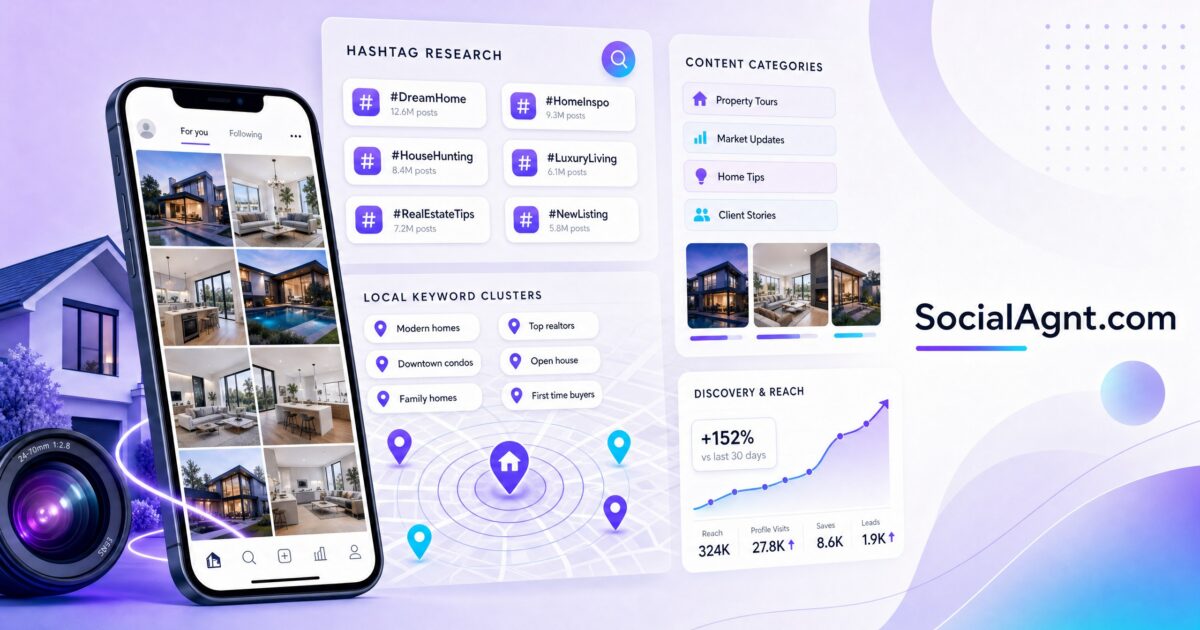
Key Takeaways: Real estate hashtags are one of the most misunderstood tools in social media marketing. Most agents either ignore them entirely or spam thirty random hashtags on every post hoping something sticks. Neither approach works. A strategic hashtag strategy — built on understanding how each platform’s algorithm uses hashtags, targeting the right mix of broad and niche tags, and adapting your approach by platform and content type — can significantly increase your content’s discoverability, attract qualified local followers, and put your posts in front of people actively searching for real estate information in your market. This guide breaks down exactly how hashtags work on every platform, the best hashtags for real estate agents by category, common mistakes to avoid, and a system for building and maintaining your own optimized hashtag strategy.
How Hashtags Actually Work in 2026
Hashtags have evolved significantly since the early days of Instagram when stuffing thirty tags on every post was a legitimate growth strategy. Today, each platform treats hashtags differently, and understanding these differences is essential for using them effectively.
At their core, hashtags serve two functions: categorization and discovery. When you add #firsttimehomebuyer to a post, you’re telling the platform’s algorithm what your content is about (categorization) and making it findable by people who search for or follow that hashtag (discovery). But the weight each platform gives to hashtags — and how they distribute hashtagged content — varies dramatically.
Instagram Hashtags
Instagram uses hashtags as one of several signals to categorize and distribute content. When you search a hashtag on Instagram, you see a feed of posts using that tag — sorted by relevance and recency. Posts can also appear in the Explore page when their hashtags align with a user’s interests.
Instagram’s current best practice is to use 3–5 highly relevant hashtags per post rather than the maximum of 30. Instagram’s own creator guidance has confirmed that a smaller number of targeted, relevant hashtags outperforms a large number of broad tags. The algorithm prioritizes relevance — a post about a home for sale in Denver that uses #denverrealestateagent will perform better than the same post with thirty generic tags like #realestate #home #dreamhome #househunting.
Place your hashtags in the caption (not a separate comment — Instagram has confirmed that caption placement performs better for distribution). Choose hashtags that accurately describe your content, your location, and your audience.
TikTok Hashtags
TikTok’s algorithm is less dependent on hashtags than Instagram’s — the algorithm primarily uses video content signals (what’s in the video, the audio, on-screen text, and viewer behavior) to categorize and distribute content. However, hashtags on TikTok serve as an additional categorization signal and are indexed for search.
Use 3–5 hashtags on TikTok that describe your content’s topic and location. Include one to two broad real estate hashtags (#realestate, #realestateagent) and one to two specific hashtags (#[city]realestate, #firsttimehomebuyer). TikTok’s search functionality is increasingly important — people search TikTok like a search engine — so think of hashtags as search keywords that help your content appear in relevant search results.
LinkedIn Hashtags
LinkedIn uses hashtags for content categorization and feed distribution. Users can follow hashtags, meaning your hashtagged content can appear in the feeds of people who follow those tags even if they’re not in your network. Use 3–5 professional, relevant hashtags. LinkedIn is a professional platform, so stick to industry-relevant tags: #realestate, #realestatemarket, #[city]realestate, #homebuying, #realestateinvesting. Avoid overly casual or irrelevant hashtags.
Facebook Hashtags
Facebook’s relationship with hashtags has always been inconsistent. Hashtags are searchable on Facebook, but they have minimal impact on content distribution compared to other platforms. Using one to three relevant hashtags on Facebook posts won’t hurt, but don’t expect them to drive significant additional reach. On Facebook, your content’s performance is determined much more by engagement signals (likes, comments, shares) than by hashtag usage.
YouTube Hashtags
YouTube allows up to 15 hashtags in your video description, with the first three appearing above your video title as clickable links. YouTube hashtags contribute to search discoverability — when someone clicks a hashtag, they see other videos using that tag. Use hashtags that match the search terms your audience would use: #[city]realestate, #homebuyingtips, #[neighborhood]tour, #realestatemarketupdate. YouTube’s algorithm relies more heavily on title, description, tags, and watch time than hashtags, but they provide a useful supplementary discoverability signal.
Google Business Profile Hashtags
Google Business Profile posts don’t use hashtags in the traditional social media sense. Instead, focus your GBP posts on location-specific keywords naturally woven into your post text — this is more effective for local search visibility than hashtags.
Building Your Real Estate Hashtag Strategy
An effective hashtag strategy isn’t about finding a magic list of tags and using them on every post. It’s about building categorized sets of hashtags that you rotate based on your content type, platform, and audience — ensuring your content reaches the right people consistently.
The Three-Tier Hashtag Framework
Tier 1 — Broad industry hashtags (1–2 per post): These are high-volume hashtags that define the general category of your content. They cast a wide net but face intense competition. Examples: #realestate, #realtor, #homesforsale, #realestateinvesting, #firsttimehomebuyer. Use one or two of these per post for broad categorization. Don’t rely on them for discoverability — the volume of content using these tags means your post will be buried quickly.
Tier 2 — Niche and topic-specific hashtags (2–3 per post): These are medium-volume hashtags that describe the specific topic of your post. They have less competition than broad tags, which means your content stays visible longer. Examples: #homebuyingprocess, #sellingyourhome, #realestatetips, #openhouse, #luxuryhomes, #homeinspection, #mortgagetips, #realestatemarketing. Match these to your content’s actual topic — a post about the buying process gets #homebuyingprocess, not #homeinspection.
Tier 3 — Local and hyperlocal hashtags (1–2 per post): These are the most valuable hashtags for real estate agents because they target people who are interested in your specific market. They have the lowest volume but the highest relevance and intent. Examples: #[city]realestate, #[city]homes, #[neighborhood]living, #[city]realtor, #livingin[city], #[city]realestateagent. These hashtags connect you with people who are searching for real estate content in your exact market — the audience most likely to become clients.
The formula: 1 broad + 2 niche + 2 local = 5 highly targeted hashtags per post. This is far more effective than 30 random hashtags and takes a fraction of the time to implement.
Creating Hashtag Sets by Content Type
Build pre-made hashtag sets for your recurring content types so you’re not reinventing your hashtag strategy with every post.
Listing posts: #[city]homesforsale #[neighborhood]realestate #justlisted #[city]realtor #homesforsale
Market updates: #[city]realestatemarket #housingmarket #marketupdate #[city]realestate #realestatedata
Educational content: #homebuyingtips #firsttimehomebuyer #realestatetips #[city]realtor #homeownership
Neighborhood content: #[neighborhood]living #livingin[city] #[city]neighborhoods #[neighborhood] #[city]lifestyle
Just sold / testimonials: #justsold #happyhomeowners #[city]realestateagent #clientreview #soldby[yourname]
Open house: #openhouse #[city]openhouse #housetoursaturday #[neighborhood]openhouse #comeseetoday
Rotate within each set — don’t use the exact same hashtags on every post of the same type. Instagram’s algorithm can interpret repeated identical hashtag usage as spammy behavior, which may limit your reach. Vary your selections while staying within the same strategic framework.
SocialAgnt’s AI analyzes your content and suggests optimized hashtags tailored to your market, content type, and platform — so every post reaches the right audience without the guesswork. Schedule posts with smart hashtags across Instagram, Facebook, TikTok, LinkedIn, YouTube, and Google Business Profile. Start free today.
Researching and Finding the Best Hashtags for Your Market
The hashtag examples above are starting points — the most effective hashtags for your business will be specific to your market, your niche, and your audience. Here’s how to research and identify the best ones.
Platform Search
The simplest research method: go to Instagram’s search bar, type a keyword related to your market (#dallasrealestate), and look at the related hashtags Instagram suggests. Note the post volume for each — this tells you how competitive the hashtag is. Repeat this on TikTok’s Discover page and YouTube’s search. This gives you a real-time view of what hashtags are active and relevant on each platform.
Competitor Analysis
Find five to ten successful real estate agents in your market (or similar markets) and study their hashtag usage. What hashtags do they use consistently? Which of their posts get the most engagement, and what hashtags are on those posts? This isn’t about copying — it’s about understanding what’s working in your market and adapting it to your own strategy.
Audience Research
Think about what your ideal client would search for on social media. A first-time buyer in Phoenix might search #phoenixfirsttimehomebuyer or #arizonahomebuying. A relocating tech worker might search #movingtoaustin or #austintxrealestate. Put yourself in your audience’s shoes and build your hashtag list based on their search behavior, not just industry jargon.
Hashtag Volume Sweet Spots
For Instagram specifically, there’s a strategic balance between hashtag volume (how many posts use that tag) and your ability to rank within it. Hashtags with millions of posts (#realestate has over 100 million) are so competitive that your post will be invisible within seconds. Hashtags with fewer than 1,000 posts have too little search volume to drive meaningful discoverability.
The sweet spot for most real estate agents is hashtags with 10,000 to 500,000 posts. These have enough volume to indicate active search interest but low enough competition that your content can actually be seen. Your local hashtags (#[city]realestate, #[neighborhood]homes) often fall naturally into this range, which is another reason local hashtags are so valuable.
Platform-Specific Hashtag Best Practices
Instagram Best Practices
Use 3–5 hashtags per post (not 30). Place them in your caption, not a separate comment. Mix broad, niche, and local hashtags using the three-tier framework. Rotate your hashtag sets — don’t repeat the same exact combination on every post. For Reels specifically, hashtags play a smaller role than they do for feed posts — the algorithm relies more on content signals — but including 3–5 relevant hashtags still helps with search discoverability. For Stories, use one to two hashtags maximum — you can add them as stickers or in the text, or use the location sticker for local discoverability.
TikTok Best Practices
Use 3–5 hashtags in your caption. Include location-specific tags because TikTok’s search increasingly serves local results. Don’t use #fyp or #foryou — these are not effective for reaching new audiences and take up space that could be used for relevant, descriptive hashtags. Think of TikTok hashtags as search keywords: what would someone type into TikTok’s search bar if they were looking for your content?
LinkedIn Best Practices
Use 3–5 hashtags at the end of your post. Keep them professional and industry-relevant. #RealEstate #RealEstateMarket #[City]RealEstate #HomeOwnership #RealEstateInvesting are appropriate. Casual or trendy hashtags that work on Instagram (#DreamHome #HouseGoals) feel out of place on LinkedIn.
YouTube Best Practices
Add 3–5 hashtags in your video description. The first three will appear above your video title as clickable links — make them your most important keywords. Use hashtags that match real search queries: #[City]HomeTour #FirstTimeHomeBuyer #RealEstateMarketUpdate2026. Also optimize your title, description, and tags independently — YouTube’s algorithm weights these more heavily than hashtags for search ranking.
Branded Hashtags: Creating Your Own
A branded hashtag is a custom tag unique to your business. It won’t drive discoverability (since nobody searches for it initially), but it serves two important purposes: organizing your content library and building brand recognition over time.
Create a branded hashtag using your name, brand name, or tagline: #HomesWith[YourName], #[YourName]RealEstate, or #[YourBrand]Homes. Use it on every post. Encourage clients to use it when they share their closing photos or home purchase stories. Over time, your branded hashtag becomes a curated feed of your content and client experiences — a portfolio of social proof that potential clients can browse.
A branded hashtag also makes it easy to track your content across platforms and see how clients and partners are engaging with your brand. It’s a small investment that compounds in value as you build your content library.
Common Hashtag Mistakes Real Estate Agents Make
Using too many hashtags. The era of stuffing 30 hashtags on every Instagram post is over. Instagram has explicitly recommended using fewer, more relevant hashtags. Overloading hashtags looks desperate, dilutes relevance, and can trigger algorithmic suspicion of spam. Three to five well-chosen hashtags outperform thirty random ones — the data is clear on this.
Using the same hashtags on every post. Using the exact same set of hashtags on every post signals to algorithms that you may be using automated spam tactics. It also limits your reach to the same audience segments. Rotate your hashtags based on content type, and vary your selections within each category to reach different audience pockets.
Using irrelevant hashtags for reach. Adding trending or viral hashtags that have nothing to do with your content (#food #travel #motivation on a listing post) doesn’t help. It signals to the algorithm that your content doesn’t match the hashtag’s topic, which can actually reduce your reach. Relevance is the fundamental principle — every hashtag should accurately describe what your post is about.
Ignoring local hashtags. Agents who only use broad national hashtags (#realestate #homesforsale) miss the most valuable opportunity: reaching people who are specifically interested in their local market. Your local hashtags (#[city]realestate #[neighborhood]homes) are where your actual future clients are searching.
Not tracking hashtag performance. Many agents never check which hashtags are actually driving reach and engagement. Instagram’s native analytics show you how many impressions came from hashtags. Review this data monthly and drop hashtags that aren’t performing. Replace them with new options and test again. Your hashtag strategy should evolve based on data, not remain static.
Using banned or restricted hashtags. Some hashtags are periodically restricted by Instagram (often due to spam or inappropriate content associated with the tag). Using a restricted hashtag can limit your post’s reach or prevent it from appearing in hashtag feeds entirely. Before adding a hashtag to your regular rotation, search for it on Instagram — if the results page shows a notice about hiding results, that hashtag is restricted. Remove it from your list immediately.
Your Hashtag Strategy Action Plan
Day 1 — Research your local hashtags: Search Instagram, TikTok, and YouTube for hashtags related to your market. Find 10–15 local hashtags with active usage. Note the post volume for each on Instagram. Identify which ones fall in the 10K–500K sweet spot.
Day 2 — Build your hashtag sets: Using the three-tier framework, create pre-made hashtag sets for each of your content types: listings, market updates, educational content, neighborhood content, testimonials, and open houses. Create three to four variations of each set for rotation.
Day 3 — Create your branded hashtag: Choose a branded hashtag that’s unique to you. Check that it’s not already in use (or that existing usage is minimal). Start using it on every post across all platforms.
Week 2 — Implement and monitor: Apply your hashtag sets to every new post. Use your content scheduling platform to save hashtag sets for quick application. At the end of the week, check Instagram’s post insights to see how many impressions came from hashtags.
Month 2 — Optimize: Review one month of hashtag performance data. Identify your top-performing hashtags and your underperformers. Replace underperformers with new options. Refine your sets. This monthly review and optimization is what turns a good hashtag strategy into a great one — and tools like SocialAgnt make the process faster by suggesting optimized hashtags and tracking performance across platforms from one dashboard.
Hashtags aren’t a silver bullet. They’re one component of a comprehensive social media strategy. But when used strategically — with the right mix of broad, niche, and local tags, adapted for each platform, and optimized based on performance data — they meaningfully increase your content’s discoverability and put you in front of the people who are actively searching for a real estate professional in your market.
SocialAgnt’s AI doesn’t just schedule your posts — it suggests optimized hashtags based on your content, your market, and each platform’s best practices. Combined with multi-platform scheduling, real estate templates, and MLS integration, it’s the complete social media toolkit for real estate agents. Try SocialAgnt free.
Ready to save 5+ hours per week on social media?
SocialAgnt helps real estate agents schedule posts, create AI content, and grow their brand across 7 platforms. Try it free for 14 days.
