
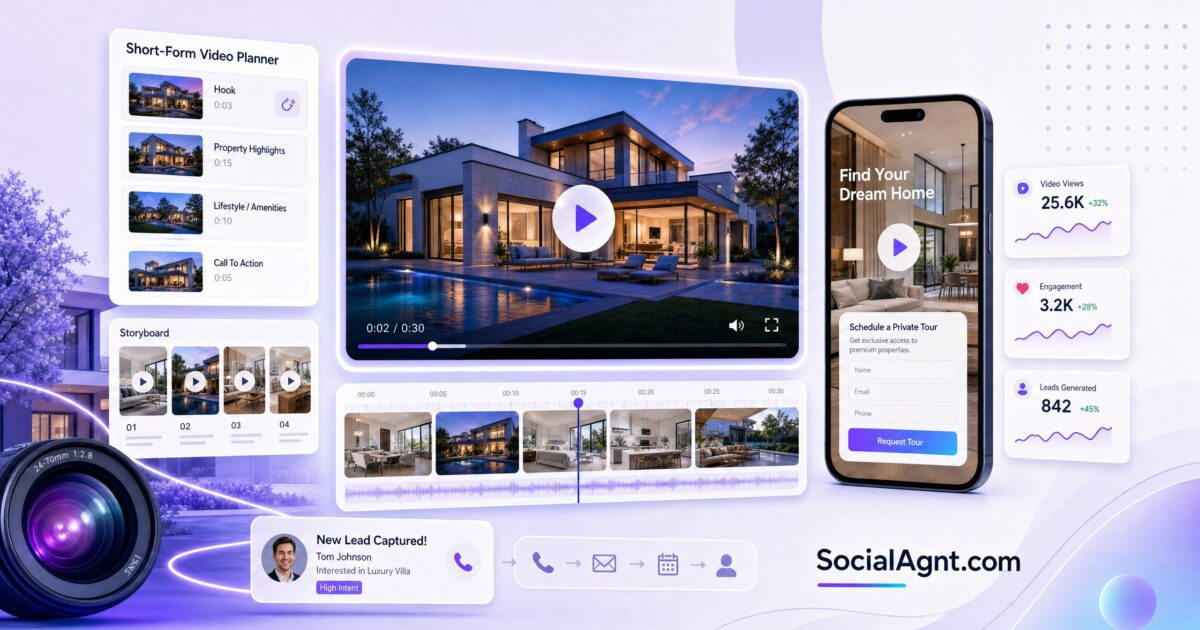
Key Takeaways: Real estate video marketing is no longer optional — it’s the single most effective way to build trust, showcase properties, and generate leads in a market where buyers and sellers expect to experience homes visually before they ever schedule a showing. Listings with video receive 403% more inquiries, agents who use video grow revenue 49% faster than those who don’t, and video content gets shared 1,200% more than text and images combined. This guide covers every aspect of real estate video marketing: the equipment you actually need, video types that generate business, filming and editing techniques, YouTube strategy, short-form video for social media, and how to turn views into clients.
Why Video Dominates Real Estate Marketing in 2026
Real estate is a visual business. People don’t buy homes from spreadsheets — they buy homes they can see, feel, and imagine themselves living in. Video is the closest a potential buyer can get to experiencing a property without walking through the front door. That’s why video has become the most powerful marketing tool in real estate, and why the gap between agents who use video and agents who don’t continues to widen.
The data tells a compelling story. According to the National Association of Realtors, 73% of homeowners are more likely to list with an agent who uses video, and listings with video receive dramatically more inquiries than those without. On social media, video content generates 1,200% more shares than text and image posts combined — meaning your listing videos, market updates, and educational content reach exponentially more people when delivered in video format.
But video’s power in real estate goes beyond listings. Video builds trust faster than any other content format because it lets potential clients see your face, hear your voice, and experience your personality before they ever meet you. A prospective buyer who’s watched twenty of your YouTube videos or Instagram Reels knows how you communicate, what you know about the market, and whether they’d enjoy working with you. By the time they reach out, the “getting to know you” phase is already complete. That’s why video leads convert at higher rates — the relationship started long before the first phone call.
Video Equipment: What You Actually Need
The biggest barrier to real estate video marketing isn’t technical skill — it’s the misconception that you need expensive equipment to create good video. You don’t. The camera in your pocket is more powerful than the professional cameras used to film feature films twenty years ago. Here’s what you actually need to start, and what to upgrade to when your video strategy is generating returns.
Starting Out: The Smartphone Setup
Camera: Your smartphone. Any iPhone from the 13 and up, or any Samsung Galaxy S series from the S21 and up, shoots video quality that is genuinely professional enough for social media and YouTube. Shoot in 4K when possible (for flexibility in editing) and use the wide-angle lens for interior shots.
Stabilization: A gimbal stabilizer (DJI OM series, $100–$150) transforms shaky handheld footage into smooth, cinematic walkthroughs. This is the single best equipment investment for real estate video. A basic phone tripod ($20–$30) works for stationary shots like market updates and talking-head content.
Audio: Audio quality matters more than video quality for viewer retention. A wireless lavalier microphone (Rode Wireless GO, $80–$200) clips to your clothing and captures clean audio even in echoey empty houses. For voiceover work and studio-style content, a USB microphone (Blue Yeti, $100) delivers excellent results.
Lighting: Natural light is your best friend for property videos — shoot during golden hour (the hour after sunrise and before sunset) for the most flattering natural light. For talking-head content, a basic ring light ($30–$50) or LED panel ($50–$100) dramatically improves video quality in any lighting condition.
Total starter investment: $150–$400 beyond the smartphone you already own.
Leveling Up: The Intermediate Setup
Once video is generating business for you, consider upgrading to a mirrorless camera (Sony a6400 or Canon EOS R50, $800–$1,200) for superior image quality and depth-of-field effects that make properties look stunning. Add a wide-angle lens (10–18mm for crop sensor) for interior shots that make rooms feel spacious and inviting. A drone (DJI Mini series, $300–$800) adds aerial footage that showcases properties, neighborhoods, and landscapes in ways that ground-level video can’t match. Note that commercial drone use requires an FAA Part 107 certificate — which involves passing a knowledge test that takes most people two to four weeks of preparation.
Types of Real Estate Videos That Generate Business
Not all real estate videos are created equal. Some attract views but don’t generate leads. Others generate leads directly. A complete video marketing strategy includes both — high-reach content that builds your audience and high-intent content that converts viewers into clients.
Property Listing Videos
Listing videos are the most straightforward application of video in real estate — and when done well, they’re incredibly effective at driving inquiries, attracting out-of-area buyers, and selling homes faster.
The cinematic walkthrough: A professionally shot, edited walkthrough set to music that showcases the property’s best features. Start with an exterior establishing shot (drone footage if available), move through the front door, and flow through the home in a logical path. Linger on standout features — the kitchen island, the view, the master bath, the backyard. Keep it under two minutes for social media, three to five minutes for YouTube and MLS. This style requires more editing but produces the highest-quality result.
The guided tour: You walk through the property on camera, narrating as you go — pointing out features, sharing your professional opinion, and giving viewers the experience of being shown the home by an agent. This format builds personal connection because viewers see and hear you, not just the property. It’s also faster to produce than a cinematic walkthrough because it requires less editing.
The quick-hit social media tour: A 30–60 second, high-energy walkthrough designed for Instagram Reels, TikTok, and YouTube Shorts. Start with a hook (“Wait until you see this kitchen”), move through the home quickly with dynamic transitions, and end with a CTA (“DM me for a private showing”). These shorter videos are designed for shareability and reach — they’re the top of the funnel that drives attention to the full listing.
Neighborhood and Community Tours
Neighborhood tour videos are among the highest-value content an agent can create because they attract relocating buyers who are researching your area — people who don’t have a local agent yet and are actively looking for one.
A strong neighborhood tour covers: a driving or walking tour of the area with your narration, highlights of key amenities (parks, restaurants, coffee shops, schools, grocery stores), a sense of the neighborhood’s personality and lifestyle, home price ranges and typical property styles, commute times to major employment centers, and your honest insider perspective on who the neighborhood is best suited for. These videos rank well on YouTube for searches like “[neighborhood] tour,” “living in [city],” and “best neighborhoods in [city]” — searches with high buyer intent and long-tail value.
Market Update Videos
Monthly or weekly video market updates position you as the data-informed expert in your market. Cover key metrics — median price, days on market, inventory levels, sales volume — and add your professional analysis of what the numbers mean for buyers and sellers. These videos build trust through repeated, consistent delivery of valuable information. They’re also easy to produce (you can film them at your desk or in your car) and easy to repurpose as social media clips.
Educational and How-To Videos
Educational videos answer the questions your ideal clients are actively Googling: “How to buy your first home,” “What to expect at a home inspection,” “How to prepare your home for sale,” “What is earnest money,” “How does the closing process work.” These videos attract viewers who are actively in the buying or selling process — high-intent leads who need the expertise you’re demonstrating on camera.
The most effective educational videos solve one specific problem per video. Don’t try to explain the entire buying process in one video — create a series. This gives you more content, keeps each video focused and consumable, and gives viewers a reason to subscribe for the next installment.
Agent Brand Videos
A brand video is a two to three minute piece that tells your story — why you got into real estate, who you serve, what drives you, and what working with you looks like. It lives on your website’s About page, your YouTube channel, and your social media profiles. It’s the video that a prospective client watches when they’re deciding between you and two other agents. A strong brand video can be the tipping point that wins you the listing or the buyer.
Testimonial Videos
Video testimonials from past clients are the most powerful form of social proof in real estate marketing. A written testimonial is good. A video of a real person, on camera, explaining how you helped them buy or sell their home is orders of magnitude more convincing. Film a quick testimonial at closing (when emotions and satisfaction are highest) or schedule a brief session with happy clients. Keep it authentic — a slightly imperfect, genuine testimonial is more convincing than a scripted, over-produced one.
SocialAgnt lets you schedule video content across Instagram, Facebook, TikTok, LinkedIn, YouTube, and Google Business Profile from one dashboard. AI-powered captions optimized for each platform. Real estate templates for thumbnails and promotional posts. One video, six platforms, zero extra effort. Start free today.
YouTube Strategy for Real Estate Agents
YouTube is the most valuable long-form video platform for real estate agents because it functions as a search engine — the second largest search engine in the world, after Google. Unlike social media platforms where content has a lifespan of hours or days, YouTube videos can generate views and leads for years after publication.
YouTube SEO for Real Estate
Every YouTube video should be optimized for search, just like a blog post. Target specific keywords that your audience is searching for: “[neighborhood] tour 2026,” “buying a home in [city],” “first-time homebuyer tips,” “[city] real estate market update.”
Include your target keyword in: the video title (at the beginning if possible), the video description (first two sentences), your tags (include variations and related keywords), and your spoken content (YouTube’s auto-transcription indexes what you say). Write video descriptions of 200 words or more that naturally incorporate relevant keywords while providing a genuine summary of the video’s content. Add timestamps (chapters) for longer videos — this improves user experience and helps YouTube understand your content’s structure.
Thumbnail Design
Your thumbnail is the most important factor in whether someone clicks on your video. A great thumbnail has: a clear, readable text overlay (four to six words maximum) that communicates the video’s topic, a high-contrast image that’s visually striking at small sizes, your face (thumbnails with faces get higher click-through rates), and bright, saturated colors that stand out in search results and suggested video feeds. Use a consistent thumbnail style across your channel so returning viewers recognize your content instantly.
Building a YouTube Content Strategy
The most successful real estate YouTube channels follow a content mix that serves both search traffic and subscriber engagement. Evergreen search content — neighborhood tours, process explainers, market guides for your city — brings in new viewers from YouTube and Google search month after month. Recurring series — weekly market updates, “new listing of the week,” monthly market reports — give subscribers a reason to come back regularly. Trending or timely content — interest rate change reactions, new housing policy commentary, seasonal market shifts — captures attention during peak search moments.
Publish consistently. One video per week is ideal, but one video every two weeks is enough to build a channel that generates meaningful leads. Front-load your efforts on evergreen content — a library of 20 neighborhood tours and process explainer videos will generate compounding search traffic for years.
Short-Form Video Strategy: Reels, TikToks, and Shorts
Short-form video (under 90 seconds) is the dominant content format on social media in 2026. Instagram Reels, TikTok, YouTube Shorts, and Facebook Reels all prioritize short video content in their algorithms, giving creators who embrace the format disproportionate organic reach.
What Works in Short-Form Real Estate Video
The hook is everything. You have one to two seconds to convince someone not to scroll. Start with a bold statement (“This is the best house I’ve listed all year”), a question (“Would you buy this house for $350K?”), or a visual that stops the scroll (a stunning home exterior, a dramatic before-and-after).
Pace and energy matter. Short-form video rewards dynamic pacing — quick cuts, movement, transitions, and energy. A listing tour that slowly pans through each room loses viewers. A tour that moves briskly from hook to highlight to highlight to CTA keeps viewers watching through the end — and completion rate is the most important signal for algorithmic distribution.
One idea per video. Don’t try to cover five tips in 30 seconds. Cover one tip thoroughly, compellingly, and memorably. If you have five tips, make five videos. More content, each more focused and more likely to perform.
Captions are mandatory. A majority of social media video is watched without sound. If your video doesn’t have captions, you’re invisible to a significant portion of your potential audience. Use auto-caption tools (CapCut, Instagram’s built-in captions, or Descript) to add them automatically.
Repurposing Long-Form Video into Short-Form
Every long-form video you create (a YouTube neighborhood tour, a market update, an educational video) contains multiple short-form videos. A five-minute neighborhood tour can yield: a 30-second highlight reel of the best moments, a 15-second clip of the most impressive home feature, a 60-second summary of the neighborhood’s top three selling points, and a talking-head clip of your most compelling insight or opinion. This repurposing approach means one filming session produces content for YouTube and three to four Reels or TikToks — maximizing your return on time invested.
Video Editing Workflow for Real Estate Agents
Efficient editing is what makes video marketing sustainable. If every video takes three hours to edit, you’ll burn out. If you build a system that lets you edit in 30–60 minutes, video becomes a manageable part of your weekly routine.
The Fast Editing Process
Step 1 — Import and trim: Pull your footage into your editing app (CapCut for short-form, Descript or iMovie for long-form). Cut the beginning and end to remove the “starting and stopping” moments. Remove any major mistakes or dead time.
Step 2 — Add music and audio: Add background music that matches the mood (upbeat for listings, professional for market updates, relaxed for neighborhood tours). Adjust levels so music complements your voice without competing. If you recorded with a separate microphone, sync the external audio and mute the camera audio.
Step 3 — Add text and graphics: Add your title, location, price, and key property features as text overlays. Add your branding (logo, contact information) at the beginning or end. For educational content, add text that reinforces key points as you make them.
Step 4 — Add captions: Generate auto-captions and review for accuracy (auto-captions frequently misspell neighborhood names and real estate terminology). Adjust timing and styling to match your brand.
Step 5 — Export and distribute: Export in the right format for each platform. Use your social media scheduling tool to distribute across multiple platforms with platform-specific captions and hashtags.
Measuring Video Marketing ROI
Video marketing is an investment of time and potentially money. Track these metrics to ensure your investment is generating returns.
Views and reach: How many people are seeing your videos. Track this across platforms and over time. Are your videos reaching more people month over month?
Watch time and retention: How much of your videos people actually watch. Average view duration tells you whether your content holds attention. If viewers drop off at the 10-second mark, your hooks need work. If they watch 80% of a three-minute video, your content is compelling.
Engagement: Likes, comments, shares, and saves. These indicate your content resonated enough to provoke a reaction. Shares are particularly valuable — every share is your content being recommended to someone new.
Lead generation: How many leads can you trace back to video content? Track link clicks from video descriptions, DM conversations sparked by video comments, and direct inquiries that mention seeing your videos. Ask every new lead “How did you find me?” and note when the answer involves video.
Listing performance: For listing videos specifically, compare inquiries, showing requests, days on market, and sale price for listings with video versus listings without. This data builds the business case for investing in listing video for every property.
Common Video Marketing Mistakes
Waiting for perfection. The agents who succeed with video are the ones who start before they feel ready. Your first videos will not be your best — and that’s fine. The only way to get good at video is to make a lot of videos. Post imperfect content, learn from each video, and improve over time. The agent who’s published 100 mediocre-to-good videos will always outperform the agent who’s published zero perfect ones.
Making every video about a listing. Listing videos are important, but they’re only one piece of a video strategy. If your entire YouTube channel is listing tours, you’ll struggle to build a subscriber base because most viewers aren’t interested in every listing — they’re interested in your market expertise, your personality, and the value you provide. Mix listing content with educational, community, and personality-driven content.
Ignoring audio quality. Viewers will tolerate imperfect video quality. They will not tolerate bad audio. Wind noise, echo in empty rooms, and muffled sound from a distant phone microphone make videos unwatchable. Invest in a basic external microphone before you invest in anything else.
Not including calls to action. Every video should tell the viewer what to do next: subscribe, follow, click the link in your bio, schedule a consultation, comment with their question, share with a friend. Without a CTA, you’re creating content that entertains but doesn’t convert.
Publishing without optimizing. A video with a compelling title, optimized description, strategic tags, and an eye-catching thumbnail will get ten times the views of an identical video published with a generic title and no optimization. Spend fifteen minutes optimizing every video before you publish it.
Your Video Marketing Action Plan
Week 1 — Get your equipment and film your first video: Set up your smartphone, gimbal, and microphone. Film a market update or a neighborhood tour — whichever feels most comfortable. Edit it simply (trim, add music, add captions) and post it. The goal is to overcome the activation energy of starting.
Week 2 — Build your content rhythm: Film and publish two videos: one listing video and one educational or community video. Set up your YouTube channel with a professional banner and optimized description. Create a thumbnail template you can reuse.
Weeks 3–4 — Expand to short-form: Take your long-form videos and create short-form clips for Instagram Reels, TikTok, and YouTube Shorts. Post two to three short-form videos per week in addition to one long-form video. Use SocialAgnt to schedule and distribute across all platforms from one dashboard.
Month 2 — Optimize and systematize: Review your analytics. Which videos got the most views? Which generated comments and leads? Build a content calendar for the next month based on what’s working. Start batch-filming — dedicate one day every two weeks to filming multiple videos, then edit and schedule them throughout the following days.
Months 3–6 — Compound: Maintain your publishing consistency. Build your YouTube library of evergreen content. Develop your on-camera presence and editing skills. By month six, you should have a video library that’s generating search traffic, building your brand, and producing leads on autopilot — an asset that grows more valuable every month.
Real estate video marketing isn’t about becoming a content creator or a YouTube star. It’s about using the most powerful communication medium available to showcase your expertise, build trust at scale, and create a lead generation asset that compounds over time. Start today, improve as you go, and let the compound effect do the heavy lifting.
SocialAgnt was built for real estate agents who create video content and need it seen on every platform. Schedule videos to Instagram, Facebook, TikTok, LinkedIn, YouTube, and Google Business Profile with AI-optimized captions for each platform. Create once, reach everywhere. Start your free account today.
Ready to save 5+ hours per week on social media?
SocialAgnt helps real estate agents schedule posts, create AI content, and grow their brand across 7 platforms. Try it free for 14 days.
