
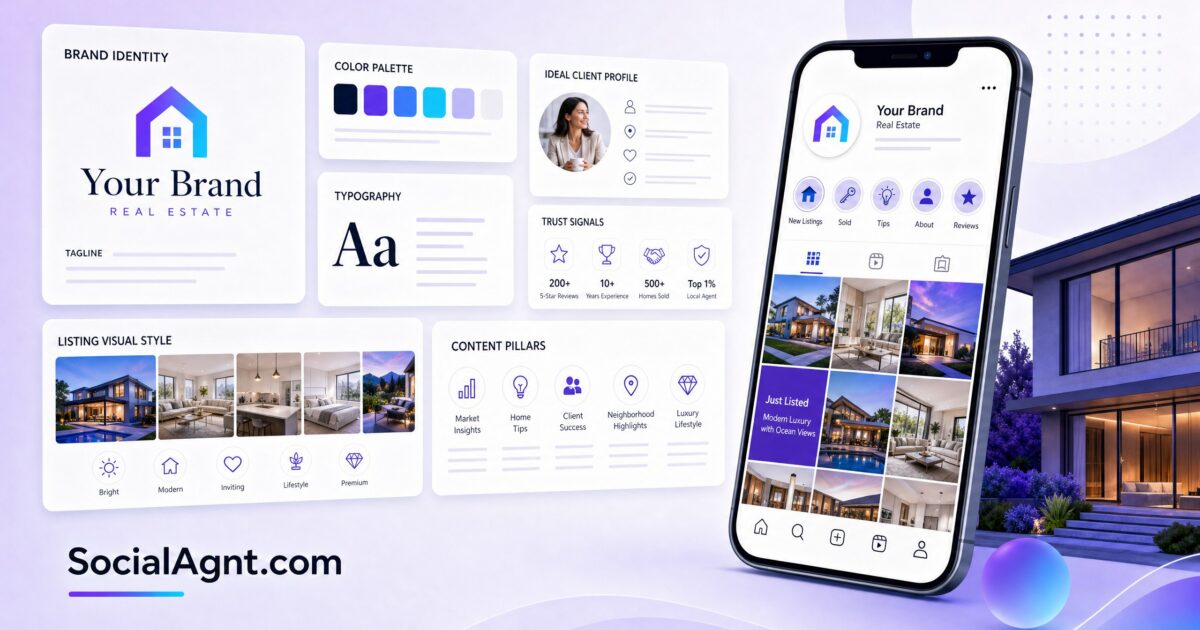
Key Takeaways: Real estate branding is the difference between being one of a thousand agents in your market and being THE agent people think of first. Your brand isn’t your logo — it’s the complete perception clients have of you based on how you look, communicate, and show up across every touchpoint. This guide walks you through building a real estate brand from scratch: defining your positioning, creating your visual identity, developing your brand voice, establishing consistency across platforms, and leveraging social media to amplify a brand that attracts clients instead of chasing them.
What Real Estate Branding Actually Means (It’s Not Just a Logo)
Real estate branding is one of the most misunderstood concepts in the industry. Most agents think branding means getting a nice logo and picking brand colors. Those are components of a brand, but they’re not the brand itself.
Your real estate brand is the total perception a potential client has of you before, during, and after working with you. It’s the feeling someone gets when they see your name in a search result, scroll past your Instagram post, or hear your name mentioned at a dinner party. It’s the answer to the question: “When people think of you, what do they think?”
Strong branding answers three questions instantly: Who are you? Who do you serve? Why should they choose you over every other agent? When those answers are clear, consistent, and compelling across every touchpoint — your website, social media, signage, email signature, business card, the way you dress at open houses, and the way you communicate with clients — that’s a brand. Everything else is decoration.
And here’s the business case: agents with strong personal brands charge higher commissions, attract clients through referrals and inbound leads rather than cold outreach, and build businesses that aren’t dependent on their brokerage’s name recognition. Your brokerage is a platform. Your brand is your business.
The Building Blocks of a Real Estate Brand
A complete real estate brand has six core elements. Think of them as layers that build on each other — skip one, and the whole structure feels incomplete.
1. Brand Positioning
Positioning is the foundation everything else is built on. It’s your answer to: “What makes me different from the hundreds of other agents in my market?” If your answer is “I provide great service” or “I really care about my clients,” you don’t have a position — you have table stakes. Every agent says those things.
Strong positioning requires specificity. You’re not just a “real estate agent in Denver.” You’re the agent who specializes in helping tech professionals relocate to Denver’s best walkable neighborhoods. Or the agent who focuses exclusively on first-time buyers in the $300K–$500K range. Or the luxury specialist who knows every penthouse and estate in the metro area.
To find your positioning, answer these questions honestly:
- What types of clients do you enjoy working with most?
- What neighborhoods or property types do you know better than anyone?
- What’s your unfair advantage — your background, network, knowledge, or skill set?
- If a past client were describing you to a friend in one sentence, what would they say?
The best positioning sits at the intersection of what you’re genuinely great at, what a specific audience needs, and what your competitors aren’t already owning. Finding that intersection is the most important branding work you’ll do.
2. Visual Identity
Your visual identity is the collection of design elements that make your brand instantly recognizable: your logo, color palette, typography, photography style, and graphic design templates. When someone scrolls past your Instagram post or drives past your yard sign, your visual identity should make them recognize it as yours before they even read your name.
Logo: Keep it clean and simple. The best real estate logos are memorable at small sizes (think social media profile photo) and look professional on signage, business cards, and digital platforms. Avoid overly complex designs, clip art, or generic house icons. A well-designed wordmark (your name in a distinctive font) often works better than a symbol-based logo. Invest in professional design — a $50 Fiverr logo communicates that you cut corners, which is not the message you want to send when someone is trusting you with a $500,000 transaction.
Color palette: Choose two to three primary colors and one to two accent colors. Your colors should reflect the feeling you want to evoke. Navy and gold communicate luxury and trust. Clean white with emerald accents feels modern and fresh. Warm neutrals with terracotta tones feel approachable and earthy. Whatever you choose, commit to it — use these exact colors on everything, every time. Consistency is what makes colors become “your” colors in people’s minds.
Typography: Select two fonts maximum — one for headings and one for body text. A serif font (like Playfair Display or Georgia) paired with a clean sans-serif (like Montserrat or Open Sans) is a timeless combination that works across digital and print. Avoid novelty fonts, script fonts that are hard to read, or anything that looks like it belongs on a party invitation.
Photography style: This is the element most agents overlook, and it makes a massive difference. Decide on a consistent visual aesthetic: bright and airy, dark and moody, warm and editorial, or clean and minimal. Your headshots, listing photos, lifestyle imagery, and social media visuals should all feel like they belong together. When someone scrolls your Instagram grid, the visual cohesion should be immediately apparent.
3. Brand Voice
Your brand voice is how you sound across all communication — social media captions, email newsletters, listing descriptions, text messages, and conversations. It should feel like a natural extension of your personality, dialed up slightly for clarity and consistency.
Define your voice with three to four adjectives. Are you warm and conversational? Professional and data-driven? Energetic and enthusiastic? Witty and irreverent? There’s no universally “right” voice for real estate — what matters is that it’s authentic to who you actually are and consistent across every channel.
Write a voice guide for yourself (or anyone who creates content for you) with specific examples:
- We say: “Let’s find you the perfect home” — Not: “Facilitating your residential real estate acquisition”
- We say: “Here’s what the data tells us” — Not: “Market conditions have fluctuated demonstrating variability”
- We say: “I’ve been in this neighborhood for 12 years and I can tell you…” — Not: “As an industry professional with extensive experience…”
The clearest sign of a weak brand voice is when your written content sounds like it could have been written by any agent anywhere. If you replaced your name with a competitor’s name and nothing felt off, your voice isn’t distinctive enough.
4. Brand Story
Every strong brand has a story — and for real estate agents, that story is deeply personal. Why did you get into real estate? What drives you? What experience or background gives you a unique perspective? Your brand story creates an emotional connection that a logo and a color palette never can.
The most compelling brand stories follow a simple structure: where you came from, the moment that led you to real estate, what you discovered about yourself in this career, and what drives you to show up every day for your clients. It doesn’t have to be dramatic. It just has to be true and specific.
Use your brand story in your social media bio, your website About page, your listing presentations, and your initial conversations with new clients. People remember stories far longer than they remember statistics. The agent who says “I got into real estate after my own terrible first-time buying experience — I swore no one I worked with would ever feel that lost” is infinitely more memorable than the agent who says “I’m passionate about helping people find their dream home.”
5. Brand Promise
Your brand promise is the specific commitment you make to every client. Not a vague promise like “exceptional service” — a tangible, measurable promise that sets expectations and holds you accountable.
Examples of strong brand promises: “I return every call within two hours.” “Every listing gets professional photography, video, and a custom social media campaign.” “You’ll never wonder what’s happening — I send you a weekly update every Friday, no matter what.” “If we can’t get your home sold in 60 days, I’ll cancel the listing, no questions asked.”
A clear brand promise differentiates you from competitors, gives clients a reason to choose you, and creates a standard you can consistently deliver against. When your promise aligns with what your target audience values most, it becomes a powerful conversion tool.
6. Brand Experience
Brand experience is what happens when a client actually works with you. It’s the gap (or alignment) between what your branding promises and what you actually deliver. The best visual identity and messaging in the world can’t save a brand that delivers a mediocre client experience.
Think about every touchpoint a client has with your brand: the first time they see you on social media, their first visit to your website, their first phone call or DM conversation, the listing presentation, the showing experience, communication during the transaction, closing day, and post-closing follow-up. Each touchpoint is an opportunity to reinforce or undermine your brand.
The agents with the strongest brands obsess over these touchpoints. They send handwritten thank-you notes. They have a polished listing presentation. They provide clients with a clear, beautiful timeline of the buying or selling process. They follow up after closing with anniversary messages and home maintenance tips. Every detail communicates: “This is a professional who cares about getting it right.”
SocialAgnt helps real estate agents maintain brand consistency across Instagram, Facebook, TikTok, LinkedIn, YouTube, and Google Business Profile with branded templates, consistent scheduling, and a unified visual identity. Your brand voice, your colors, every platform — automatically. Start free today.
Building Your Brand on Social Media
Social media is where your brand lives and breathes daily. It’s where potential clients discover you, evaluate you, and decide whether you’re someone they want to work with. Your website is your storefront. Your social media is the conversation that draws people inside.
Profile Consistency Across Platforms
Use the same professional headshot, the same display name format, and the same bio structure across every social media platform. This sounds basic, but a shocking number of agents have a professional photo on Instagram, a selfie on Facebook, a stock image on LinkedIn, and a completely different bio on each. Consistency builds recognition and trust. Inconsistency creates confusion and looks unprofessional.
Content That Builds Your Brand
Every piece of content you post either reinforces or dilutes your brand. Before publishing anything, ask: “Does this align with my positioning, voice, and visual identity?” A luxury agent posting meme graphics with Comic Sans text is diluting their brand. A first-time buyer specialist sharing content about $3 million estates is confusing their audience.
The content pillars that build the strongest real estate brands:
Authority content proves your expertise — market updates with your analysis, educational posts that teach something valuable, and answers to common client questions. This establishes you as the knowledgeable professional.
Personality content shows who you are — behind-the-scenes moments, personal stories, your perspective on the industry, and the human side of your business. This makes you relatable and likeable.
Proof content validates your track record — testimonials, client success stories, just-sold announcements with transaction stories, and milestone celebrations. This builds confidence that you deliver results.
Community content demonstrates your local connection — neighborhood spotlights, local business features, community event coverage, and hyperlocal knowledge that shows you don’t just work in your market, you live it.
The balance of these four content types, delivered consistently in your brand voice and visual style, creates a social media presence that feels intentional, trustworthy, and distinctly yours.
Visual Branding on Social Media
Your Instagram grid, Facebook page, and LinkedIn profile should feel cohesive. This doesn’t mean every post needs to look identical — it means there should be a recognizable visual thread. Use your brand colors in graphic overlays. Use the same font in text-based posts. Apply the same filter or editing style to photos. Create templates for recurring content types (market updates, testimonials, tips) so they’re instantly recognizable as yours.
SocialAgnt provides branded real estate templates that you can customize with your colors, logo, and fonts — so every post you publish reinforces your visual identity without requiring you to be a graphic designer.
Niche Positioning: The Fastest Path to a Memorable Brand
The most effective branding strategy in real estate is niche positioning — becoming the undisputed expert in a specific segment of the market. Agents who try to be everything to everyone end up being memorable to no one. Agents who own a niche become the automatic choice for that audience.
Types of Niches That Work
Geographic niche: Own a specific neighborhood, suburb, or micro-market. Become the agent who knows every street, every school, every restaurant. “The Eastside Expert” or “Your [Neighborhood] Specialist.”
Client type niche: Specialize in serving a specific buyer or seller profile. First-time homebuyers, military families relocating, luxury buyers, real estate investors, empty nesters downsizing, or divorcees navigating the sale of a shared home.
Property type niche: Focus on a specific property category. Condos and urban living. Historic homes. New construction. Waterfront properties. Fixer-uppers and renovation projects.
Lifestyle niche: Align your brand with a lifestyle. Eco-friendly and sustainable homes. Family-friendly communities. Active adult living. Walkable urban neighborhoods.
The counterintuitive truth about niching: narrowing your focus doesn’t limit your business — it amplifies it. When you’re known as THE first-time buyer specialist in your market, you don’t just attract first-time buyers who find you through search or social media. You attract referrals from mortgage brokers, financial advisors, and other agents who don’t serve that niche but know someone who does — you. The referral network that forms around a well-defined niche is more valuable than any amount of generic marketing.
When and How to Rebrand
Rebranding isn’t something to take lightly, but there are situations where it’s the right move. Consider a rebrand if: you’ve changed brokerages and your previous branding was tied to your old brokerage’s identity, your business has evolved significantly (you used to serve first-time buyers but now focus on luxury), your current branding feels dated or unprofessional, or your brand doesn’t reflect who you actually are and the clients you want to attract.
If you decide to rebrand, do it all at once — not gradually. Update your logo, colors, bio, headshot, website, signage, social media profiles, and email signature simultaneously. A half-rebranded presence (old logo on your business cards, new logo on Instagram) creates confusion. Announce the rebrand to your audience as a fresh chapter: share the story behind the change, show the new look, and give people a reason to be excited about it.
Common Real Estate Branding Mistakes
Leading with your brokerage’s brand instead of your own. Your brokerage’s brand helps with credibility, but it’s not your differentiator. Every KW, RE/MAX, Coldwell Banker, and Compass agent shares the same brokerage brand. What makes YOU different? Build your personal brand first, and use your brokerage affiliation as a credibility signal, not a crutch.
Inconsistency. Using different colors, fonts, photos, and messaging across platforms. Getting professional photos done once and never updating them. Changing your visual identity every few months because you saw something you liked. Consistency is what turns design elements into a recognizable brand. It takes time and repetition.
Copying another agent’s brand. It’s tempting to replicate what a successful agent in another market is doing, but your brand needs to be authentically yours. Take inspiration from others, then filter it through your own personality, positioning, and market. A copy is always weaker than the original.
Prioritizing aesthetics over substance. A beautiful logo means nothing if you can’t articulate what you stand for, who you serve, and what makes you different. Start with positioning and strategy. Then make it look good.
Never investing in professional help. Your brand is the foundation of your entire marketing effort. A few hundred dollars for a professional logo, a headshot session, and a basic brand guide pays dividends for years. DIY branding has a ceiling, and your clients can feel it.
Your Branding Action Plan
Week 1 — Define Your Foundation: Write your positioning statement, identify your niche (or narrow your current focus), and draft your brand story. Survey five past clients: “How would you describe me to a friend who needs an agent?” Their answers reveal how your brand is actually perceived.
Week 2 — Build Your Visual Identity: Hire a designer (or use a professional template platform) to create your logo, select your color palette and fonts, and get professional headshots and lifestyle photos taken. Create templates for your most common social media post types.
Week 3 — Implement Everywhere: Update every touchpoint — social media profiles, website, email signature, business cards, yard signs, listing presentations, and any other client-facing materials. Make sure everything is consistent. Use SocialAgnt to maintain brand consistency across all social platforms with branded templates and scheduled content.
Week 4 — Launch and Announce: Post your brand story on social media. Share the thinking behind your positioning. Show behind-the-scenes of the rebrand process if applicable. Start creating content that consistently reinforces your new brand identity, and commit to showing up with it every single day.
A strong real estate brand doesn’t happen overnight. It’s built through consistent, intentional choices about how you present yourself, communicate your value, and deliver on your promises — day after day, month after month, until your name becomes synonymous with the kind of real estate experience your clients deserve.
SocialAgnt is the social media platform built for real estate agents who take their brand seriously. Branded templates, consistent multi-platform scheduling, AI-powered content in your voice, and testimonial-to-graphic conversion — all designed to make your brand look professional everywhere, every day. Try SocialAgnt free.
Ready to save 5+ hours per week on social media?
SocialAgnt helps real estate agents schedule posts, create AI content, and grow their brand across 7 platforms. Try it free for 14 days.
