
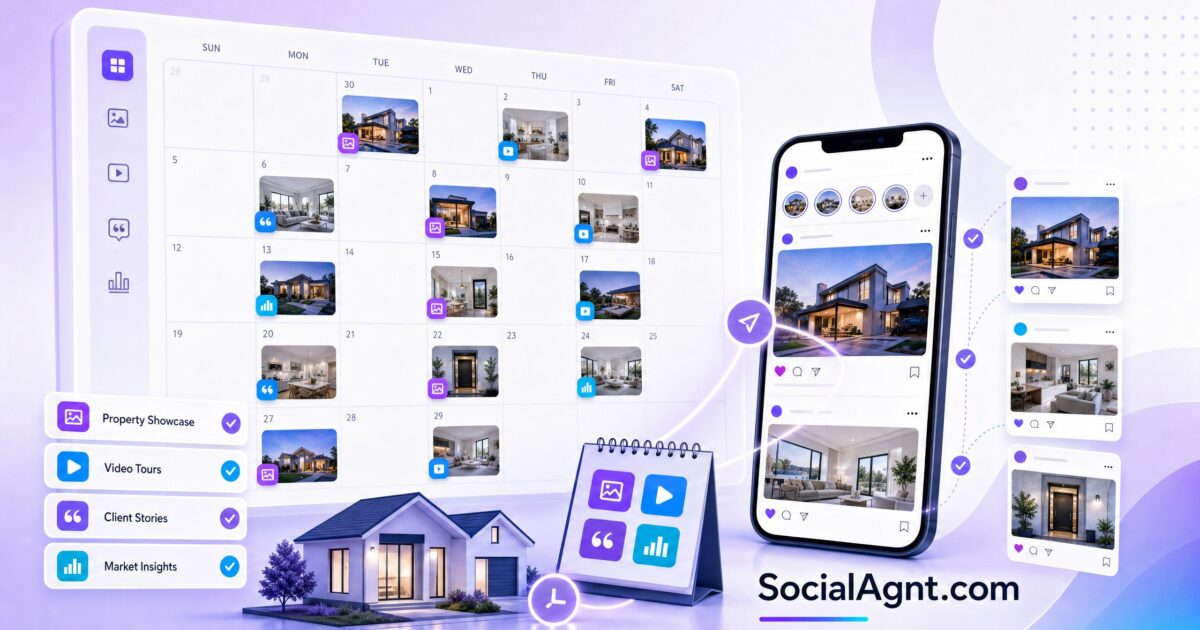
Key Takeaways: Consistency is the single greatest predictor of Instagram success for real estate agents — yet most agents post sporadically because they lack a system for planning content in advance. An Instagram content calendar eliminates the daily “what should I post?” decision by mapping out your content weeks ahead, ensuring you maintain the three-to-five-posts-per-week cadence that builds visibility and pipeline. Research shows that agents who maintain a consistent posting schedule generate 40% more referrals than those who post reactively. The difference isn’t talent or creativity — it’s having a repeatable system. This guide provides the complete framework for building your real estate Instagram content calendar: the content pillars that keep your feed balanced, the weekly posting structure that maintains variety, the monthly planning process that makes consistency effortless, and a free template you can customize to your market and schedule.
Why a Content Calendar Changes Everything
The agents who struggle with Instagram consistency aren’t lazy or uncreative — they’re overwhelmed by the daily decision of what to post. Without a plan, every day brings the same question: “What should I post today?” That question leads to analysis paralysis, which leads to skipped days, which leads to inconsistency, which leads to the algorithm deprioritizing your content, which leads to poor results, which leads to the conclusion that “Instagram doesn’t work for real estate.” The content calendar breaks this cycle by removing the daily decision entirely.
A content calendar also ensures strategic balance in your content. Without one, most agents default to posting whatever’s top of mind — which usually means listing after listing with occasional market updates. But a feed dominated by listings feels like an advertisement, not a resource. A content calendar distributes your posts across multiple content pillars so your feed provides genuine value to followers while still showcasing your business. Balance is what keeps followers engaged rather than muting you.
The compound effect of consistency is dramatic. Instagram’s algorithm rewards accounts that post regularly — three to five times per week for at least 90 to 180 consecutive days — with increased distribution and reach. The agents who commit to this cadence through a content calendar build momentum that sporadic posters never achieve. After 90 days of consistent posting, most agents report measurable increases in profile visits, DM conversations, and direct inquiries. The calendar is what makes 90 days achievable.
Your Content Pillars: The Foundation of Every Calendar
What Are Content Pillars?
Content pillars are the four to six recurring themes that make up your content strategy. They’re the categories you rotate through each week to ensure your feed stays balanced, valuable, and engaging. Each pillar serves a different purpose — some build authority, some create connection, some generate leads, and some boost discoverability. Together, they create a feed that serves your audience’s diverse needs while building the know-like-trust factor that converts followers into clients.
The Six Real Estate Content Pillars
Pillar 1: Educational Content (25% of posts). Tips for buyers and sellers, market explainers, process walkthroughs, myth-busting, and financial literacy content. This pillar builds authority and is the most shareable content type — people save and send educational posts to friends who are thinking about real estate. Examples: “5 costs buyers forget to budget for,” “What happens between offer and closing,” “The truth about 20% down payments.”
Pillar 2: Local and Community Content (20% of posts). Neighborhood spotlights, local business features, community events, restaurant reviews, and area guides. This pillar attracts local followers who may not be actively buying or selling but live in your market — the audience that generates referrals and long-term business. Examples: “Best coffee shops in [neighborhood],” “Weekend events in [city],” “What $500K gets you in three different neighborhoods.”
Pillar 3: Property and Listing Content (20% of posts). New listings, just-sold celebrations, property tours, price-point comparisons, and feature spotlights. This pillar showcases your active business and attracts people who are actively searching. Keep listing content engaging by focusing on storytelling and lifestyle rather than just specs and features. Examples: virtual tours, “Would you buy this for [price]?” posts, before-and-after staging reveals.
Pillar 4: Market Updates and Data (15% of posts). Weekly or monthly market stats, interest rate updates, inventory reports, and trend analysis. This pillar positions you as the local market expert and attracts serious buyers and sellers who want to make informed decisions. Keep data conversational — lead with the headline insight and explain what it means for your audience. Examples: “Homes sold in [X] days this month,” “Interest rates just dropped — here’s what that means for your buying power.”
Pillar 5: Personal and Behind-the-Scenes (10% of posts). Day-in-the-life content, personal interests, family moments, work celebrations, and personality-driven posts. This pillar humanizes you beyond your professional role and creates the personal connection that drives referrals. People refer agents they feel they know personally — and personal content accelerates that familiarity. Examples: “What my morning routine looks like,” “Why I became an agent,” “Celebrating my team’s win this quarter.”
Pillar 6: Social Proof and Client Stories (10% of posts). Testimonials, client reviews, closing day photos, success stories, and milestone celebrations. This pillar builds credibility through third-party validation and shows prospects what it’s like to work with you. Examples: “Another happy family in their new home,” client video testimonials, Google review screenshots with permission.
SocialAgnt’s AI-powered content engine creates posts across all six pillars — educational tips, local content, market updates, and more — with captions optimized for engagement. Schedule across Instagram, Facebook, TikTok, LinkedIn, YouTube, and Google Business Profile from one dashboard. Start your free account today.
The Weekly Posting Structure
How Many Times to Post Per Week
The optimal posting frequency for real estate agents on Instagram in 2026 is three to five feed posts per week, supplemented by daily Stories. This cadence balances visibility with sustainability — posting fewer than three times per week makes it difficult to build algorithmic momentum, while posting more than seven times per week can overwhelm your audience and lead to lower per-post engagement. Within that range, four posts per week is the sweet spot that most agents can sustain long-term without burnout.
The Ideal Content Format Mix
Instagram’s algorithm in 2026 heavily favors Reels for discovery and reach. The recommended format mix is: 60-70% Reels (your primary discovery tool, distributed to non-followers), 20-30% carousels (highest save rates, excellent for educational content), and 10% single-image posts (lower reach but useful for specific content types). If you’re posting four times per week, that translates to approximately three Reels and one carousel — or two Reels and two carousels if carousel creation comes more naturally to you.
Sample Weekly Schedule
Monday — Educational Reel. Start the week with a tip, myth-bust, or process explainer that provides immediate value. Educational Reels tend to perform well early in the week when audiences are in “learning mode.” Topic examples: buying tips, selling preparation, market terminology, financial literacy.
Wednesday — Local or Community Reel. Midweek, spotlight something local — a neighborhood feature, a business recommendation, an event preview, or a community highlight. Local Reels attract followers in your market and position you as the neighborhood expert. Film these during your normal workday as you move through your community.
Friday — Property or Market Carousel/Reel. End the workweek with either a listing showcase, a market data update, or a property comparison. Friday posts catch weekend browsers who are thinking about real estate as they enter their time off. Carousel format works well for market data and property comparisons; Reel format works for virtual tours.
Sunday — Personal or Social Proof Post. Weekend content should feel lighter and more personal. Share a behind-the-scenes moment, a client celebration, or a personal reflection. Sunday audiences are relaxed and receptive to relationship-building content rather than heavy educational material.
Daily Stories Alongside Your Calendar
Your content calendar primarily maps feed posts — but Stories should run daily regardless of whether you have a feed post that day. Stories maintain your presence in the Stories bar, keep you top of mind, and provide the casual touchpoints that build familiarity over time. Aim for six to ten Story frames per day: a mix of behind-the-scenes moments, quick tips, interactive polls or questions, and personal glimpses. Stories don’t need to be planned in detail — they thrive on spontaneity — but having prompts in your calendar (“Post a poll today,” “Do a talking-head tip”) ensures you don’t forget them on busy days.
The Monthly Planning Process
Step 1: Review Last Month’s Performance
Before planning next month’s content, spend 30 minutes reviewing what worked last month. Check your Instagram Insights for: which posts received the most reach (indicates content the algorithm distributed broadly), which posts got the most saves (indicates high-value content people want to revisit), which posts drove the most profile visits (indicates content that makes people curious about you), and which content types and topics underperformed. Use these insights to inform next month’s plan — create more of what works and less of what doesn’t.
Step 2: Identify Monthly Themes and Events
Map out the relevant events, holidays, market moments, and seasonal themes for the upcoming month. In real estate, every month has content opportunities: spring brings buying season content, summer has moving tips and neighborhood outdoor activities, fall offers market year-end preparation, and winter brings new year planning content and year-in-review posts. Layer in local events, market milestones, and any business activities (new listings, open houses, closings) you know about in advance.
Step 3: Assign Content Pillars to Calendar Slots
Using your weekly structure as a template, assign specific content pillars and topics to each posting slot for the month. You don’t need to write full captions yet — just slot in the topic and format. For example: “Monday 5/5 — Educational Reel: 3 things that kill a real estate deal” or “Wednesday 5/7 — Local Reel: New restaurant opening in [neighborhood].” This high-level mapping takes 20 to 30 minutes and gives you a complete month of direction.
Step 4: Batch Create Content
With your topics assigned, dedicate one to two content creation sessions per week (60 to 90 minutes each) to filming, writing, and designing your content in batches. Batch creation is dramatically more efficient than creating content one post at a time because you eliminate the mental switching cost of repeatedly entering and exiting “creative mode.” Film three to five Reels in one sitting, design a week’s worth of carousel graphics in another, and write all your captions in a dedicated writing session.
Step 5: Schedule and Automate
Once content is created, schedule it using Instagram’s native scheduling tools or a third-party platform. Scheduling in advance means your content goes live at optimal times regardless of what your day looks like — you’re never scrambling to post between showings or during a closing. The best posting times for real estate content are typically weekdays between 10 AM and 3 PM, though your specific audience may differ. Check your Instagram Insights to identify when your followers are most active and schedule accordingly.
SocialAgnt lets you plan, create, and schedule your entire content calendar from one dashboard — across Instagram, Facebook, TikTok, LinkedIn, YouTube, and Google Business Profile. AI-powered captions save hours of writing time, and multi-platform scheduling ensures consistency without the daily grind. Start free today.
Free Instagram Content Calendar Template for Real Estate Agents
How to Use This Template
The template below provides a four-week rolling content calendar structure designed specifically for real estate agents posting four times per week. Each week follows the same pillar rotation to maintain strategic balance while allowing unlimited topic variety within each slot. Customize this template to your market, your strengths, and your audience’s preferences — the structure is the foundation, but the specific topics should reflect your local expertise and your followers’ interests.
Week 1 Template
Monday — Educational Reel: Choose a buyer tip, seller insight, market myth, or process explanation. Hook format: bold statement or surprising statistic. Length: 15 to 30 seconds. CTA: “Follow for more [city] real estate tips” or “Save this for when you’re ready to buy.”
Wednesday — Local/Community Reel: Feature a neighborhood, local business, community event, or area highlight. Film on location for authenticity. Length: 15 to 45 seconds. CTA: “Tag someone who lives in [area]” or “Follow for more [city] local tips.”
Friday — Market or Listing Content (Carousel or Reel): Share a market stat, listing showcase, price comparison, or inventory update. Carousel for data-heavy content; Reel for visual property tours. CTA: “DM me for a full market report” or “Want to see more homes like this? Link in bio.”
Sunday — Personal or Social Proof: Share a client win, personal moment, behind-the-scenes glimpse, or testimonial. Keep the tone warm and relational rather than promotional. CTA: “What’s your dream home feature?” or tag the client (with permission).
Week 2-4: Rotating Topics Within the Same Structure
Repeat the Monday-Wednesday-Friday-Sunday structure each week, but rotate topics within each pillar to maintain freshness. Week two’s educational Reel covers a different topic than week one’s. Week two’s local content features a different neighborhood or business. This rotation ensures your feed never feels repetitive while maintaining the strategic balance your calendar provides.
Content Ideas Bank by Pillar
Educational (rotate through these): Closing costs explained, home inspection red flags, pre-approval vs. pre-qualification, negotiation strategies, appraisal process, title insurance explained, earnest money deposits, contingencies explained, what affects home value, timeline from offer to close, credit score tips for buyers, tax benefits of homeownership.
Local/Community (rotate through these): Top restaurants by neighborhood, parks and outdoor spaces, school district overviews, commute comparisons, new development updates, local business spotlights, seasonal events calendar, hidden gems in your city, cost of living comparisons between neighborhoods, weekend activity guides.
Market/Listings (rotate through these): Monthly market stats, interest rate updates, inventory levels, days on market trends, price per square foot by area, new listing tours, just-sold celebrations, price-point comparison tours, coming-soon teasers, open house announcements.
Personal/Social Proof (rotate through these): Day in the life, client closing celebrations, milestone anniversaries, team spotlights, why you became an agent, lessons learned, morning routine, book recommendations, community involvement, holiday celebrations, year-in-review.
Adapting Your Calendar to Market Conditions
Your content calendar should be flexible enough to respond to market shifts while maintaining its structural foundation. When interest rates change significantly, swap in a timely market update even if it wasn’t scheduled. When a major local event happens, create a community post that connects to the moment. When you list a spectacular property, add an extra listing post that week. The calendar provides structure, not rigidity — think of it as a framework with permission to flex when opportunities arise.
Seasonal adjustments matter too. Spring and early summer are peak buying seasons — increase listing content and buyer-focused education during these months. Fall and winter lean more toward seller preparation, year-end market reviews, and relationship-nurturing personal content. Your pillar percentages can shift by five to ten percent seasonally without disrupting your overall balance.
Tools for Managing Your Content Calendar
Scheduling Platforms
Several tools make content calendar management straightforward for real estate agents. Meta Business Suite (free) handles Instagram and Facebook scheduling natively. Later, Buffer, and Hootsuite offer multi-platform scheduling with visual calendar views and optimal-time suggestions. For real estate specifically, platforms like SocialAgnt provide AI-powered caption generation alongside scheduling — reducing the content creation burden significantly.
Content Creation Tools
Pair your scheduling platform with content creation tools: Canva for carousel and graphic design (their real estate templates are excellent), CapCut for Reel editing (free and powerful), and a simple notes app or spreadsheet for caption writing. The simpler your tool stack, the more likely you are to use it consistently. Complexity is the enemy of consistency.
Making Your Calendar Sustainable Long-Term
The best content calendar is the one you actually follow. Start with a frequency you can maintain for six months without burning out — three posts per week is perfectly effective if four feels unsustainable. Batch your creation sessions to minimize the time investment: 90 minutes of focused content creation once per week can produce all four posts plus Story prompts for the entire week.
Build in flexibility for busy weeks. If you have a week full of closings and showings, having content pre-scheduled means your Instagram presence doesn’t suffer even when you’re too busy to create in real time. That’s the ultimate value of a content calendar — it decouples your posting consistency from your daily schedule, ensuring your Instagram presence remains strong regardless of what your workweek looks like.
An Instagram content calendar transforms your social media from a stressful daily decision into a strategic business system. Plan your pillars, map your monthly topics, batch your creation, schedule in advance, and let consistency compound your results over months and years. The agents who build this system — and stick with it — are the agents who turn Instagram into a reliable source of leads, referrals, and closed business. Let SocialAgnt power your content calendar with AI-generated captions, real estate templates, and multi-platform scheduling that makes consistency effortless.
SocialAgnt’s AI creates scroll-stopping captions for every content pillar — educational, local, listing, and personal — and schedules them across Instagram, Facebook, TikTok, LinkedIn, YouTube, and Google Business Profile. Build your calendar in minutes, not hours. Start free today.
Ready to save 5+ hours per week on social media?
SocialAgnt helps real estate agents schedule posts, create AI content, and grow their brand across 7 platforms. Try it free for 14 days.
