
Key Takeaways: Part-time real estate agents face a unique social media challenge: you have less time to create content, less availability for real-time engagement, and potentially less transaction experience to draw from — but you still need a professional, consistent social media presence to compete with full-time agents. The good news is that a well-designed social media strategy for part-time agents can produce outsized results relative to the time invested. This guide covers exactly how part-time real estate agents should approach social media: the minimum viable content strategy that builds your brand, the platforms that give the best return on limited time, the automation and batching techniques that make consistency possible alongside another job, and how to leverage your part-time status as a genuine advantage in your content.
The Part-Time Agent’s Social Media Reality
Part-time real estate agents typically have two to five hours per week available for all marketing activities — not just social media. You may have a full-time job, family responsibilities, or other commitments that limit when and how much you can focus on your real estate business. The social media strategies designed for full-time agents — daily posting across multiple platforms, filming video content three times per week, spending 45 minutes a day on engagement — simply aren’t realistic for your situation.
But here’s what most advice ignores: you don’t need to do everything full-time agents do. You need to do fewer things, done well, done consistently. A part-time agent who posts three times per week on one platform and engages for 15 minutes daily will build more social media traction than a part-time agent who tries to manage four platforms and burns out in six weeks. The strategy isn’t about doing more with less time — it’s about doing the right things with the time you have.
Choosing Your One Platform
Full-time agents can reasonably manage two to three platforms. As a part-time agent, you should master one platform before considering a second. The right platform depends on your strengths, your target audience, and the time each platform demands.
Instagram is the best choice if you enjoy visual content and can commit to three to four posts per week plus 15 minutes of daily engagement. Instagram’s combination of feed posts, Stories, and Reels gives you multiple content formats to work with, and the platform’s local discovery features help you reach people in your market. Total weekly time: three to five hours.
Facebook is the best choice if your target audience is 35 and older, if you’re comfortable managing a local Facebook Group, or if you plan to use paid advertising. Facebook allows you to build community through Groups with less content creation than Instagram requires. Total weekly time: two to four hours.
LinkedIn is the best choice if you’re focused on referral networking with other professionals or if you target higher-income buyers and sellers. LinkedIn requires the least posting frequency (two to three posts per week) and favors written content over video — making it a strong option for agents who prefer writing over filming. Total weekly time: two to three hours.
Google Business Profile should be maintained regardless of which primary platform you choose. It requires minimal time (one post per week plus review management) and has an outsized impact on local search visibility. Think of it as your always-on baseline — not a primary content platform, but an essential local search presence.
YouTube and TikTok are generally not recommended as primary platforms for part-time agents. YouTube requires significant video production time (five-plus hours per video), and TikTok requires high-volume daily posting to gain traction. Both are time-intensive platforms that are better suited to agents who can dedicate eight or more hours per week to social media.
The Part-Time Agent Content Strategy
The Three-Post-Per-Week Framework
Three posts per week is the minimum frequency that builds meaningful social media traction on Instagram, Facebook, or LinkedIn. More is better, but three consistent posts per week will keep your profile active, your audience engaged, and your algorithms fed.
Structure your three posts around these pillars:
Post 1 — Market or educational content. Share a market update, a home buying or selling tip, or an educational insight. This content establishes your expertise and attracts people interested in real estate in your area. Examples: “Here’s what happened in the [city] market this week,” “Three things first-time buyers always forget about closing costs,” or “Should you renovate before selling? Here’s my take.”
Post 2 — Local or community content. Feature a local business, neighborhood, event, or community highlight. This content attracts local followers, builds community connections, and positions you as someone who knows and loves the area. Examples: a neighborhood spotlight, a local restaurant recommendation, or coverage of a community event.
Post 3 — Personal or behind-the-scenes content. Share something about you — your real estate journey, a showing experience, a lesson learned, or a personal story that connects you to your audience. This content builds the “know, like, and trust” factor that converts followers into clients. Examples: “What I learned from my first open house,” a day-in-the-life post, or a candid reflection on why you love real estate.
This three-pillar approach ensures your content is varied, valuable, and personal — the three qualities that keep audiences engaged over time.
Batching for Part-Time Agents
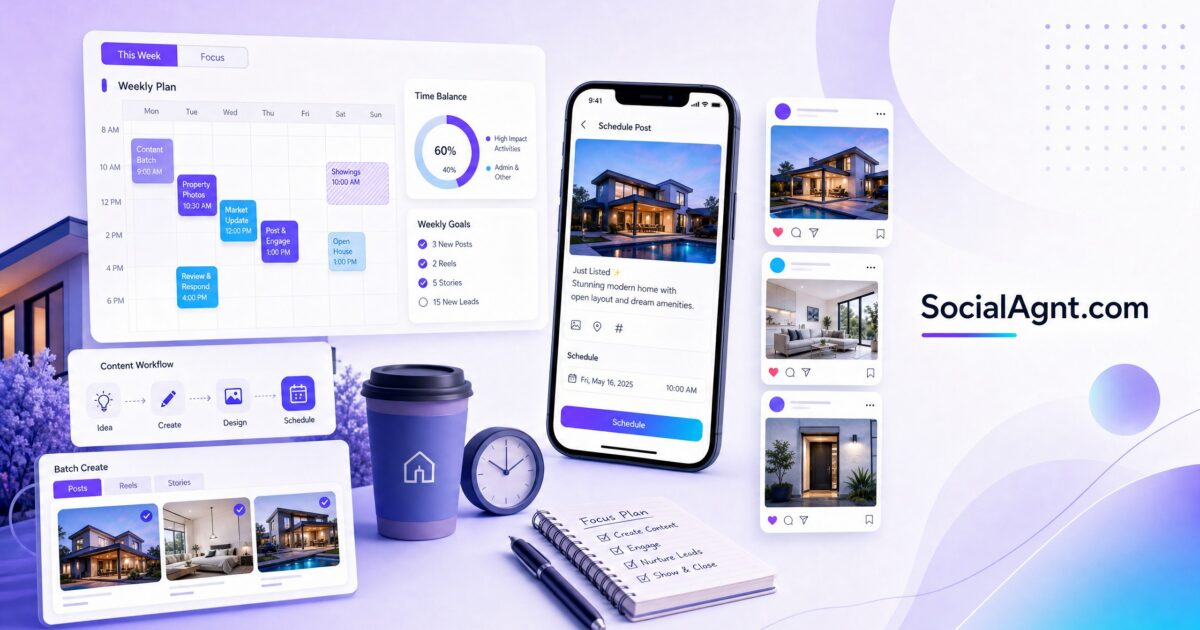
As a part-time agent, your batching sessions are your lifeline. Dedicate one block of 90 minutes to two hours per week to creating and scheduling all three posts plus any Stories content. Many part-time agents batch on Sunday evenings or early Monday mornings — before the week’s client responsibilities and primary job demands take over.
During your batching session: write all three captions (use AI caption tools to generate first drafts and then personalize them), design or select graphics and photos for each post, schedule all posts using a social media management platform, and prepare two to three days of Story content if applicable. When you walk away from your batching session, your entire week of social media content should be queued and scheduled to publish automatically. Your only remaining daily task is engagement.
SocialAgnt’s AI captions and scheduling tools are built for agents who don’t have hours to spend on content creation. Generate professional real estate captions in seconds, schedule across platforms, and maintain a consistent presence — even with limited time. Start your free account today.
The 15-Minute Daily Engagement Plan
Engagement is non-negotiable — even for part-time agents. Fifteen minutes per day is the minimum that maintains relationships and keeps the algorithm working in your favor.
Minutes 1–5: Respond to all comments on your recent posts and reply to all DMs. Prioritize DMs — these are your highest-potential lead conversations.
Minutes 6–10: Leave genuine comments on five to eight posts from local accounts — businesses, community pages, and people in your target area. Focus on accounts whose audiences overlap with yours.
Minutes 11–15: Send one proactive DM to a new follower, an engaged community member, or someone who interacted with your content. A simple, friendly message opens conversations that can lead to real estate business.
Do this every day — including weekends when your primary job doesn’t demand your attention. Fifteen minutes is doable even on the busiest days. Set a specific time for your engagement block (lunch break, morning coffee, evening wind-down) and protect that time. Consistency in engagement compounds just like consistency in posting.
Leveraging Part-Time Status in Your Content
Many part-time agents view their status as a disadvantage and try to hide it on social media. This is a missed opportunity. Your part-time status can be a genuine differentiator if you frame it correctly.
Your other career adds credibility. If you’re a financial analyst, teacher, nurse, engineer, or any other professional, your primary career gives you skills and perspectives that full-time agents don’t have. A financial analyst turned agent understands investment returns at a level most agents can’t match. A teacher turned agent knows how to explain complex processes simply. Share how your professional background makes you a better agent — this is a compelling differentiator that full-time agents can’t replicate.
Relatability factor. Many of your potential clients also work full-time jobs and fit homebuying or selling around their schedules. As a part-time agent, you understand their time constraints in a way that full-time agents might not. You can schedule showings on evenings and weekends — which is when most buyers are available anyway. Content that acknowledges the reality of busy schedules resonates with an audience that’s in the same position.
No-pressure positioning. Part-time agents don’t need to close every deal to pay their bills. This can be positioned as a client benefit: “I don’t push you toward a decision because I need the commission to make rent. I’ll help you find the right home on the right timeline — because I do this because I love it.” This no-pressure positioning attracts clients who are turned off by aggressive sales tactics.
Content Efficiency Hacks for Limited Time
Repurpose everything. One idea should produce multiple pieces of content. A market update post on Instagram becomes a LinkedIn post with a more professional tone. A long caption becomes a series of Stories. A video you film for Instagram Reels gets posted to TikTok and Facebook with no additional editing. Repurposing lets you maintain a multi-platform presence (when you’re ready for a second platform) without creating unique content for each one.
Use templates religiously. Create or download templates for your recurring content types: market updates, new listings, testimonials, tips, and community features. Templates reduce your per-post creation time from 20 to 30 minutes to five to ten minutes because you’re filling in blanks rather than designing from scratch.
Build a content idea bank. Keep a running note on your phone where you jot down content ideas as they occur to you — during a showing, after a client conversation, while reading market news, or while scrolling social media. When you sit down for your weekly batching session, you’ll have a list of ideas ready to develop instead of starting from scratch.
Film in batches when you have time. If you create video content, dedicate one session per month (two to three hours) to filming a month’s worth of video. Change your outfit between clips to avoid looking like you filmed everything in one day. This batch filming approach produces four to eight videos that you schedule across the month.
Leverage AI for first drafts. AI caption generators can produce a solid first-draft caption in seconds. You then spend two to three minutes personalizing it with your voice, local details, and specific context. This approach cuts caption writing time by 60-70% — a significant savings when your total weekly time budget is three to four hours.
Scaling Up: When and How to Add More
As your real estate business grows — and potentially transitions from part-time to full-time — your social media strategy should grow with it. Here’s the progression:
Phase 1 (Months 1–6): One platform, three posts per week, 15 minutes daily engagement. Focus on building consistency and refining your content style. Total: three to four hours per week.
Phase 2 (Months 6–12): Add Google Business Profile (if you haven’t already) and one Story per day on your primary platform. Begin repurposing content to a second platform (just cross-posting, no unique content). Total: four to five hours per week.
Phase 3 (Year 2): Increase primary platform to four to five posts per week. Add unique content for your second platform (two to three posts per week). Consider adding video content if you haven’t already. Total: five to seven hours per week.
Phase 4 (Full-time transition): If and when you transition to full-time real estate, expand to a full multi-platform strategy with daily posting, dedicated video content, and paid advertising. Total: eight to twelve hours per week.
Each phase builds on the habits and systems established in the previous one. You never have to overhaul your entire social media approach — you’re just adding incrementally to a foundation that’s already working.
Being a part-time agent doesn’t mean settling for a part-time social media presence. With the right strategy, efficient batching, and consistent engagement, you can build a professional brand that competes with any full-time agent in your market. Choose one platform, commit to three posts per week, engage for 15 minutes daily, and let SocialAgnt handle the scheduling, AI captions, and templates that make your limited time go further.
SocialAgnt’s AI captions, real estate templates, and multi-platform scheduling are designed for agents who need professional content without all-day effort. Batch your content, schedule it, and get back to your day. Start free today.
Ready to save 5+ hours per week on social media?
SocialAgnt helps real estate agents schedule posts, create AI content, and grow their brand across 7 platforms. Try it free for 14 days.
