
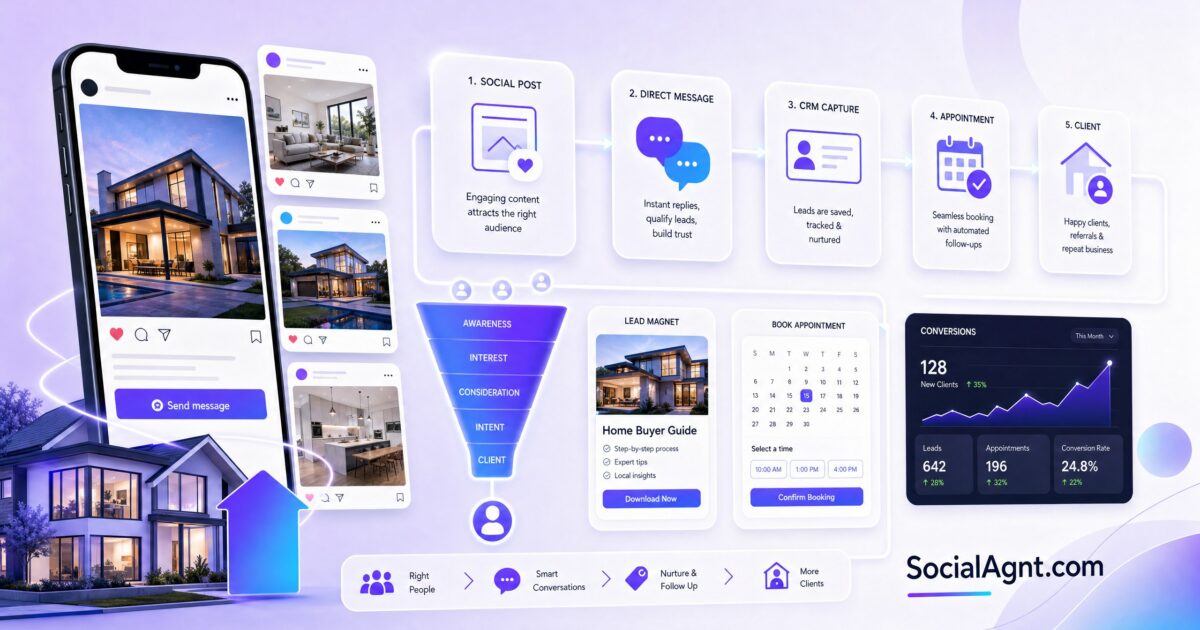
Key Takeaways: Getting likes and followers is easy. Getting actual clients from social media — people who sign a buyer agreement, list their home with you, and close a transaction — is a different skill entirely. The gap between social media activity and social media-sourced closings is where most real estate agents get stuck. They post consistently, grow their following, even generate DMs and inquiries — but they can’t seem to convert that activity into signed clients and commission checks. This guide bridges that gap with a specific, actionable system for turning social media followers into real estate clients: the content that attracts ready-to-act prospects, the lead capture systems that identify them, the DM and follow-up strategies that convert them, and the nurture approach that brings long-timeline leads to the closing table.
Why Followers Don’t Automatically Become Clients
Social media creates the illusion of progress. Your follower count grows. Your posts get engagement. People leave positive comments and heart-eye emojis on your listing photos. But at the end of the month, none of those interactions turned into appointments, and none of those followers became clients.
The disconnect happens because most agents treat social media as a broadcasting platform rather than a relationship and conversion platform. They create content designed to attract attention (likes, follows, views) rather than content designed to attract intent (people who are actively considering buying, selling, or investing). They don’t have a system for identifying which followers are potential clients. And they don’t have a follow-up process that moves interested followers from “I like your content” to “I want to work with you.”
Getting clients from social media requires a deliberate system with three components: attraction content that draws the right audience, lead capture mechanisms that identify potential clients, and conversion workflows that turn leads into signed clients. Let’s build each one.
Attraction: Content That Draws Potential Clients
The Content Pyramid
Not all content serves the same purpose. Think of your social media content as a pyramid with three levels:
Top of pyramid — Awareness content (60% of posts). This content reaches the broadest audience and builds your following: entertaining real estate content, local community features, personal stories, trending formats, and general tips. This content gets you found and followed by a wide audience — including people who may need an agent someday but aren’t actively in the market right now.
Middle of pyramid — Consideration content (30% of posts). This content targets people who are thinking about buying, selling, or investing: market updates and analysis, neighborhood comparisons, home valuation insights, mortgage rate commentary, first-time buyer education, and selling preparation guides. People who consistently engage with this content are signaling interest in real estate decisions — they’re your warm audience.
Bottom of pyramid — Conversion content (10% of posts). This content is designed to generate direct action: calls to action for free home valuations, buyer consultation offers, open house invitations, “DM me the word [keyword] for a free [resource]” posts, and testimonials from recent clients that demonstrate your results. This content gives your warm audience a clear next step to take.
The mistake most agents make is inverting this pyramid — posting 80% conversion content (“Call me for a free consultation!” “Just listed!” “Want to know your home’s value?”) with very little awareness or consideration content. This approach feels salesy and repels the audience you’re trying to attract. The pyramid approach builds an audience with awareness content, warms them with consideration content, and converts them with strategic, well-timed conversion content.
High-Intent Content Formats
Certain content formats attract higher-intent prospects than others. Market updates and price analysis attract people actively monitoring the market — a strong buying or selling signal. “What you can buy for $[X] in [city/neighborhood]” content attracts active buyers researching price points. “How to prepare your home for sale” content attracts people considering listing. Neighborhood comparison content (“Living in [Area A] vs. [Area B]”) attracts relocating buyers who are narrowing their search. And mortgage and financing educational content attracts first-time buyers who are getting serious about purchasing.
Create more of these high-intent formats and less generic inspiration or motivational content. The goal isn’t maximum reach — it’s reaching the right people with content that aligns with their current stage of the real estate journey.
Lead Capture: Identifying Potential Clients
The DM Keyword Strategy
One of the most effective lead capture techniques on social media is the DM keyword strategy. In a post or Reel, offer something valuable — a market report, a list of homes in a specific price range, a neighborhood guide, a home preparation checklist — and tell viewers to DM you a specific keyword to receive it. “DM me the word MARKET for my latest [City] market report.” “Comment BUYER and I’ll send you my first-time home buyer checklist.”
This approach works because it converts passive viewers into active leads. When someone DMs you a keyword, they’ve raised their hand and identified themselves as interested. You now have a direct conversation open — which is far more valuable than a like or a comment. The resource you send provides immediate value, and the open DM thread creates a natural opportunity to ask qualifying questions: “Are you currently in the market?” “What areas are you looking at?” “When are you thinking about making a move?”
Link-in-Bio Lead Funnels
Your social media bio link should lead to a page designed to capture leads — not just your brokerage homepage. Create a link-in-bio landing page with multiple options that align with different prospect needs: a home search portal (for active buyers), a free home valuation tool (for potential sellers), a downloadable resource (market report, buyer guide, relocation guide), and your calendar booking link (for prospects ready to schedule a consultation). Each option should collect at minimum a name and email address, which flows into your CRM for follow-up.
Story-Based Lead Generation
Instagram and Facebook Stories provide built-in engagement tools that function as lead generation mechanisms. Use poll stickers (“Are you thinking about buying this year? Yes / Just dreaming”), question stickers (“What’s your biggest question about buying a home?”), quiz stickers (“Can you guess the median home price in [City]?”), and countdown stickers for events like open houses. Each interaction gives you insight into who your interested followers are. When someone answers your poll with “Yes, I’m thinking about buying,” follow up with a DM: “I saw your answer — that’s exciting! What’s your timeline looking like?” This transforms a casual Story interaction into a lead conversation.
SocialAgnt helps you maintain the consistent posting schedule that attracts and nurtures potential clients across Instagram, Facebook, TikTok, LinkedIn, YouTube, and Google Business Profile. AI-powered captions and real estate templates keep your content professional and on-strategy. Start your free account today.
Conversion: Turning Leads into Clients
The DM Conversation Framework
Most social media leads won’t convert from a single message. The DM conversation is where the relationship deepens and the prospect moves from “interested follower” to “potential client.” Use a conversational framework that builds rapport before pitching your services.
Step 1 — Acknowledge and connect. When someone DMs you (whether from a keyword prompt, a story reply, or a direct inquiry), respond warmly and quickly. Speed matters — responding within an hour converts at dramatically higher rates than responding the next day. Acknowledge their message, answer their question or deliver the promised resource, and ask one open-ended question to continue the conversation.
Step 2 — Qualify the lead. Through natural conversation (not an interrogation), determine their timeline, motivation, and readiness. “When are you thinking about making a move?” “What areas are you looking at?” “Have you been pre-approved for a mortgage?” “Are you working with an agent?” These questions help you understand whether this person is an active prospect or a future prospect — and how to prioritize your follow-up accordingly.
Step 3 — Provide value before asking for commitment. Before suggesting a meeting or consultation, demonstrate your value. Send a relevant listing they might like. Share a quick market insight about their target area. Answer a question they didn’t even know to ask. When you lead with value, the prospect experiences what working with you feels like — and the transition to “let’s set up a time to meet” feels natural rather than transactional.
Step 4 — Suggest the next step. When the conversation has established rapport and you’ve qualified the prospect, suggest a clear next step: “I’d love to sit down with you for 20 minutes and walk through the current market in [area]. Would Tuesday or Thursday work better for you?” Offer a specific time and a low-commitment format. A 20-minute conversation feels less intimidating than “let’s schedule a buyer consultation.”
The Follow-Up System
Not every DM conversation converts immediately. Many social media leads are early in their journey — they might be six months from buying or a year from selling. Without a follow-up system, these warm leads go cold and eventually work with another agent.
Add every social media lead to your CRM with the source tagged (Instagram DM, Facebook message, TikTok, etc.) and set follow-up reminders. For active prospects (buying or selling within three months), follow up every three to five days with relevant market information, new listings, or a quick check-in. For longer-timeline prospects, follow up every two to four weeks with value-added content — a market update, a relevant article, or a personal note. And continue engaging with their social media content. Liking their posts, commenting on their updates, and staying visible in their feed maintains the relationship between direct follow-ups.
The Social Proof Conversion Accelerator
Social proof — testimonials, reviews, client success stories — is the most powerful conversion tool on social media. When a prospect is considering working with you, seeing other people’s positive experiences reduces their perceived risk. Post client testimonials regularly (video testimonials are the most compelling). Share closing day photos with client stories (with permission). Highlight specific results: “Helped Sarah find her first home in [neighborhood] — under asking price and closed in 30 days.” Direct prospects in your DM conversations to your Google reviews or testimonial highlight reel when they’re in the decision-making stage.
The Client Acquisition Pipeline: Putting It All Together
Your social media client acquisition system works as a pipeline, with each stage feeding the next:
Stage 1 — Reach: Your awareness content reaches new audiences. People discover you through hashtags, the Explore page, search results, shared content, and advertising. You measure success by impressions, reach, and new followers.
Stage 2 — Engage: Your consideration content engages your growing audience. Followers who consistently engage with your market updates, neighborhood content, and educational posts are self-identifying as warm prospects. You measure success by engagement rate, saves, shares, and DM conversations initiated.
Stage 3 — Capture: Your conversion content and lead capture mechanisms (DM keywords, link-in-bio funnels, Story engagement) convert engaged followers into identified leads. You measure success by leads generated and contact information captured.
Stage 4 — Convert: Your DM conversations and follow-up system convert identified leads into consultations, then appointments, then signed clients. You measure success by consultations booked, agreements signed, and transactions closed.
Stage 5 — Multiply: Satisfied clients become social proof (testimonials, reviews, referrals) that feeds Stage 1 with the most powerful form of awareness content. Every closed transaction should produce at least one testimonial post, one Google review, and a request for referrals. This creates a self-reinforcing cycle where social media success generates more social media success.
Common Mistakes That Prevent Client Conversion
Posting only listings. Listing posts don’t build relationships or demonstrate expertise. An agent who posts exclusively listings is indistinguishable from every other agent posting listings. Use the content pyramid — 60% awareness, 30% consideration, 10% conversion — and your listings become one part of a much more compelling narrative.
Ignoring DMs. Every unanswered DM is a lost potential client. Respond to every message within a few hours. If you’re too busy to respond to DMs, you’re too busy for the leads social media generates — which means you either need to make DM response a priority or stop expecting social media to produce clients.
No follow-up system. Generating a lead and then never following up is worse than never generating the lead at all — because you invested the time to attract and capture them and then let the investment go to waste. Every lead needs a CRM entry, a source tag, and a follow-up schedule.
Selling too soon. Asking for a meeting in the first DM message converts at near-zero rates. Build the relationship first. Provide value. Qualify the prospect. Then suggest the next step. Patience in the conversion process produces significantly more clients than urgency.
Getting real estate clients from social media is systematic, not accidental. Build the content pyramid that attracts the right audience, create lead capture mechanisms that identify interested prospects, develop a DM and follow-up system that converts leads into clients, and use SocialAgnt to maintain the consistent content schedule that keeps the entire pipeline full. The clients are on social media. The question is whether your system is designed to find them, engage them, and convert them.
SocialAgnt powers the content consistency that fills your client pipeline. AI captions, real estate templates, and multi-platform scheduling across Instagram, Facebook, TikTok, LinkedIn, YouTube, and Google Business Profile — so you can focus on converting the leads your content generates. Start free today.
Ready to save 5+ hours per week on social media?
SocialAgnt helps real estate agents schedule posts, create AI content, and grow their brand across 7 platforms. Try it free for 14 days.
