
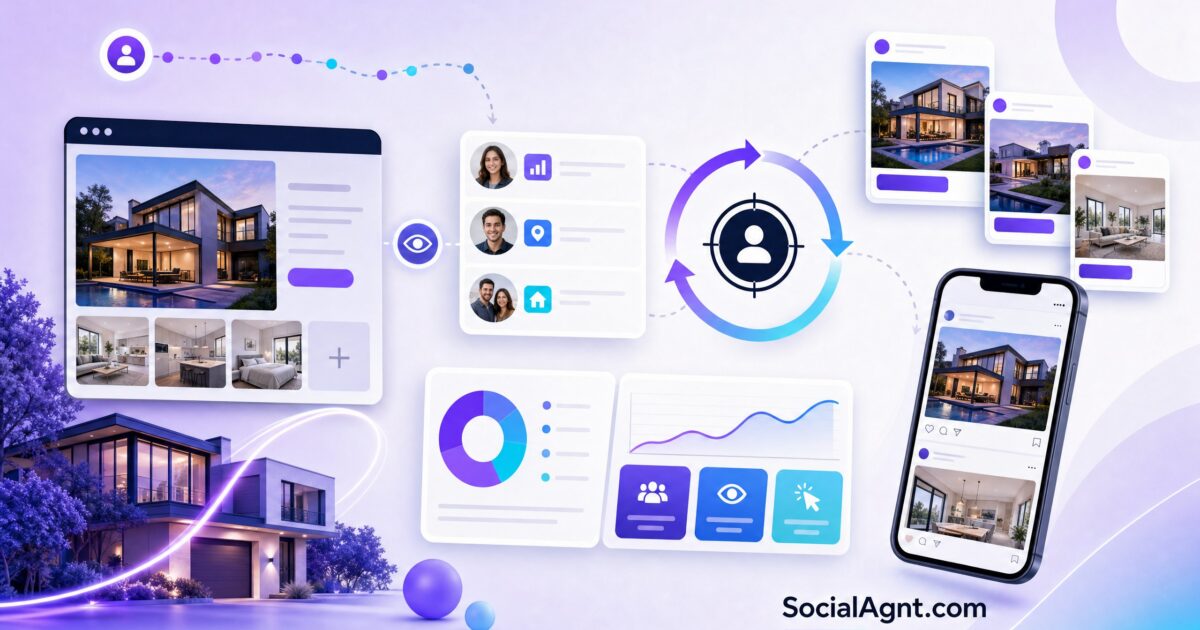
Key Takeaways: Only 2% of website visitors convert on their first visit — meaning 98% of the people who browse your listings, read your blog posts, or visit your home valuation page leave without taking action. Facebook retargeting solves this problem by showing targeted ads to those visitors as they continue browsing Facebook and Instagram — keeping your name, your listings, and your value proposition visible until they’re ready to take the next step. For real estate agents, retargeting is the highest-ROI advertising strategy available because it focuses your budget exclusively on people who’ve already demonstrated interest in your services. Instead of spending money to reach cold audiences who may never need a real estate agent, you’re investing in people who visited your website, watched your video content, engaged with your Facebook page, or started but didn’t complete a lead form. These warm audiences convert at dramatically higher rates — and at lower costs — than any cold prospecting campaign. This guide covers the complete Facebook retargeting system for real estate: setting up the Meta Pixel, building retargeting audiences, creating ads that re-engage interested prospects, and structuring a retargeting funnel that nurtures website visitors into signed clients.
Why Retargeting Is Your Highest-ROI Strategy
The 98% Problem
Consider the journey of a typical potential client. They discover your Reel on Instagram, click through to your profile, tap the link in your bio, and browse three or four listings on your website. They’re interested — but they’re not ready to reach out today. Maybe they’re still six months from being ready to buy. Maybe they got distracted. Maybe they want to think about it. Whatever the reason, they leave your website without calling, emailing, or filling out a form. Without retargeting, that prospect disappears — and you’ve lost the opportunity entirely.
Retargeting changes this dynamic. Instead of losing that prospect, you show them targeted ads over the following days and weeks: similar properties to the ones they viewed, a free market report for the neighborhood they browsed, or a personal introduction video that reminds them you’re available when they’re ready. Each retargeting ad is a gentle nudge that keeps you top of mind without being intrusive. When that prospect eventually reaches the point of needing an agent, you’re the name they remember — because you’ve been consistently visible since their first visit.
The Cost Advantage
Retargeting audiences convert at significantly higher rates than cold audiences — which means your cost per lead is dramatically lower. Real estate Facebook ads targeting cold audiences typically generate leads at $15 to $25 each. Retargeting campaigns targeting warm audiences often generate leads at $5 to $12 each — sometimes even lower. The math is compelling: the same budget that generates 10 cold leads can generate 20 to 30 retargeted leads, each of whom is more likely to convert because they already know who you are.
Setting Up the Meta Pixel
What the Pixel Does
The Meta Pixel is a small piece of code you install on your website that tracks visitor behavior — which pages they view, how long they stay, whether they fill out forms, and what actions they take. This tracking data feeds into Meta Ads Manager, where you can build audiences based on specific visitor behaviors. Without the Pixel installed, you cannot retarget website visitors — making Pixel installation the essential first step in any retargeting strategy.
How to Install the Pixel
Navigate to Meta Events Manager (within Meta Business Suite), create a new Pixel, and follow the installation instructions for your website platform. Most website builders and real estate website providers (WordPress, Squarespace, KVCore, Sierra Interactive, Boomtown, and others) have simple Pixel integration options — often just pasting your Pixel ID into a settings field. For WordPress, plugins like PixelYourSite simplify installation to a few clicks. Verify your installation by visiting your website and checking Events Manager for incoming data — you should see “PageView” events appearing within minutes.
Setting Up Standard Events
Beyond basic page views, configure standard events that track meaningful visitor actions: ViewContent (when someone views a specific listing page), Lead (when someone submits a contact form), Search (when someone uses your home search tool), and AddToWishlist (when someone saves or favorites a listing). These events allow you to build more specific retargeting audiences — targeting people who viewed listing pages rather than everyone who visited any page on your site.
SocialAgnt’s AI-powered content drives traffic to your website — creating the audience that your retargeting campaigns convert into leads. Schedule across Instagram, Facebook, TikTok, LinkedIn, YouTube, and Google Business Profile. Start your free account today.
Building Retargeting Audiences
Website Visitor Audiences
Create Custom Audiences based on website visitor behavior, segmented by engagement level. A tiered audience structure works best: all website visitors in the last 180 days (broadest audience — anyone who’s been to your site), listing page viewers in the last 90 days (more qualified — they looked at specific properties), visitors who spent significant time on site in the last 60 days (high interest — they engaged deeply with your content), and lead form visitors who didn’t submit in the last 30 days (highest intent — they almost converted but didn’t).
Each audience tier represents a different level of interest and readiness — and each should receive different messaging. Broad visitors get awareness content (your value proposition, your market expertise). Listing viewers get property-focused ads (similar listings, market updates for the areas they browsed). Near-converters get direct action ads (schedule a consultation, get a free home valuation).
Facebook and Instagram Engagement Audiences
Beyond website visitors, create retargeting audiences from your social media engagement: people who engaged with your Facebook Page in the last 365 days, people who engaged with your Instagram account, people who watched at least 50% of any video you posted, and people who opened or submitted a lead form from a previous ad. These audiences haven’t necessarily visited your website, but they’ve demonstrated interest in your content — making them significantly warmer than cold audiences.
Customer List Audiences
Upload your CRM contact list to create a Custom Audience of past clients, current leads, and sphere-of-influence contacts. This audience is valuable for: staying visible to past clients who generate referrals, nurturing current leads who aren’t yet ready to transact, and maintaining top-of-mind awareness with your sphere. Customer list retargeting is often the highest-converting audience because these people already have a direct relationship with you.
Video Viewer Audiences
If you create video content (Reels, property tours, market updates), build audiences based on video view duration: people who watched 25%, 50%, 75%, or 95% of a video. Higher completion percentages indicate stronger interest. Someone who watched 95% of your three-minute property tour video is significantly more interested than someone who watched the first three seconds before scrolling past. Target high-completion viewers with ads that advance the conversation: “Like what you saw? Schedule a private tour.”
Retargeting Ad Creative
Awareness-Stage Retargeting
For broad website visitors and casual social engagers, create ads that reinforce your brand and provide value without asking for commitment. Share educational content (market tips, buying guides, neighborhood insights), your agent introduction video, or client testimonial compilations. The goal at this stage is building familiarity and trust — not generating an immediate lead. These ads keep you visible as the prospect moves through their real estate decision timeline.
Consideration-Stage Retargeting
For listing page viewers, active social engagers, and video completers, create ads that offer specific value related to their demonstrated interests. If someone viewed listings in a particular neighborhood, show them new listings in that area or a market report for that neighborhood. If someone watched your market update video, offer a downloadable detailed market analysis. Match your ad content to what the prospect has already shown interest in — relevance dramatically increases conversion rates.
Decision-Stage Retargeting
For near-converters — people who visited your contact page, started a lead form but didn’t submit, or visited your site multiple times — create ads with direct calls to action. “Ready to take the next step? Schedule a free, no-obligation consultation.” “Still thinking about [neighborhood]? Let’s chat — I’ll share some listings that aren’t on the market yet.” Decision-stage retargeting is where your lowest-cost, highest-quality leads come from because these prospects have already demonstrated strong intent.
Dynamic Ads for Real Estate
Meta’s Advantage+ catalog ads (formerly dynamic ads) automatically show specific properties to people based on what they viewed on your website. If a visitor browsed a three-bedroom listing in a specific neighborhood, dynamic ads automatically show them that listing — and similar properties — across Facebook and Instagram. This personalization happens automatically once you’ve set up your product catalog (property listings) and connected it to your Pixel. Dynamic ads are particularly effective for agents with multiple active listings because they deliver hyper-relevant content without requiring you to create individual ads for each property.
Retargeting Budget Strategy
Budget Allocation
A well-structured advertising budget allocates 60-70% to prospecting campaigns (reaching new audiences) and 30-40% to retargeting campaigns (re-engaging warm audiences). The retargeting portion generates disproportionate results relative to its budget share — often producing more than half your total leads from less than half your total spend. As your retargeting audiences grow (more website traffic, more social engagement, more video views), you can increase the retargeting allocation proportionally.
Frequency and Duration
Set appropriate frequency caps for your retargeting ads to avoid ad fatigue — the point where seeing the same ad too many times becomes annoying rather than persuasive. A frequency of three to five impressions per week is typically effective for real estate retargeting. Rotate your ad creative every two to three weeks to keep the messaging fresh. Adjust your retargeting window based on the typical real estate timeline in your market — if your average prospect takes six months from first search to purchase, a 180-day retargeting window ensures you stay visible throughout their decision journey.
Measuring Retargeting Performance
Track these metrics for your retargeting campaigns: cost per lead (should be lower than your prospecting campaigns), click-through rate (retargeting audiences typically show 3-5x higher CTR than cold audiences), conversion rate (the percentage of retargeted visitors who take your desired action), frequency (how often each person sees your ad — watch for fatigue), and return on ad spend (revenue generated versus ad spend invested). Compare retargeting performance against your prospecting campaigns to validate the ROI advantage and justify budget allocation decisions.
Facebook retargeting is the bridge between interest and action — turning the 98% of website visitors who don’t convert into a warm, nurtured audience that converts over time. Install your Pixel, build your audiences, create stage-appropriate ad creative, and let your retargeting system work continuously in the background — re-engaging prospects while you focus on active clients. Drive the website traffic that feeds your retargeting funnel with SocialAgnt‘s AI-powered content across every platform — the more traffic your organic content generates, the larger and more effective your retargeting audiences become.
SocialAgnt’s AI content drives the website traffic that builds your retargeting audiences. Schedule across Instagram, Facebook, TikTok, LinkedIn, YouTube, and Google Business Profile — then let retargeting convert your visitors into leads. Start free today.
Ready to save 5+ hours per week on social media?
SocialAgnt helps real estate agents schedule posts, create AI content, and grow their brand across 7 platforms. Try it free for 14 days.
